High levels of adenosine pathway genes were associated with worse outcomes in ovarian cancer
High-dimensional analysis of the adenosine pathway in high-grade serous ovarian cancer
Transcriptomic meta-analysis and multiparametric studyHarm found
What is the impact of the adenosine pathway in high-grade serous ovarian cancer?
Who
1200
Patients with high-grade serous ovarian cancer
Compared
High eADO gene signature: worse prognosis
Low eADO gene signature
Main outcome
Clinical outcomes and prognosis
Bottom line: High adenosine pathway gene expression is associated with worse prognosis in high-grade serous ovarian cancer.
J Immunother Cancer · 2021-03-27Download image
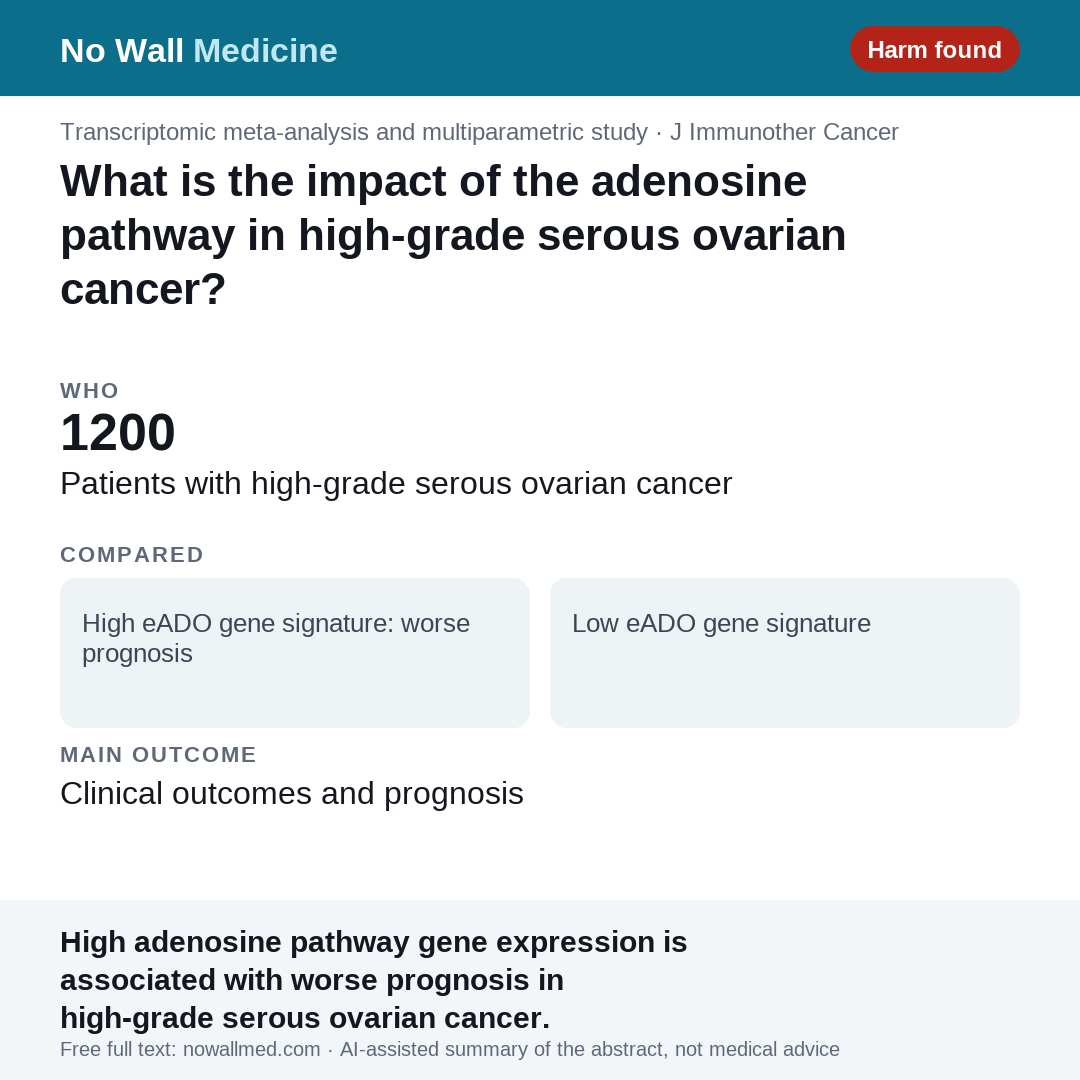
Clinical question: What is the impact of the adenosine pathway in high-grade serous ovarian cancer?
Why it matters: The impact of the extracellular adenosine pathway on clinical outcomes and the immune environment in high-grade serous ovarian cancer was unknown.
Key points
- Researchers analyzed approximately 1200 patients with high-grade serous ovarian cancer using transcriptomic meta-analysis and protein expression on approximately 1000 cases.
- High levels of an adenosine signaling gene signature and concomitant CD39 and CD73 gene expression were associated with worse prognosis, especially in the immunoregulatory molecular subtype.
- CD39 protein expression was associated with chemotherapy resistance and was found on exhausted tumor-infiltrating lymphocytes, which are immune cells that have entered the tumor.
Headline and key points written with AI from the paper’s abstract, with every number checked against it. Read the paper before relying on them.
Was this summary helpful?
Abstract
Background
Hydrolysis of extracellular ATP to adenosine (eADO) is an important immune checkpoint in cancer immunology. We here investigated the impact of the eADO pathway in high-grade serous ovarian cancer (HGSC) using multiparametric platforms. Methods
We performed a transcriptomic meta-analysis of eADO-producing CD39 and CD73, an eADO signaling gene signature, immune gene signatures and clinical outcomes in approximately 1200 patients with HGSC. Protein expression, localization and prognostic impact of CD39, CD73 and CD8 were then performed on approximately 1000 cases on tissue microarray, and tumor-infiltrating lymphocytes (TILs) were analyzed by flow cytometry and single-cell RNA sequencing on a subset of patients. Results
Concomitant CD39 and CD73 gene expression, as well as high levels of an eADO gene signature, were associated with worse prognosis in patients with HGSC, notably in the immunoregulatory molecular subtype, characterized by an immune-active microenvironment. CD39 was further associated with primary chemorefractory and chemoresistant human HGSC and platinum-based chemotherapy of murine HGSC was significantly more effective in CD39-deficient mice. At protein level, CD39 and CD73 were predominantly expressed by cancer-associated fibroblasts, and CD39 was expressed on severely exhausted, clonally expanded and putative tissue-resident memory TILs. Conclusions
Our study revealed the clinical, immunological, subtype-specific impacts of eADO signaling in HGSC, unveiled the chemoprotective effect of CD39 and supports the evaluation of eADO-targeting agents in patients with ovarian cancer.
Abstract reproduced under the article’s CC BY NC licence.
Subject terms
Cite this article
Bareche Y, Pommey S, Carneiro M, Buisseret L, Cousineau I, Thebault P. High-dimensional analysis of the adenosine pathway in high-grade serous ovarian cancer. J Immunother Cancer. 2021. doi:10.1136/jitc-2020-001965
Spotted a mistake? Suggest a correction
Top studies every Monday
The week’s key trials and guidelines in your specialties, plus any topics you follow. By email, free.
Get the weekly digest