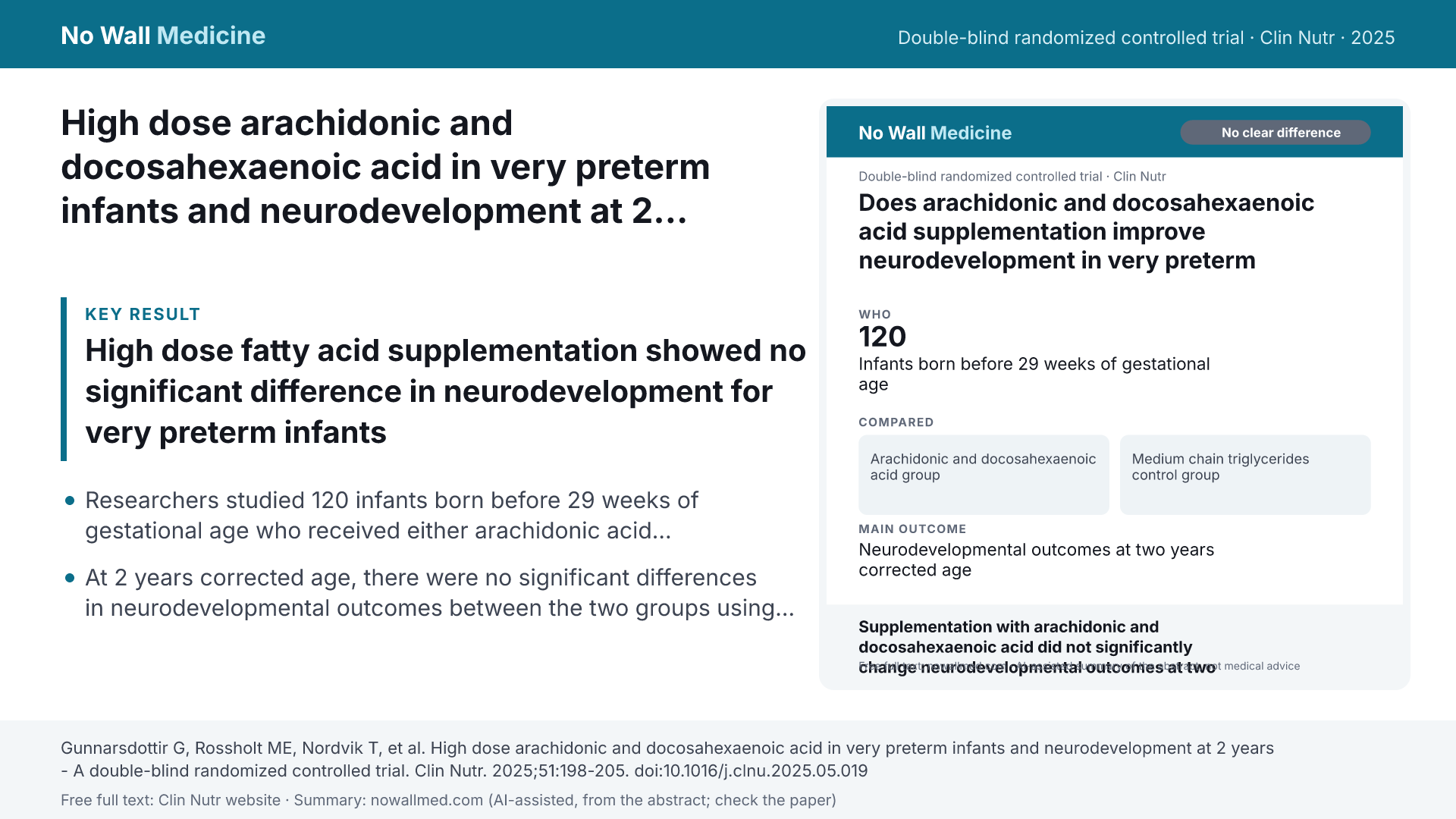
High dose fatty acid supplementation showed no significant difference in neurodevelopment for very preterm infants
High dose arachidonic and docosahexaenoic acid in very preterm infants and neurodevelopment at 2 years - A double-blind randomized controlled trial
Double-blind randomized controlled trialNo clear difference
Does arachidonic and docosahexaenoic acid supplementation improve neurodevelopment in very preterm infants?
Who
120
Infants born before 29 weeks of gestational age
Compared
Arachidonic and docosahexaenoic acid group
Medium chain triglycerides control group
Main outcome
Neurodevelopmental outcomes at two years corrected age
Bottom line: Supplementation with arachidonic and docosahexaenoic acid did not significantly change neurodevelopmental outcomes at two years.
Clin Nutr · 2025-06-04Download image
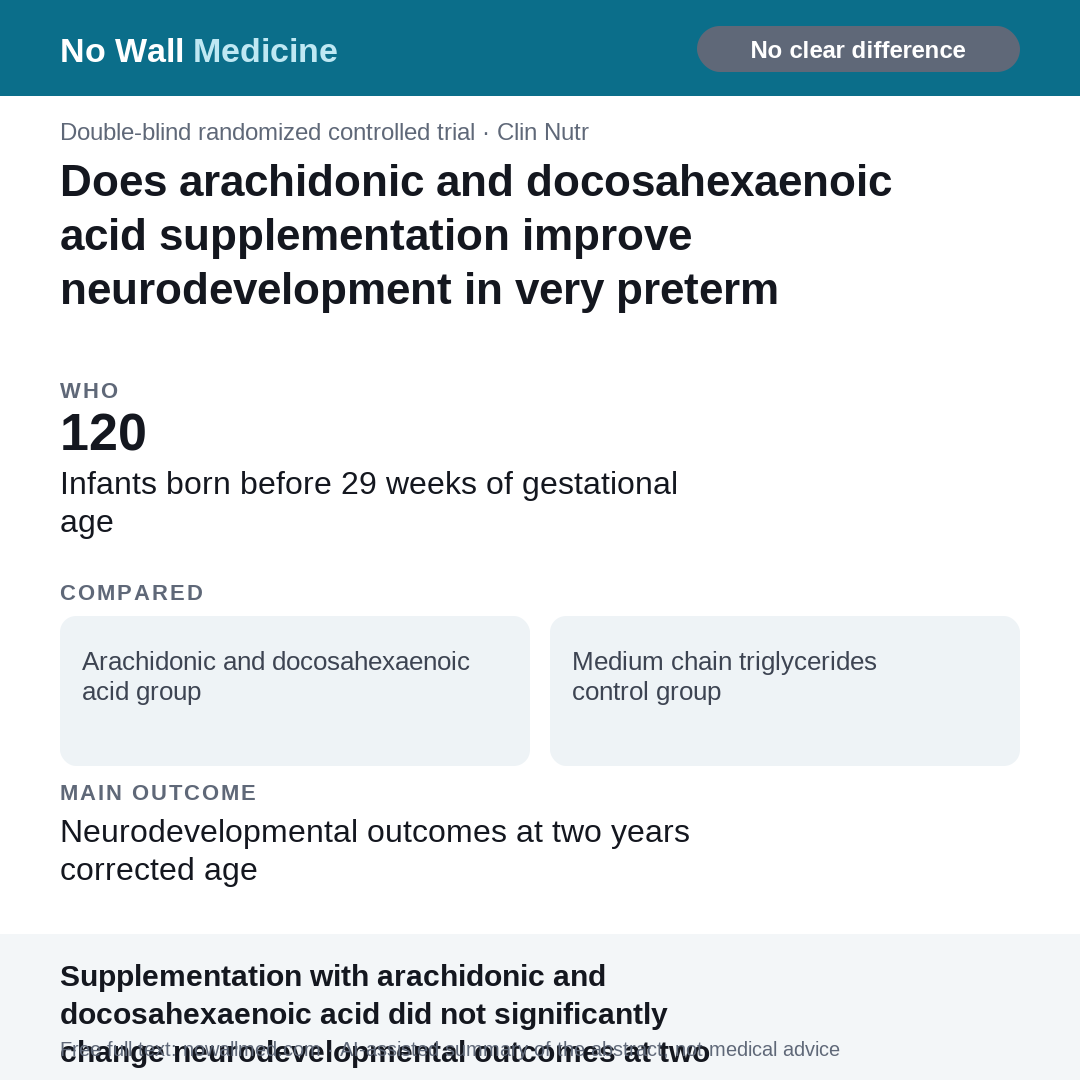
Clinical question: Does arachidonic and docosahexaenoic acid supplementation improve neurodevelopment in very preterm infants?
Why it matters: Preterm infants have lower levels of arachidonic acid and docosahexaenoic acid in neural tissue compared to term-born infants, and the impact of supplementation is unknown.
Key points
- Researchers studied 120 infants born before 29 weeks of gestational age who received either arachidonic acid and docosahexaenoic acid or medium chain triglycerides.
- At 2 years corrected age, there were no significant differences in neurodevelopmental outcomes between the two groups using the Bayley Scales and Peabody Developmental Motor Scales.
- Higher maternal education level, female sex, and faster linear growth from 28 to 36 weeks postmenstrual age were associated with better neurodevelopmental scores.
Headline and key points written with AI from the paper’s abstract, with every number checked against it. Read the paper before relying on them.
Was this summary helpful?
Subject terms
Cite this article
Gunnarsdottir G, Rossholt ME, Nordvik T, et al. High dose arachidonic and docosahexaenoic acid in very preterm infants and neurodevelopment at 2 years - A double-blind randomized controlled trial. Clin Nutr. 2025. doi:10.1016/j.clnu.2025.05.019
Spotted a mistake? Suggest a correction