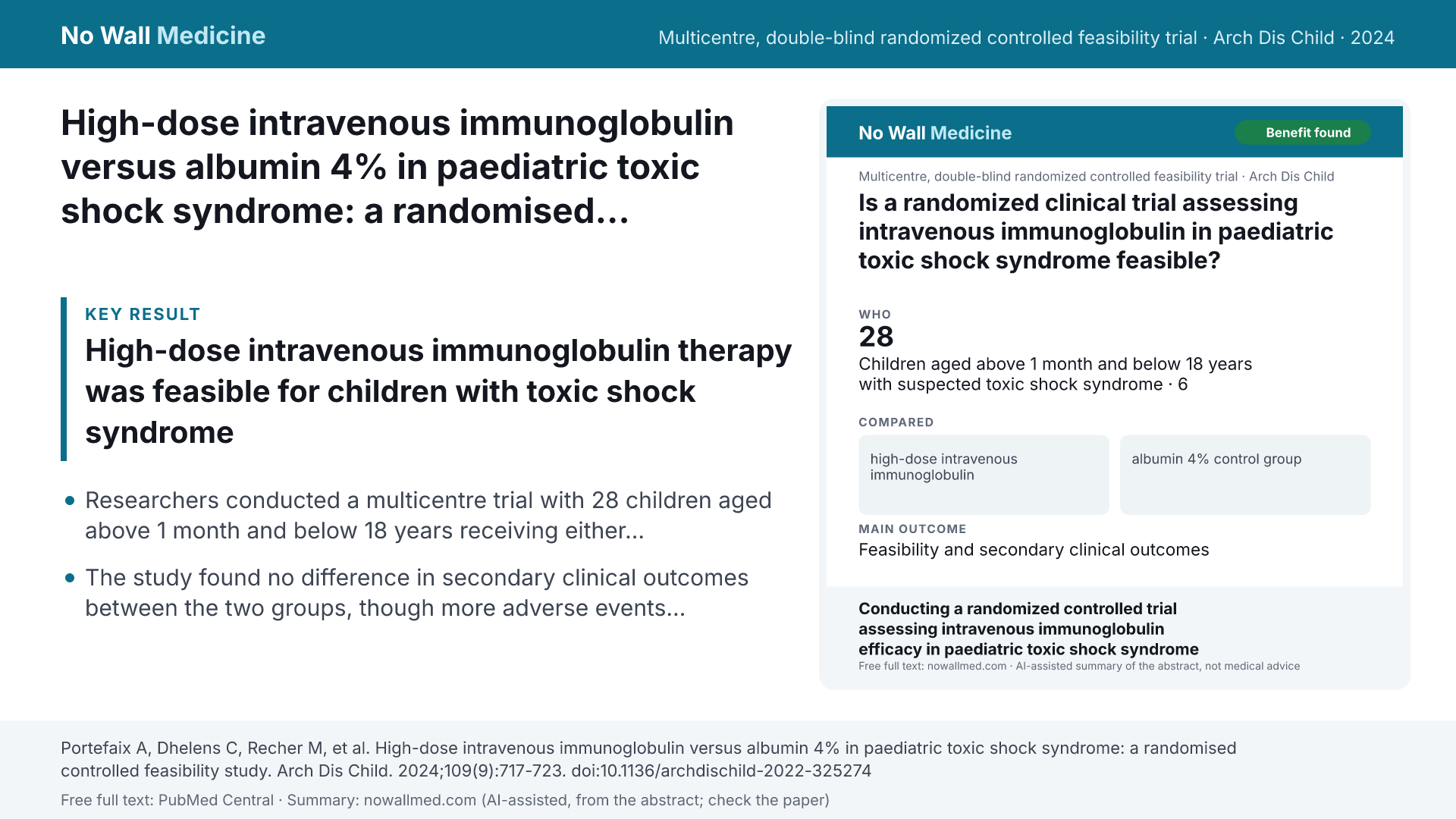
High-dose intravenous immunoglobulin therapy was feasible for children with toxic shock syndrome
High-dose intravenous immunoglobulin versus albumin 4% in paediatric toxic shock syndrome: a randomised controlled feasibility study
Multicentre, double-blind randomized controlled feasibility trialBenefit found
Is a randomized clinical trial assessing intravenous immunoglobulin in paediatric toxic shock syndrome feasible?
Who
28
Children aged above 1 month and below 18 years with suspected toxic shock syndrome · 6 paediatric intensive care units
Compared
high-dose intravenous immunoglobulin
albumin 4% control group
Main outcome
Feasibility and secondary clinical outcomes
Bottom line: Conducting a randomized controlled trial assessing intravenous immunoglobulin efficacy in paediatric toxic shock syndrome is feasible.
Arch Dis Child · 2024-08-16 · Save PNG
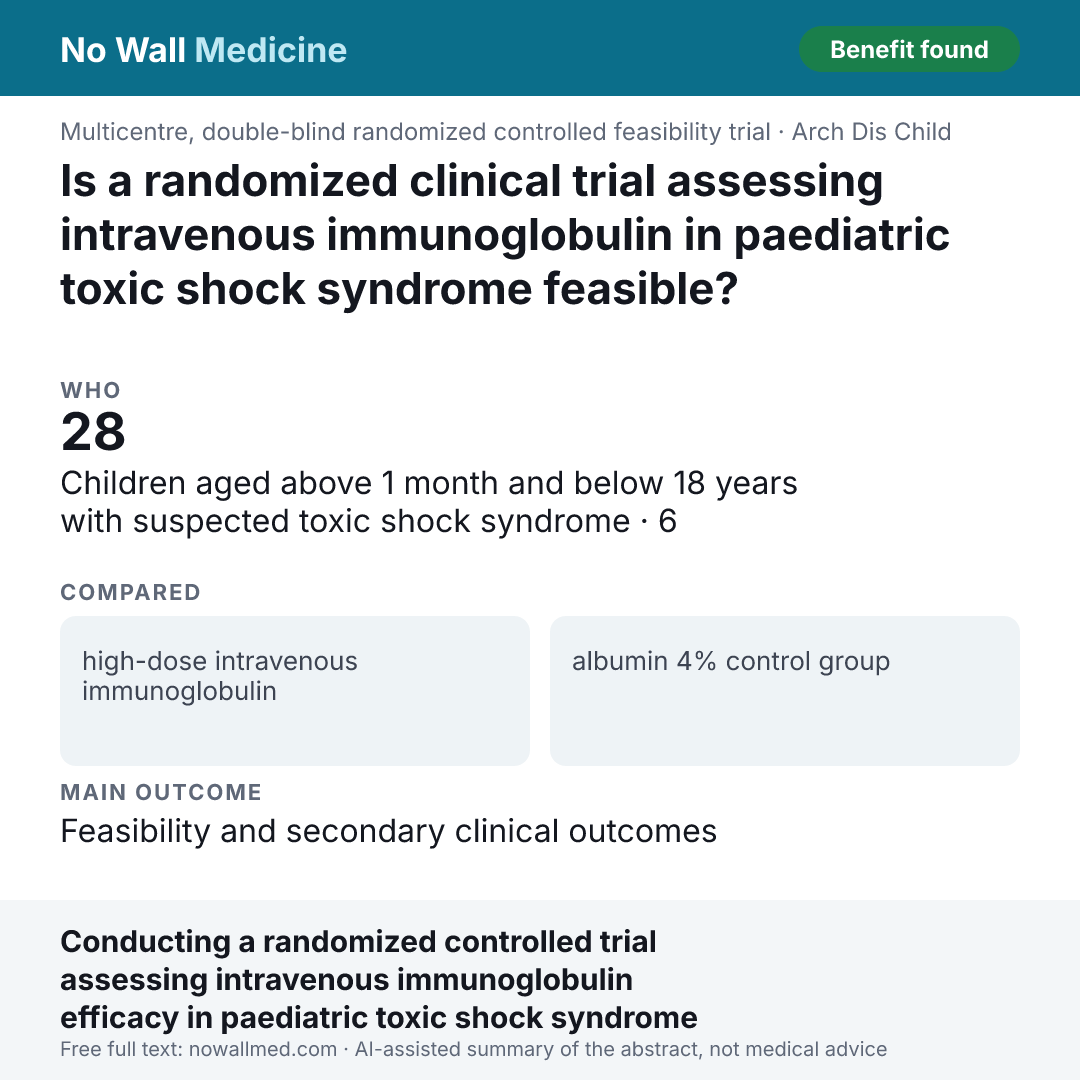
Clinical question: Is a randomized clinical trial assessing intravenous immunoglobulin in paediatric toxic shock syndrome feasible?
Why it matters: Consistent efficacy and safety data are needed regarding whether intravenous immunoglobulin therapy can improve shock and organ failure in children with toxic shock syndrome.
Key points
- Researchers conducted a multicentre trial with 28 children aged above 1 month and below 18 years receiving either high-dose intravenous immunoglobulin or albumin 4%.
- The study found no difference in secondary clinical outcomes between the two groups, though more adverse events were reported in the albumin 4% control group.
- Feasibility metrics were met with an inclusion rate above 50%, protocol deviations below 30%, and missing data for death and the Pediatric Logistic Organ Dysfunction-2 score below 10%.
Headline and key points written with AI from the paper’s abstract, with every number checked against it. Read the paper before relying on them.
Was this summary helpful?
Abstract
Purpose
Toxic shock syndrome (TSS) is a rare disease responsible for significant morbidity and mortality. Intravenous immunoglobulin (IG) therapy in paediatric TSS could improve shock and organ failure, but more consistent efficacy and safety data are needed. Our objective was to determine whether a randomised clinical trial (RCT) assessing intravenous IG in TSS in children is feasible. Methods
We performed a multicentre, feasibility, double-blind RCT assessing efficacy of high-dose intravenous IG versus albumin 4% (control group) within the first 12 hours of shock onset. Included patients were aged above 1 month and below 18 years with suspected TSS and septic shock. Feasibility was assessed by measuring inclusion rate, protocol compliance and missing data regarding death and the Pediatric Logistic Organ Dysfunction-2 (PELOD-2) Score. Other secondary clinical outcomes were evaluated during hospital stay, at 60 day and 1 year. Results
28 patients, admitted in 6 paediatric intensive care units during 36 consecutive months and followed for 1 year, received the allocated treatment: 13 in intravenous IG group, 15 in control group. The median age was 10.6 years and the sex ratio was 1. Inclusion rate was above 50%, protocol deviations were below 30% and missing data regarding death and PELOD-2 Score below 10%. No difference concerning secondary clinical outcomes between groups was observed, and more adverse events were reported in the control group. Conclusion
It seems to be feasible to conduct an RCT assessing intravenous IG efficacy and safety in paediatric TSS but must be realised internationally, with choice of a clinically relevant endpoint and a specific design in order to be realistic. Trial registration number
NCT02219165.
Abstract reproduced under the article’s CC BY NC licence.
Subject terms
Headline, design, result, key points, caveat and citation as plain text.
Cite this article
Portefaix A, Dhelens C, Recher M, et al. High-dose intravenous immunoglobulin versus albumin 4% in paediatric toxic shock syndrome: a randomised controlled feasibility study. Arch Dis Child. 2024;109(9):717-723. doi:10.1136/archdischild-2022-325274
Spotted a mistake? Suggest a correction