High-flow nasal oxygen reduced the need for increased respiratory support during bronchoscopy in respiratory failure patients
High-flow nasal oxygen therapy via a single-prong cannula interface during bronchoscopy in patients with acute respiratory failure: a two-center, open-label, randomized controlled trial
Two-center, open-label, randomized controlled trialBenefit found
Does high-flow nasal oxygen via single-prong cannula reduce respiratory support escalation during bronchoscopy?
Who
160
Patients with acute respiratory failure undergoing flexible bronchoscopy · Two centers
Compared
15.0%High-flow nasal oxygen via single-prong cannula
33.8%Standard oxygen therapy
Main outcome
Escalation of respiratory support within 24 hours after bronchoscopy
Bottom line: High-flow nasal oxygen via single-prong cannula reduces respiratory support escalation after bronchoscopy in acute respiratory failure patients.
Ann Intensive Care · 2026-05-12Download image
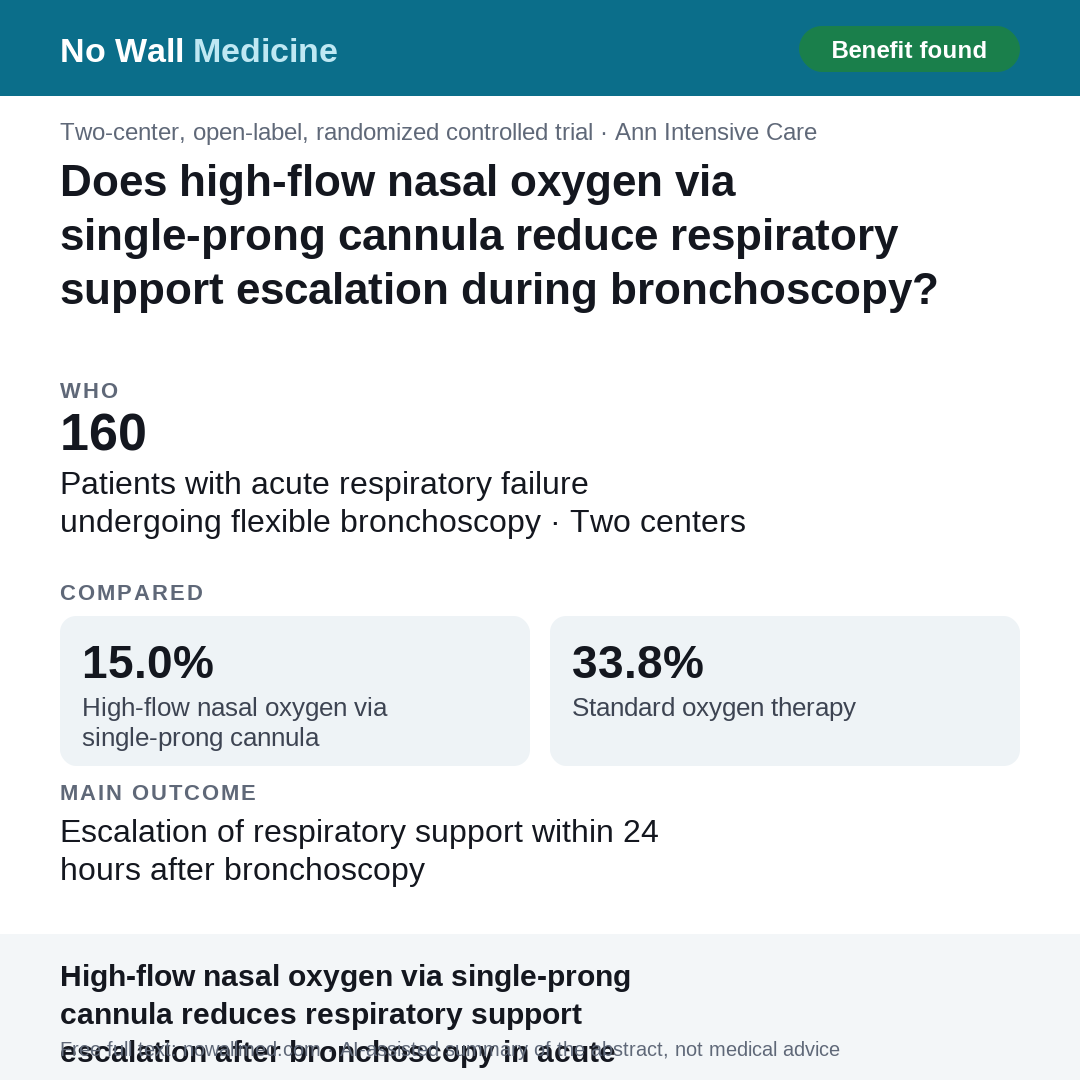
Clinical question: Does high-flow nasal oxygen via single-prong cannula reduce respiratory support escalation during bronchoscopy?
Why it matters: It was uncertain if high-flow nasal oxygen therapy could reduce the need for increased respiratory support during bronchoscopy in patients with acute respiratory failure.
Key points
- Researchers studied 160 patients with acute respiratory failure undergoing flexible bronchoscopy, comparing high-flow nasal oxygen via a single-prong cannula to standard oxygen therapy.
- The high-flow nasal oxygen group had a lower rate of respiratory support escalation within 24 hours compared to the standard oxygen group (15.0% vs. 33.8%).
- Patients receiving high-flow nasal oxygen also had a lower rate of intubation, which is the placement of a breathing tube, within 24 hours (7.5% vs. 20.0%).
Headline and key points written with AI from the paper’s abstract, with every number checked against it. Read the paper before relying on them.
Spotted a mistake? Suggest a correction