High-flow nasal oxygen was as successful as laryngeal mask ventilation for respiratory support during anesthesia
High-Flow Nasal Oxygen versus Mechanical Ventilation Through a Laryngeal Mask During General Anesthesia Without Muscle Paralysis: A Randomized Clinical Trial
Randomized, single-center, noninferiority trialBenefit found
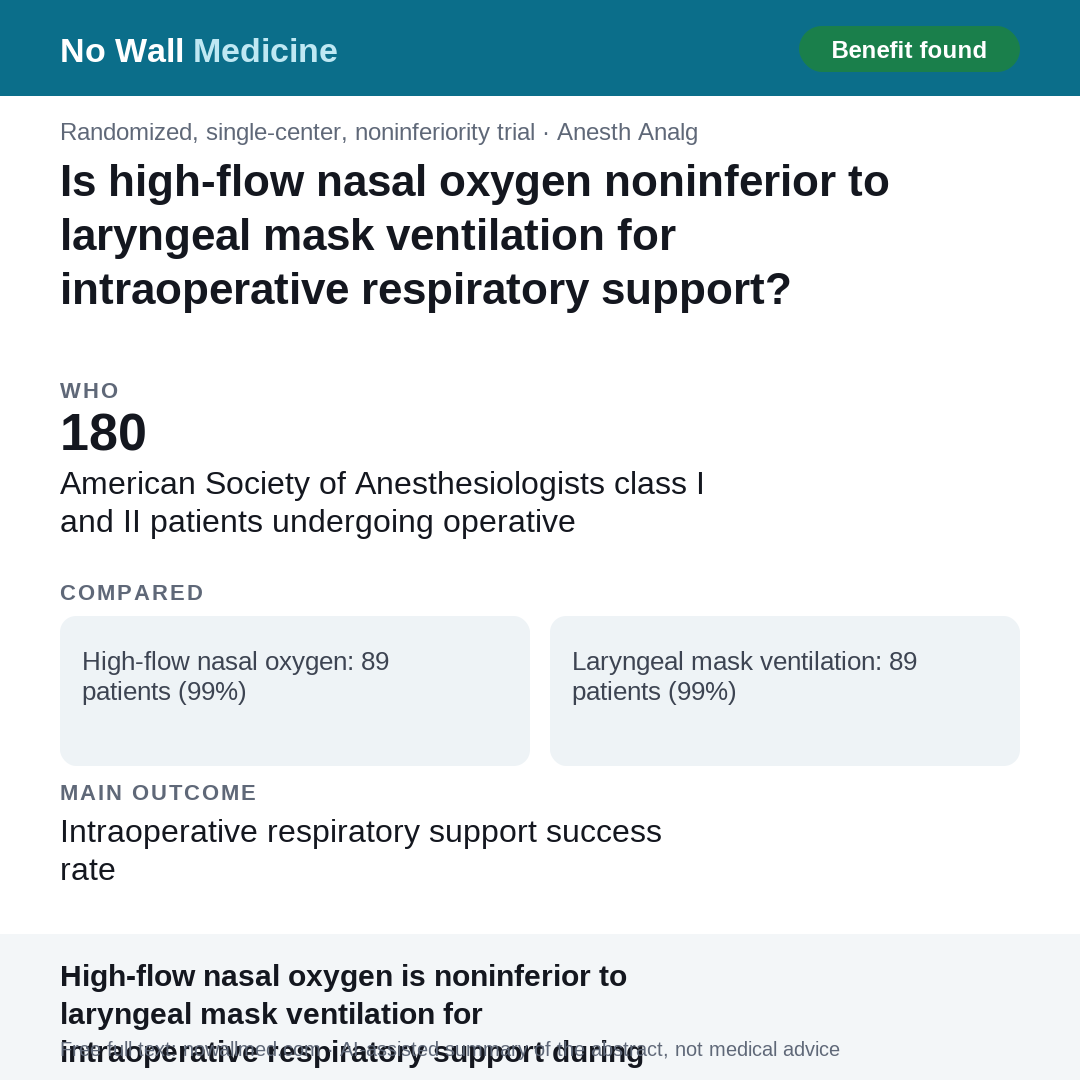
Is high-flow nasal oxygen noninferior to laryngeal mask ventilation for intraoperative respiratory support?
Who
180
American Society of Anesthesiologists class I and II patients undergoing operative hysteroscopy · Italy
Compared
High-flow nasal oxygen: 89 patients (99%)
Laryngeal mask ventilation: 89 patients (99%)
Main outcome
Intraoperative respiratory support success rate
Result: absolute difference 0, unilateral 95% confidence interval, 3%
Bottom line: High-flow nasal oxygen is noninferior to laryngeal mask ventilation for intraoperative respiratory support during short general anesthesia.
Anesth Analg · 2025-07-21Download image
Clinical question: Is high-flow nasal oxygen noninferior to laryngeal mask ventilation for intraoperative respiratory support?
Why it matters: Clinical data is scarce regarding the effectiveness of high-flow nasal oxygen as an intraoperative respiratory support strategy during general anesthesia.
Key points
- Researchers studied 180 patients undergoing 30-minute general anesthesia for hysteroscopy, comparing high-flow nasal oxygen to ventilation through a laryngeal mask airway device.
- The success rate of respiratory support was 99% in both groups, showing that high-flow nasal oxygen was noninferior to the laryngeal mask.
- Postoperative respiratory symptoms occurred in 2% of the high-flow group compared to 19% in the laryngeal mask group, though carbon dioxide levels were higher in the high-flow group.
Limitation the authors note: This was a single-center trial conducted in Italy.
Headline and key points written with AI from the paper’s abstract, with every number checked against it. Read the paper before relying on them.
Topics
Cite this article
Frassanito L, Grieco DL, Vassalli F, Piersanti A, Scorzoni M, Ciano F. High-Flow Nasal Oxygen versus Mechanical Ventilation Through a Laryngeal Mask During General Anesthesia Without Muscle Paralysis: A Randomized Clinical Trial. Anesth Analg. 2025. doi:10.1213/ANE.0000000000007620
Spotted a mistake? Suggest a correction
Top studies every Monday
The week’s key trials and guidelines in your specialties, plus any topics you follow. By email, free.
Get the weekly digest