High-flow nasal oxygen did not improve oxygen levels during transcatheter aortic valve replacement
High-flow nasal oxygen vs. standard oxygen therapy for patients undergoing transcatheter aortic valve replacement with conscious sedation: a randomised controlled trial
Randomised controlled trialNo clear difference
Does high-flow nasal oxygen provide superior oxygenation compared to standard oxygen therapy during transcatheter aortic valve replacement?
Who
72
Patients undergoing transcatheter aortic valve replacement with conscious sedation
Compared
High-flow nasal oxygen: median increase from 12.10 (10.05-15.22 [7.2-29.8]) to 13.69 (10.85-18.38 [8.5-32.3]) kPa
Standard oxygen therapy: decrease from 15.45 (12.17-19.33 [9.2-22.8]) to 14.20 (11.80-19.40 [9.7-35.1]) kPa
Main outcome
Change in arterial partial pressure of oxygen during the procedure
Bottom line: High-flow nasal oxygen does not improve arterial oxygenation compared to standard oxygen therapy during the procedure.
Perioper Med · 2023-04-14Download image
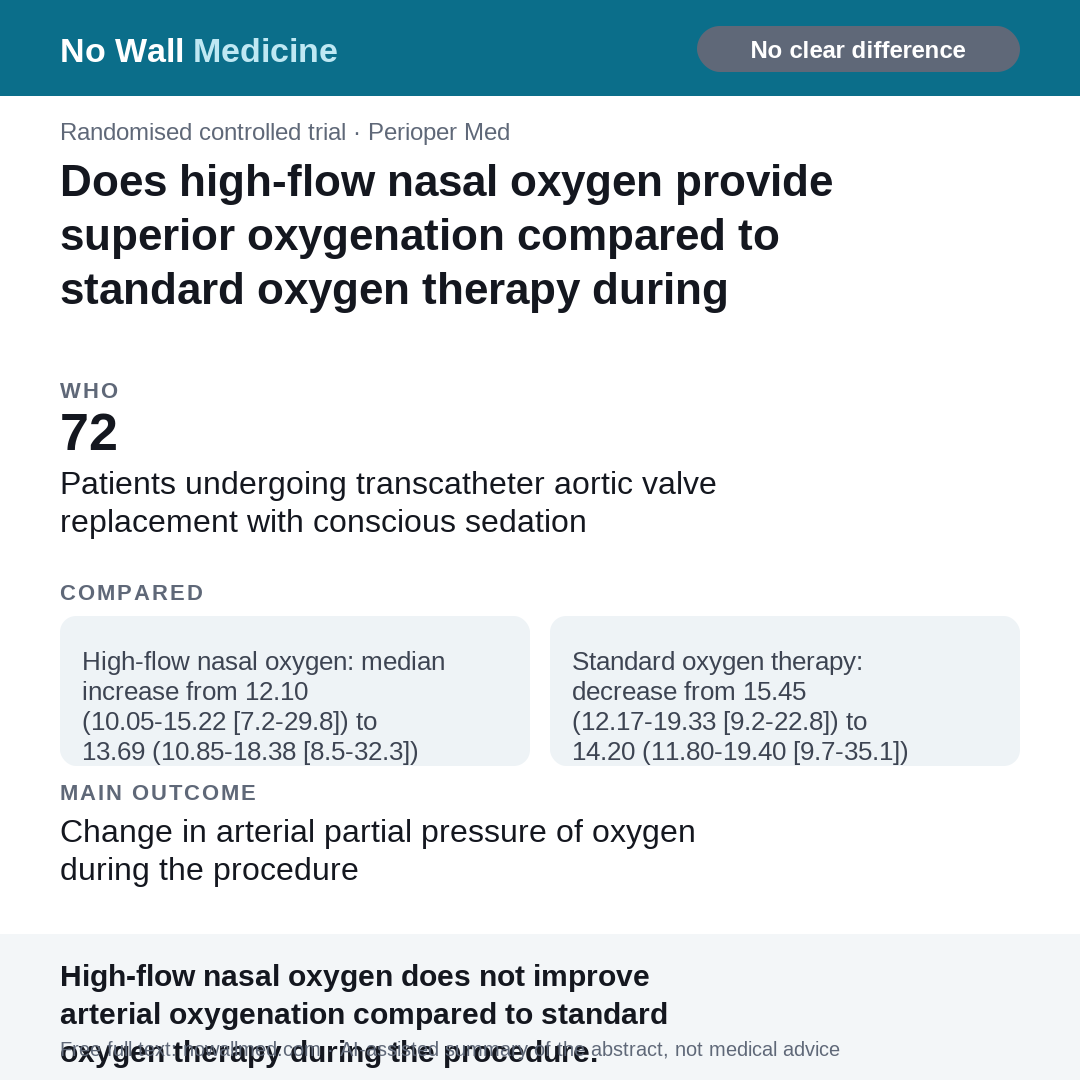
Clinical question: Does high-flow nasal oxygen provide superior oxygenation compared to standard oxygen therapy during transcatheter aortic valve replacement?
Why it matters: Patients undergoing minimally invasive heart valve replacement under conscious sedation often experience low blood oxygen levels and agitation.
Key points
- Researchers randomized 72 patients undergoing transcatheter aortic valve replacement with conscious sedation to receive either high-flow nasal oxygen or standard oxygen therapy.
- High-flow nasal oxygen did not result in a different change in arterial partial pressure of oxygen compared to standard oxygen therapy (p = 0.171).
- The high-flow group had a lower incidence of oxygen desaturation and higher patient comfort scores than the standard oxygen group.
Headline and key points written with AI from the paper’s abstract, with every number checked against it. Read the paper before relying on them.
Was this summary helpful?
Cite this article
Scheuermann S, Tan A, Govender P, Mckie M, Pack J, Martinez G. High-flow nasal oxygen vs. standard oxygen therapy for patients undergoing transcatheter aortic valve replacement with conscious sedation: a randomised controlled trial. Perioper Med. 2023. doi:10.1186/s13741-023-00300-8
Spotted a mistake? Suggest a correction
Top studies every Monday
The week’s key trials and guidelines in your specialties, plus any topics you follow. By email, free.
Get the weekly digest