High-flow nasal oxygenation did not reduce oxygen desaturation in infants undergoing tracheal intubation
High-flow Nasal Oxygenation in Infants Undergoing Tracheal Intubation: A Single-center Randomized Controlled Trial
Prospective, single-center randomized controlled trialNo clear difference
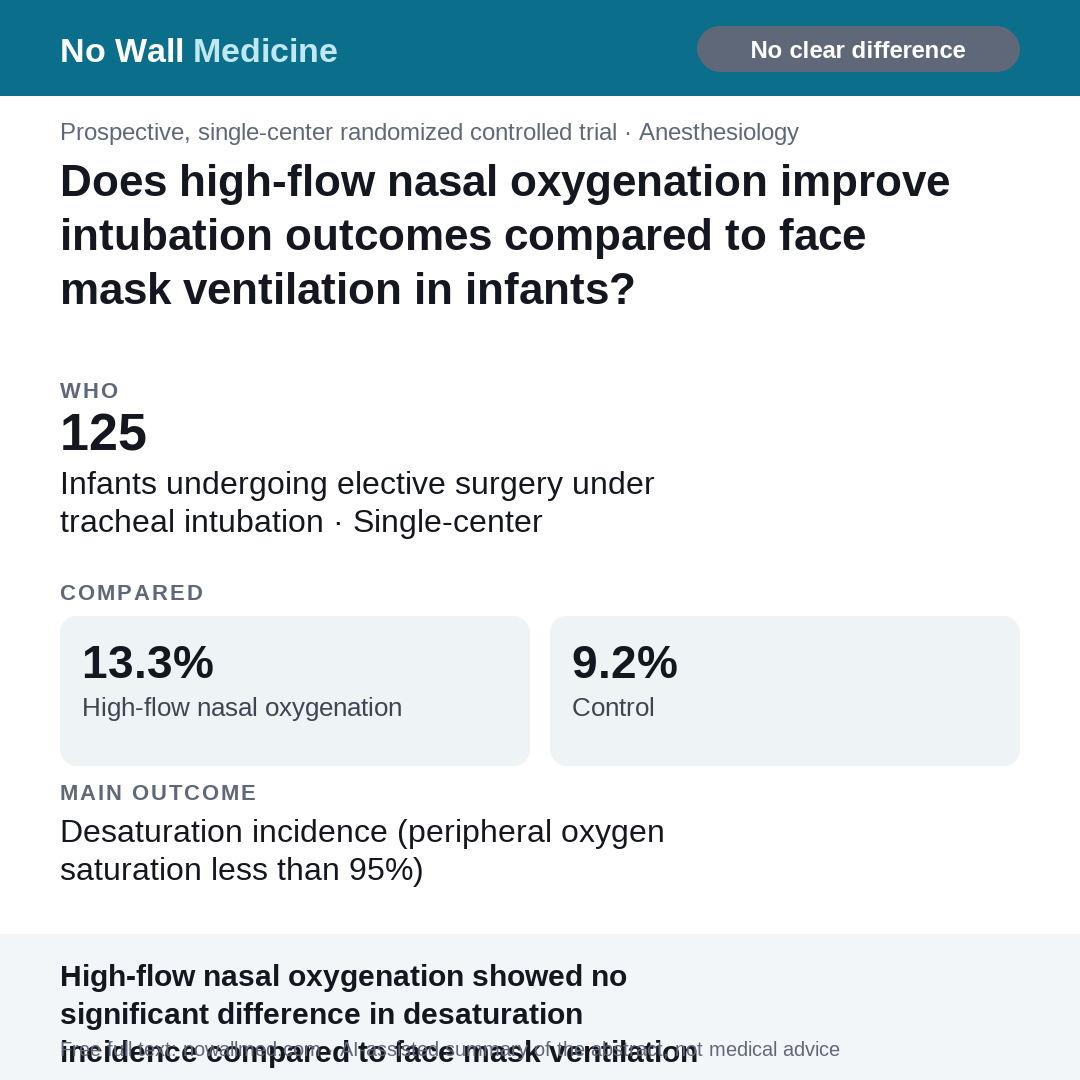
Does high-flow nasal oxygenation improve intubation outcomes compared to face mask ventilation in infants?
Who
125
Infants undergoing elective surgery under tracheal intubation · Single-center
Compared
13.3%High-flow nasal oxygenation
9.2%Control
Main outcome
Desaturation incidence (peripheral oxygen saturation less than 95%)
Result: relative risk 1.44 (95% CI 0.53 to 3.92)
Bottom line: High-flow nasal oxygenation showed no significant difference in desaturation incidence compared to face mask ventilation in infants.
Anesthesiology · 2026-01-20Download image
Clinical question: Does high-flow nasal oxygenation improve intubation outcomes compared to face mask ventilation in infants?
Why it matters: The efficacy of high-flow nasal oxygenation for preoxygenation and apneic oxygenation during tracheal intubation in infants remains underexplored.
Key points
- Researchers studied 125 infants undergoing elective surgery to compare high-flow nasal oxygenation with standard face mask ventilation.
- The incidence of oxygen saturation falling below 95% was 13.3% in the high-flow group compared to 9.2% in the control group.
- High-flow nasal oxygenation was associated with less frequent gastric insufflation, which is the inflation of the stomach with air, at 36.7% versus 70.8%.
Limitation the authors note: This was a single-center randomized controlled trial.
Headline and key points written with AI from the paper’s abstract, with every number checked against it. Read the paper before relying on them.
Topics
Cite this article
Park JB, Ji SH, Jang YE, Lee JH, Kim JT, Kim HS. High-flow Nasal Oxygenation in Infants Undergoing Tracheal Intubation: A Single-center Randomized Controlled Trial. Anesthesiology. 2026. doi:10.1097/ALN.0000000000005946
Spotted a mistake? Suggest a correction