Focused ultrasound techniques were associated with symptom improvement in psychiatric patients in eight studies
High-intensity focused ultrasound (HIFU) and low-intensity focused ultrasound (LIFU) as neurosurgical approaches in psychiatry: A systematic review of current clinical evidence
Systematic reviewBenefit found
What is the clinical evidence for high-intensity and low-intensity focused ultrasound in psychiatry?
Who
Adults with psychiatric or neuropsychiatric disorders
Compared
High-intensity focused ultrasound: improvements in several psychiatric rating scales
Low-intensity focused ultrasound: improvements in several psychiatric rating scales
Main outcome
clinical outcomes and safety
Bottom line: High-intensity and low-intensity focused ultrasound may improve symptoms in selected psychiatric populations.
Limitation: Small sample sizes, heterogeneous diagnoses, variable follow-up, and risk of bias.
Brain Spine · 2026-09-07 · Save PNG
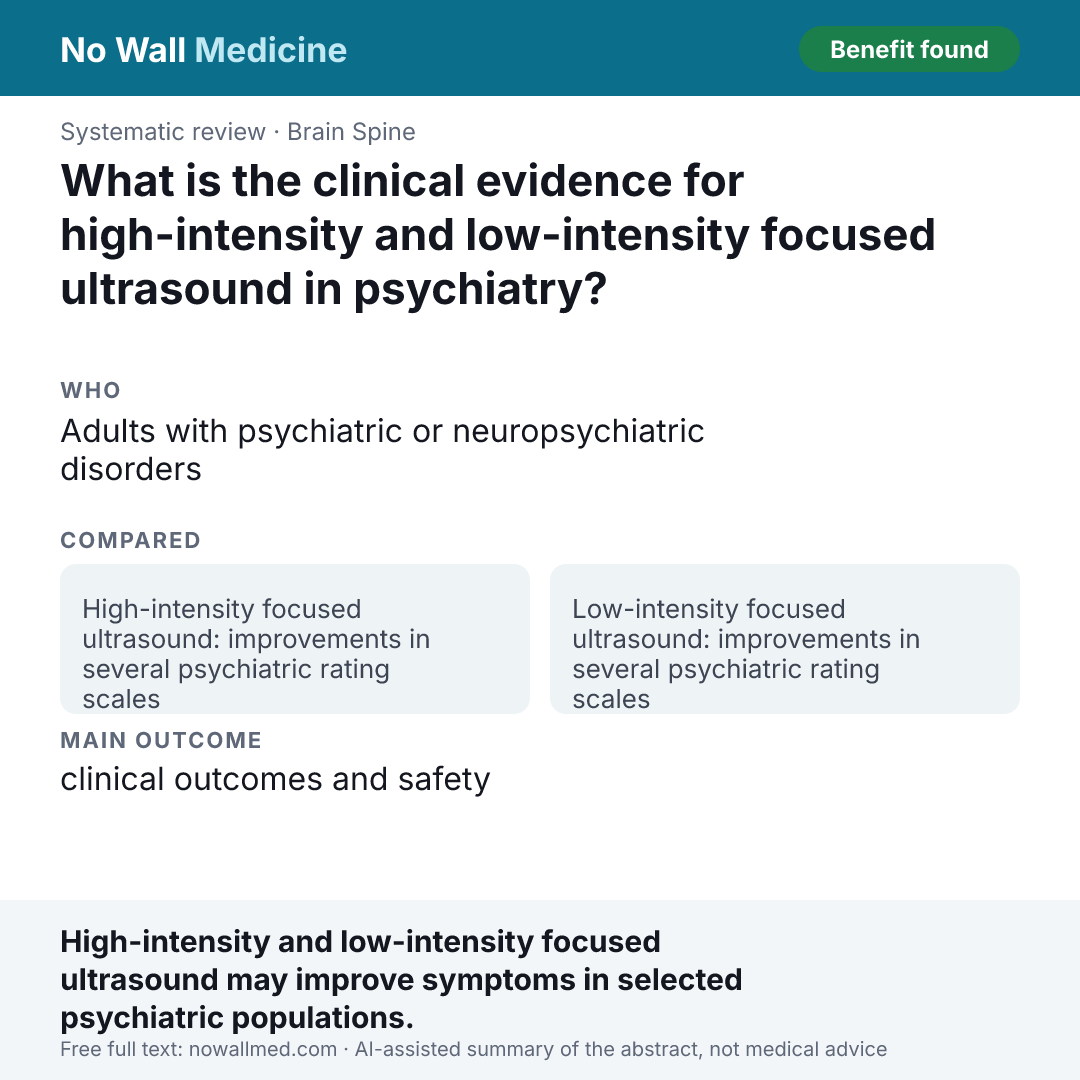
Clinical question: What is the clinical evidence for high-intensity and low-intensity focused ultrasound in psychiatry?
Why it matters: Clinical evidence is needed to determine the efficacy, safety, and optimal targets for using high-intensity and low-intensity focused ultrasound in psychiatry.
Key points
- Researchers reviewed eight studies involving high-intensity focused ultrasound for brain ablation and low-intensity focused ultrasound for reversible brain stimulation in adults with psychiatric disorders.
- Focused ultrasound was associated with improvements in several psychiatric rating scales, though adverse effects like headache and dizziness were reported as generally mild and transient.
- High-intensity focused ultrasound primarily targeted the internal capsule for obsessive-compulsive disorder and major depressive disorder, while low-intensity focused ultrasound targeted fronto-limbic areas.
Limitation the authors note: The evidence was limited by small sample sizes, heterogeneous diagnoses, variable follow-up, and risk of bias.
Headline and key points written with AI from the paper’s abstract, with every number checked against it. Read the paper before relying on them.
Was this summary helpful?
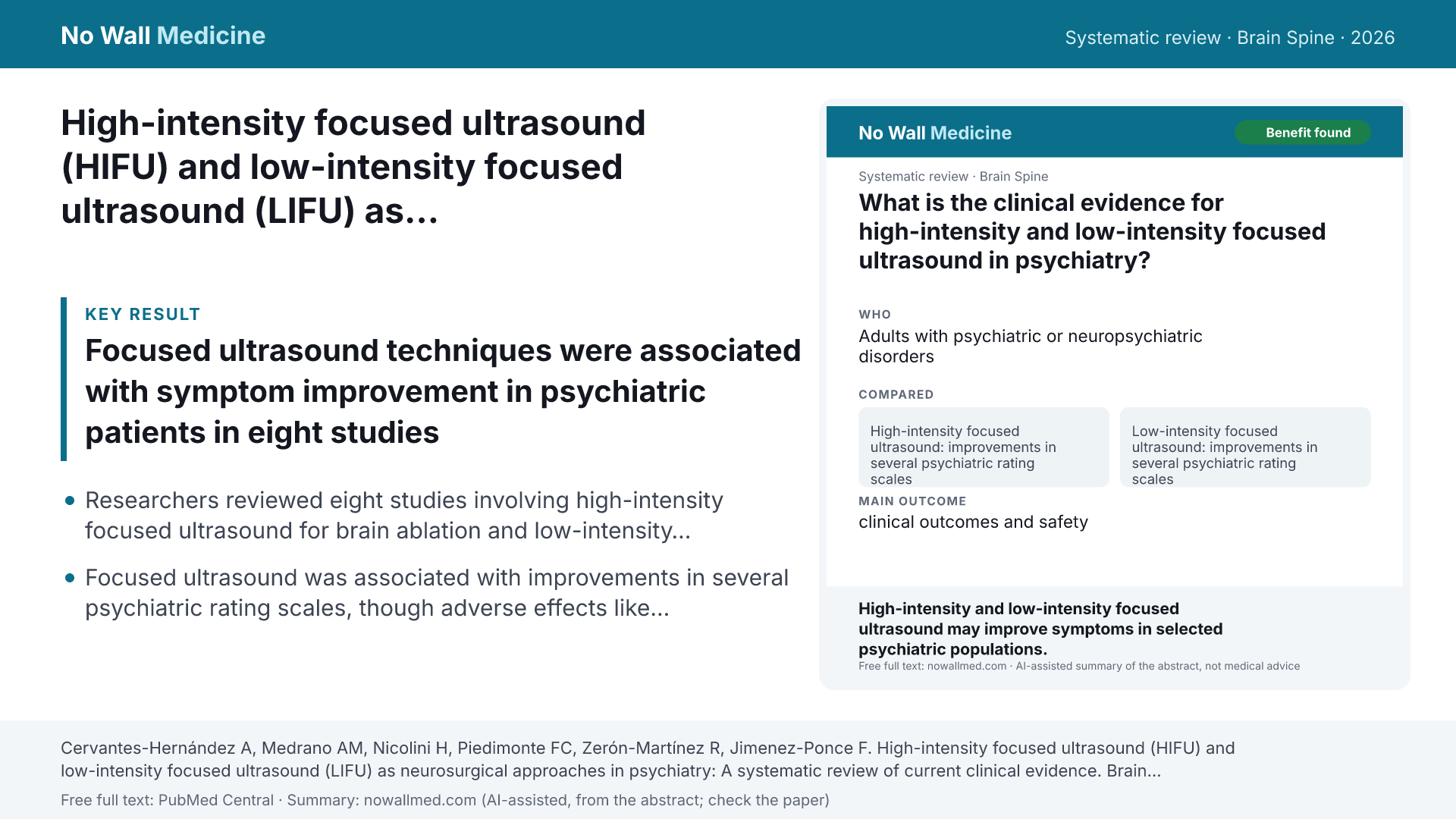
Headline, design, result, key points, caveat and citation as plain text.
Cite this article
Cervantes-Hernández A, Medrano AM, Nicolini H, Piedimonte FC, Zerón-Martínez R, Jimenez-Ponce F. High-intensity focused ultrasound (HIFU) and low-intensity focused ultrasound (LIFU) as neurosurgical approaches in psychiatry: A systematic review of current clinical evidence. Brain Spine. 2026;6:107438. doi:10.1016/j.bas.2026.107438
Spotted a mistake? Suggest a correction