Higher levels of bacterial components after eating are linked to more cardiovascular events
High postprandial endotoxemia is associated with recurrence of cardiovascular events in patients with coronary heart disease: from the CORDIOPREV randomized clinical trial
Randomized clinical trialHarm found
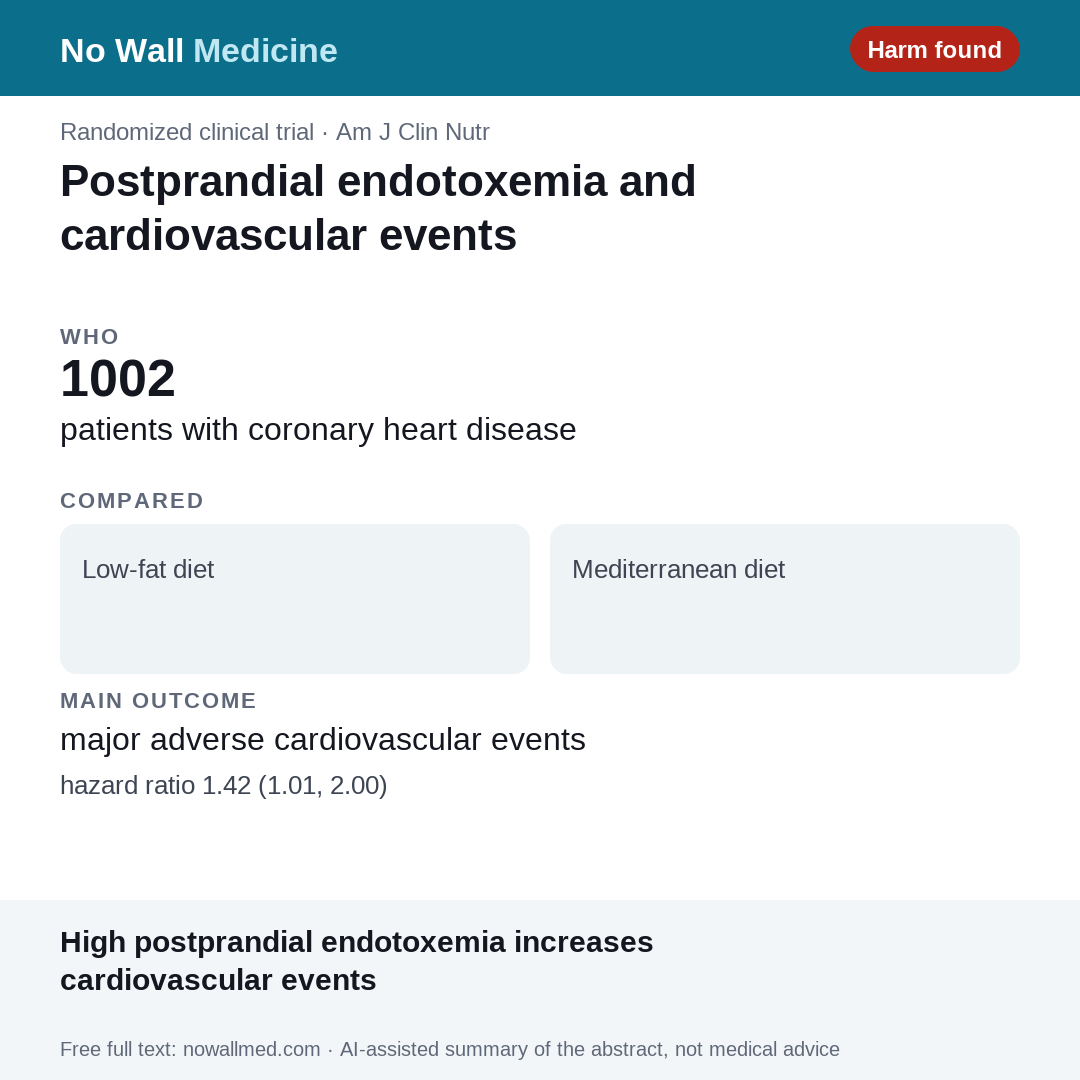
Postprandial endotoxemia and cardiovascular events
Who
1002
patients with coronary heart disease
Compared
Low-fat diet
Mediterranean diet
Main outcome
major adverse cardiovascular events
Result: hazard ratio 1.42 (1.01, 2.00)
Bottom line: High postprandial endotoxemia increases cardiovascular events
Am J Clin Nutr · 2026-06-08Download image
Why it matters: It is unclear how the movement of proinflammatory bacterial components into the bloodstream after meals affects the risk of future cardiovascular events in patients with coronary heart disease.
Key points
- Researchers studied 1002 patients with coronary heart disease who were assigned to either a low-fat diet or a Mediterranean diet for 7 years.
- An increase in lipopolysaccharide, a proinflammatory bacterial component, after eating was associated with a higher risk of major adverse cardiovascular events [hazard ratio (HR): 1.42 (1.01, 2.00)].
- Patients on a low-fat diet with moderate increases in these bacterial components had a higher risk of cardiovascular events than those on a Mediterranean diet [HR: 1.45 (1.01, 2.09)].
Headline and key points written with AI from the paper’s abstract, with every number checked against it. Read the paper before relying on them.
Topics
Cite this article
Arenas-Montes J, Garcia-Fernandez H, Alcala-Diaz JF, Boughanem H, Allais A, Gutierrez-Mariscal FM. High postprandial endotoxemia is associated with recurrence of cardiovascular events in patients with coronary heart disease: from the CORDIOPREV randomized clinical trial. Am J Clin Nutr. 2026. doi:10.1016/j.ajcnut.2026.101323
Spotted a mistake? Suggest a correction