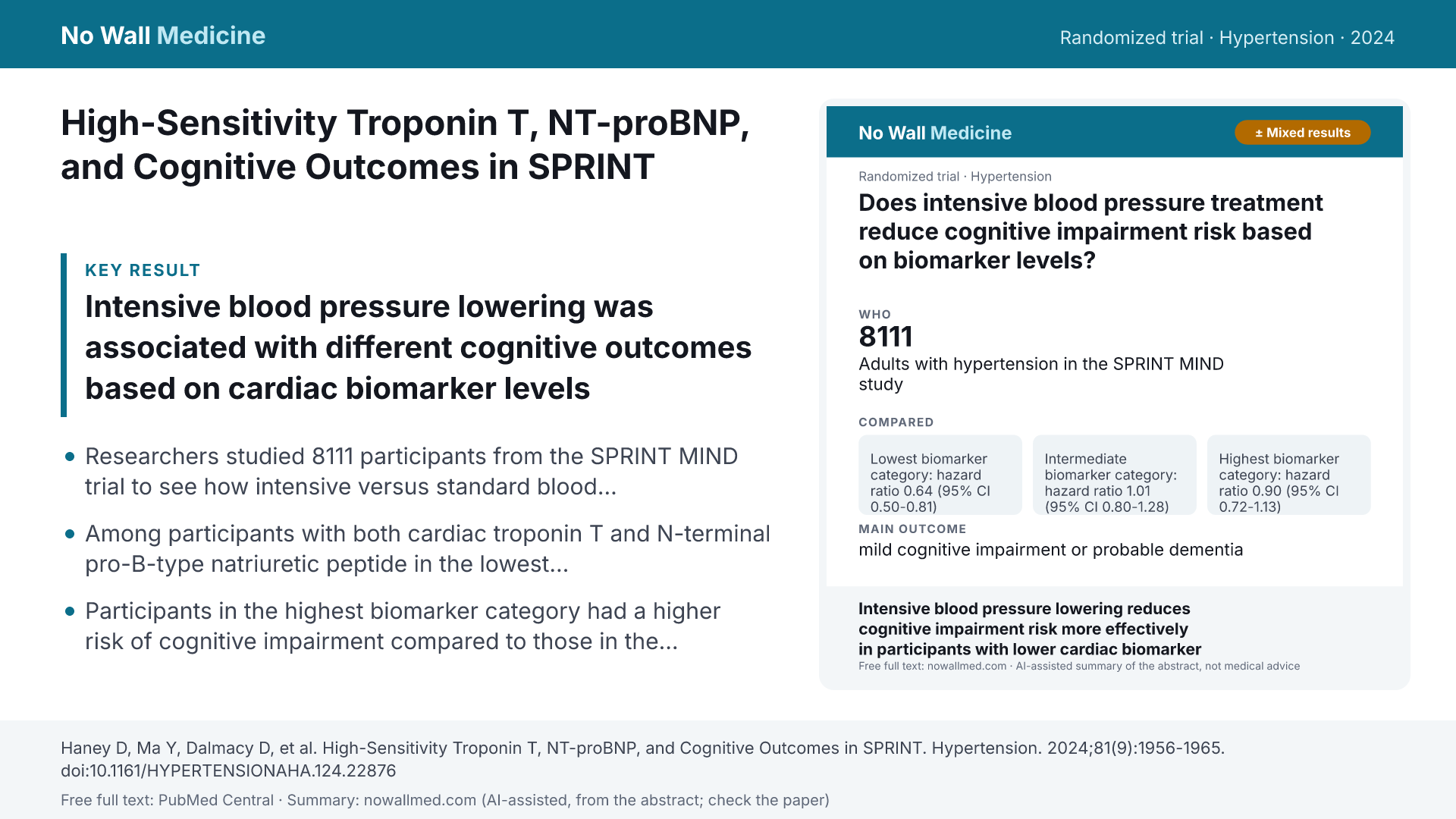
Intensive blood pressure lowering was associated with different cognitive outcomes based on cardiac biomarker levels
High-Sensitivity Troponin T, NT-proBNP, and Cognitive Outcomes in SPRINT
Randomized trialMixed results
Does intensive blood pressure treatment reduce cognitive impairment risk based on biomarker levels?
Who
8111
Adults with hypertension in the SPRINT MIND study
Compared
Lowest biomarker category: hazard ratio 0.64 (95% CI 0.50-0.81)
Intermediate biomarker category: hazard ratio 1.01 (95% CI 0.80-1.28)
Highest biomarker category: hazard ratio 0.90 (95% CI 0.72-1.13)
Main outcome
mild cognitive impairment or probable dementia
Result: hazard ratio 1.34 (95% CI 1.00-1.56)
Bottom line: Intensive blood pressure lowering reduces cognitive impairment risk more effectively in participants with lower cardiac biomarker levels.
Hypertension · 2024-07-03 · Save PNG
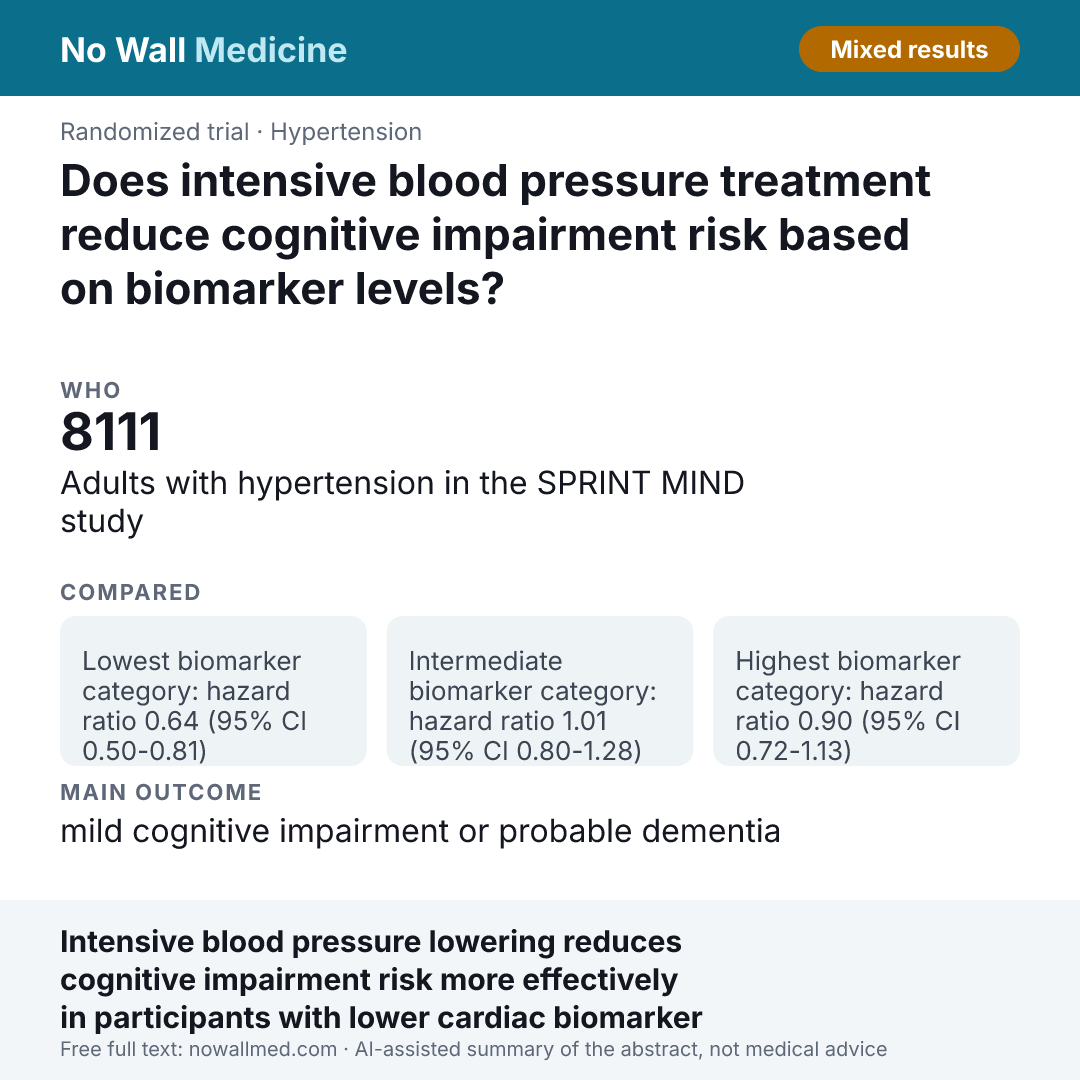
Clinical question: Does intensive blood pressure treatment reduce cognitive impairment risk based on biomarker levels?
Key points
- Researchers studied 8111 participants from the SPRINT MIND trial to see how intensive versus standard blood pressure treatment affected mild cognitive impairment or probable dementia.
- Among participants with both cardiac troponin T and N-terminal pro-B-type natriuretic peptide in the lowest tertiles, intensive treatment was associated with a hazard ratio of 0.64.
- Participants in the highest biomarker category had a higher risk of cognitive impairment compared to those in the lowest category with a hazard ratio of 1.34.
Headline and key points written with AI from the paper’s abstract, with every number checked against it. Read the paper before relying on them.
Was this summary helpful?
Subject terms
Headline, design, result, key points, caveat and citation as plain text.
Cite this article
Haney D, Ma Y, Dalmacy D, et al. High-Sensitivity Troponin T, NT-proBNP, and Cognitive Outcomes in SPRINT. Hypertension. 2024;81(9):1956-1965. doi:10.1161/HYPERTENSIONAHA.124.22876
Spotted a mistake? Suggest a correction