High energy nutrition versus gradual energy increases showed no difference in acute pancreatitis outcomes
High versus gradually increasing energy nutrition in the early phase of acute pancreatitis (GOULASH): a multicentre double-blind randomised clinical trial
Multicentric, double-blind, randomised clinical trialNo clear difference
Is high versus gradually increasing energy enteral nutrition better for acute pancreatitis?
Who
636
Patients with acute pancreatitis regardless of predicted severity · Multicentric
Compared
9.0%High energy (28/312)
5.7%Low energy (18/307)
Main outcome
Mortality and severe acute pancreatitis
Bottom line: High energy nutrition does not decrease mortality or severity compared to gradually increasing energy in acute pancreatitis.
Gut · 2026-04-07Download image
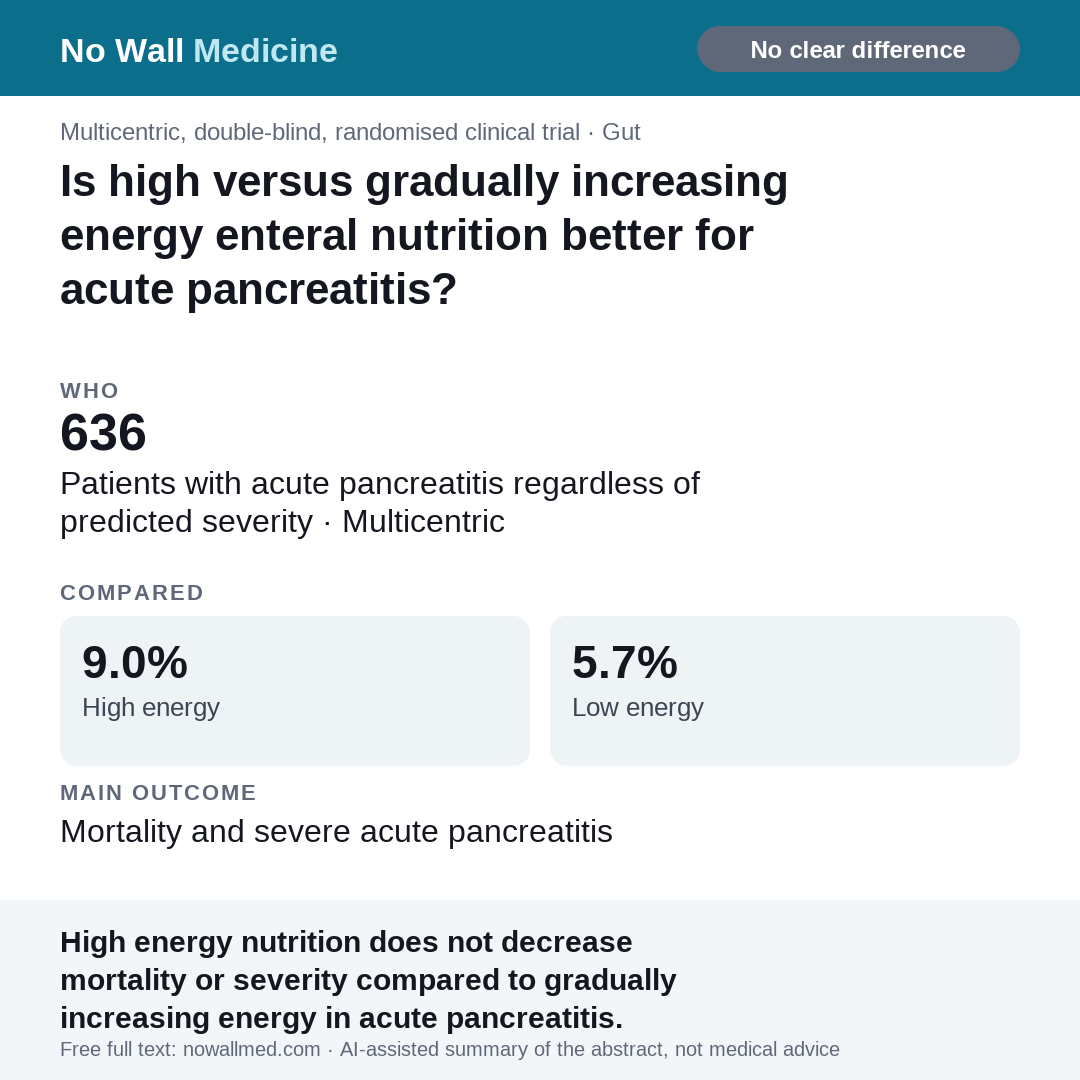
Clinical question: Is high versus gradually increasing energy enteral nutrition better for acute pancreatitis?
Why it matters: It is currently unknown whether high energy or gradually increasing energy enteral nutrition, which is feeding through a tube into the stomach or intestines, is optimal for acute pancreatitis.
Key points
- Researchers studied 636 patients with acute pancreatitis, comparing high energy nutrition of 30 kcal/kg/day to a low energy strategy that increased to 30 kcal/kg/day over 4 days.
- The primary outcome of mortality and severe disease showed no difference between the high energy group (9.0%) and the low energy group (5.7%).
- Secondary outcomes including organ failure and pain relapse also showed no statistically significant differences between the two groups after correcting for multiple testing.
Headline and key points written with AI from the paper’s abstract, with every number checked against it. Read the paper before relying on them.
Abstract
Background
Acute pancreatitis (AP) is among the most common gastrointestinal diseases requiring hospitalisation, often with severe outcomes and no disease-specific therapy. Nutritional support has been proven to improve outcome, but little is known regarding optimal timing and composition. Objective
This clinical trial aimed to compare high (30 kcal/kg/day, high energy (HE)) versus gradually increasing energy (0 increased to 30 kcal/kg/day over 4 days, low energy (LE)) strategies for enteral nutritional support in AP. Design
This was a multicentric, double-blind, randomised clinical trial, enrolling patients with AP regardless of predicted severity (January 2017 to April 2023). The primary outcome was a combination of mortality and severe acute pancreatitis (Revised Atlanta Criteria); secondary outcomes included severity, rate of infection, organ failure and pain relapse. Interim analysis was planned after 50% enrolment. The Benjamini-Hochberg false discovery rate (FDR) method was used to correct p value for multiple testing. Results
The trial was stopped early after enrolling 636 patients. Interim analysis showed that the primary outcome showed no difference between groups in the modified intention-to-treat (mITT) population (HE: 28/312, 9.0% vs LE: 18/307, 5.7%, p(uncorrected/corrected)=0.19/0.42). Secondary outcomes showed no difference in the mITT analysis. Without correction for multiplicity testing, results favoured a low gradual energy strategy in terms of organ failure (HE: 52/312, 16.7% vs LE: 28/307, 9.1%, p(uncorrected)=0.007) and pain relapse (80/312, 27.1% vs 54/307, 19.0% p(uncorrected)=0.03) but showed no differences between groups after correction for multiple testing (p=0.13 and p=0.23, respectively). It was determined that the superiority of the intervention would not be shown even with an increased sample size, and thus the trial was terminated based on a post hoc decision on ethics and futility. Conclusion
Based on this early terminated trial, a high-energy strategy for early nutrition in pancreatitis does not decrease mortality/severity, but potentially increases organ failure and pain relapse rate. Trial registration number
ISRCTN63827758.
Abstract reproduced under the article’s CC BY NC licence.
Topics
Cite this article
Márta K, Engh MA, Vincze Á, Erőss B, Hegyi PJ, Mikó A. High versus gradually increasing energy nutrition in the early phase of acute pancreatitis (GOULASH): a multicentre double-blind randomised clinical trial. Gut. 2026. doi:10.1136/gutjnl-2025-335970
Spotted a mistake? Suggest a correction