High vs Low PEEP in Patients With ARDS Exhibiting Intense Inspiratory Effort During Assisted Ventilation: A Randomized Crossover Trial
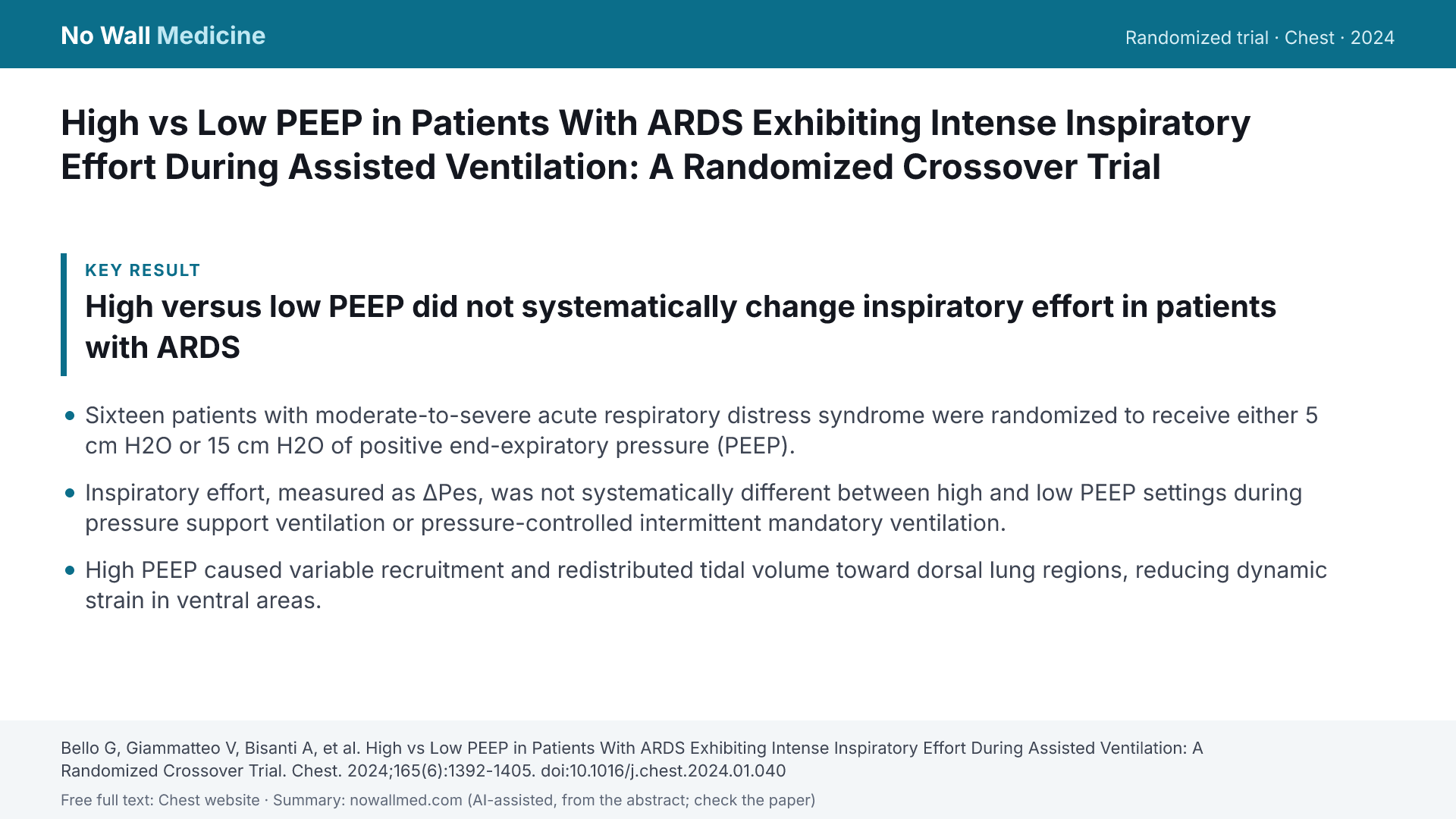
Key result: High versus low PEEP did not systematically change inspiratory effort in patients with ARDS
Key points
- Sixteen patients with moderate-to-severe acute respiratory distress syndrome were randomized to receive either 5 cm H2O or 15 cm H2O of positive end-expiratory pressure (PEEP).
- Inspiratory effort, measured as ΔPes, was not systematically different between high and low PEEP settings during pressure support ventilation or pressure-controlled intermittent mandatory ventilation.
- High PEEP caused variable recruitment and redistributed tidal volume toward dorsal lung regions, reducing dynamic strain in ventral areas.
Discussion prompts
- Would these patients look like yours? Who was left out?
- Is the main outcome one that matters to patients?
- Is the difference large enough to change what you do?
Cite: Bello G, Giammatteo V, Bisanti A, et al. High vs Low PEEP in Patients With ARDS Exhibiting Intense Inspiratory Effort During Assisted Ventilation: A Randomized Crossover Trial. Chest. 2024;165(6):1392-1405. doi:10.1016/j.chest.2024.01.040
Free full text: Chest website · Summary and visual abstract: nowallmed.com/a/high-vs-low-peep-in-patients-with-ards-exhibiting-intense-inspiratory-u7hc3v/ (AI-assisted from the abstract; check the paper before relying on it).