Higher risk, lower recurrence: A year of risk-adapted twist-drill craniostomy with pressure-controlled fibrinolytic irrigation therapy for chronic subdural hematoma
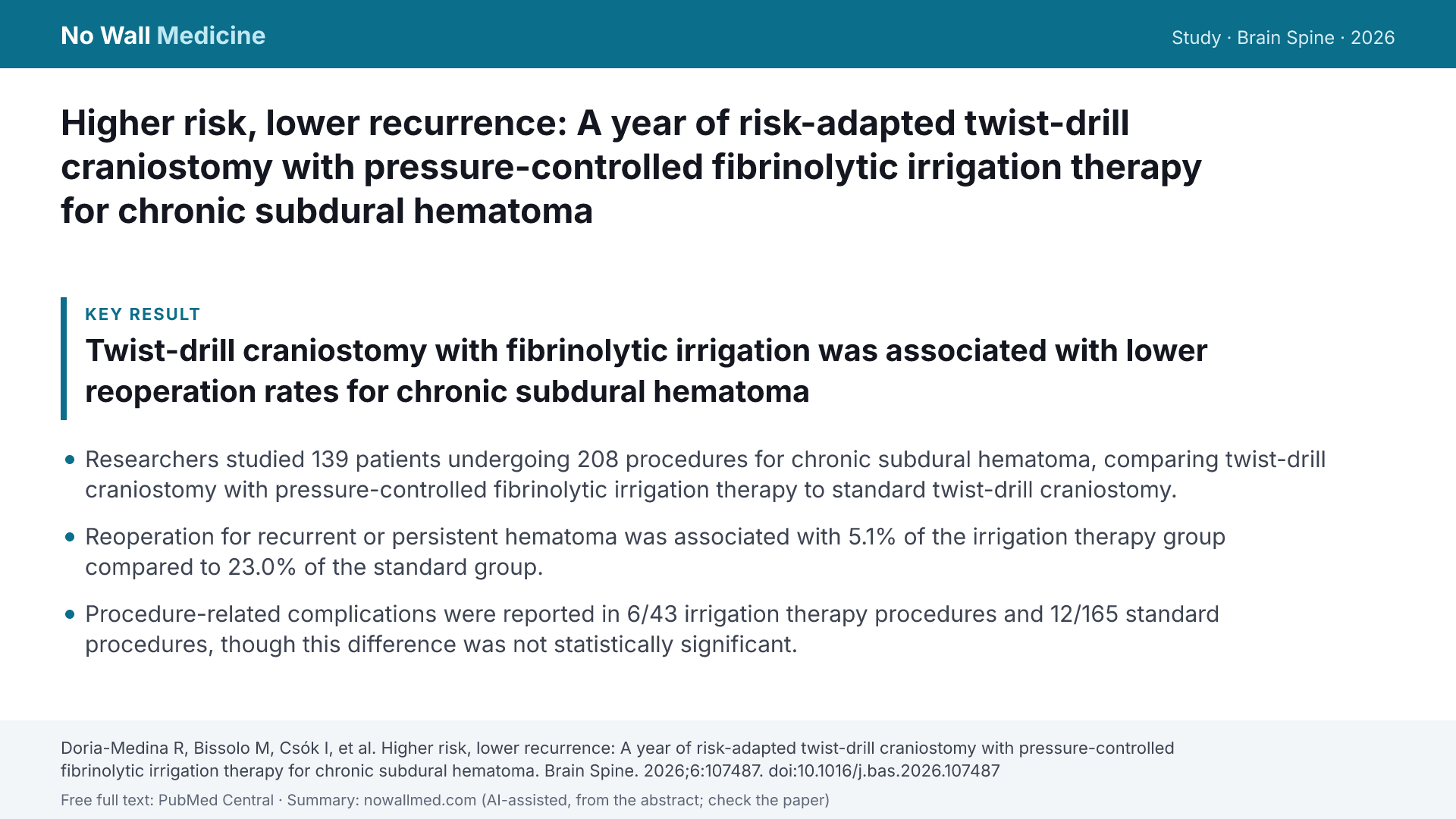
Key result: Twist-drill craniostomy with fibrinolytic irrigation was associated with lower reoperation rates for chronic subdural hematoma
Key points
- Researchers studied 139 patients undergoing 208 procedures for chronic subdural hematoma, comparing twist-drill craniostomy with pressure-controlled fibrinolytic irrigation therapy to standard twist-drill craniostomy.
- Reoperation for recurrent or persistent hematoma was associated with 5.1% of the irrigation therapy group compared to 23.0% of the standard group.
- Procedure-related complications were reported in 6/43 irrigation therapy procedures and 12/165 standard procedures, though this difference was not statistically significant.
Why it matters: Standard twist-drill craniostomy may have limited effectiveness in treating membranous hematomas due to incomplete evacuation of the blood collection.
Discussion prompts
- Would these patients look like yours? Who was left out?
- Is the main outcome one that matters to patients?
- Is the difference large enough to change what you do?
Cite: Doria-Medina R, Bissolo M, Csók I, et al. Higher risk, lower recurrence: A year of risk-adapted twist-drill craniostomy with pressure-controlled fibrinolytic irrigation therapy for chronic subdural hematoma. Brain Spine. 2026;6:107487. doi:10.1016/j.bas.2026.107487
Free full text: PubMed Central · Summary and visual abstract: nowallmed.com/a/higher-risk-lower-recurrence-a-year-of-risk-adapted-twist-drill-124dwvo/ (AI-assisted from the abstract; check the paper before relying on it).