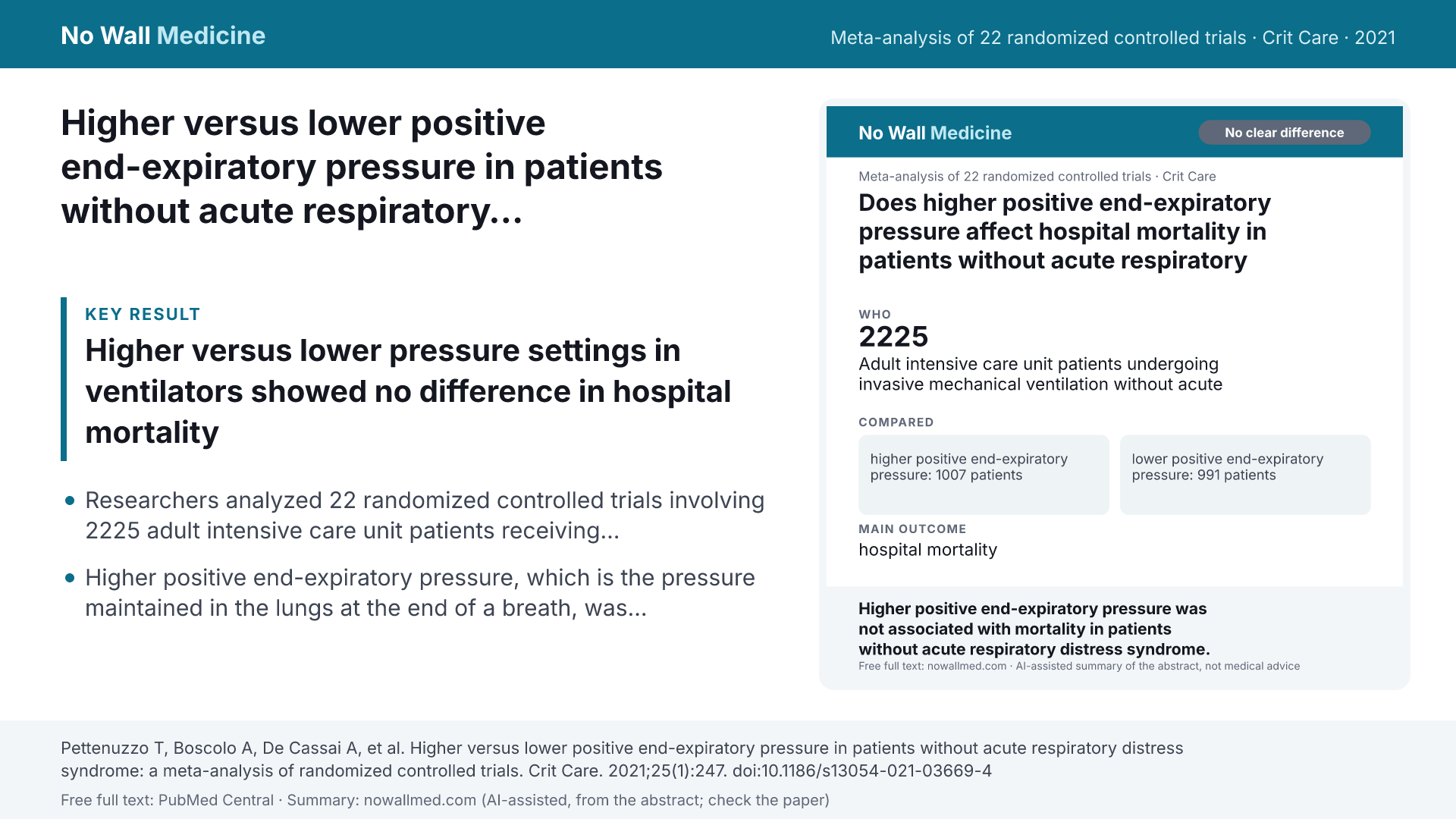
Higher versus lower pressure settings in ventilators showed no difference in hospital mortality
Higher versus lower positive end-expiratory pressure in patients without acute respiratory distress syndrome: a meta-analysis of randomized controlled trials
Meta-analysis of 22 randomized controlled trialsNo clear difference
Does higher positive end-expiratory pressure affect hospital mortality in patients without acute respiratory distress syndrome?
Who
2225
Adult intensive care unit patients undergoing invasive mechanical ventilation without acute respiratory distress syndrome
Compared
higher positive end-expiratory pressure: 1007 patients
lower positive end-expiratory pressure: 991 patients
Main outcome
hospital mortality
Result: risk ratio 1.02 (95% confidence interval 0.89-1.16)
Bottom line: Higher positive end-expiratory pressure was not associated with mortality in patients without acute respiratory distress syndrome.
Crit Care · 2021-07-15 · Save PNG
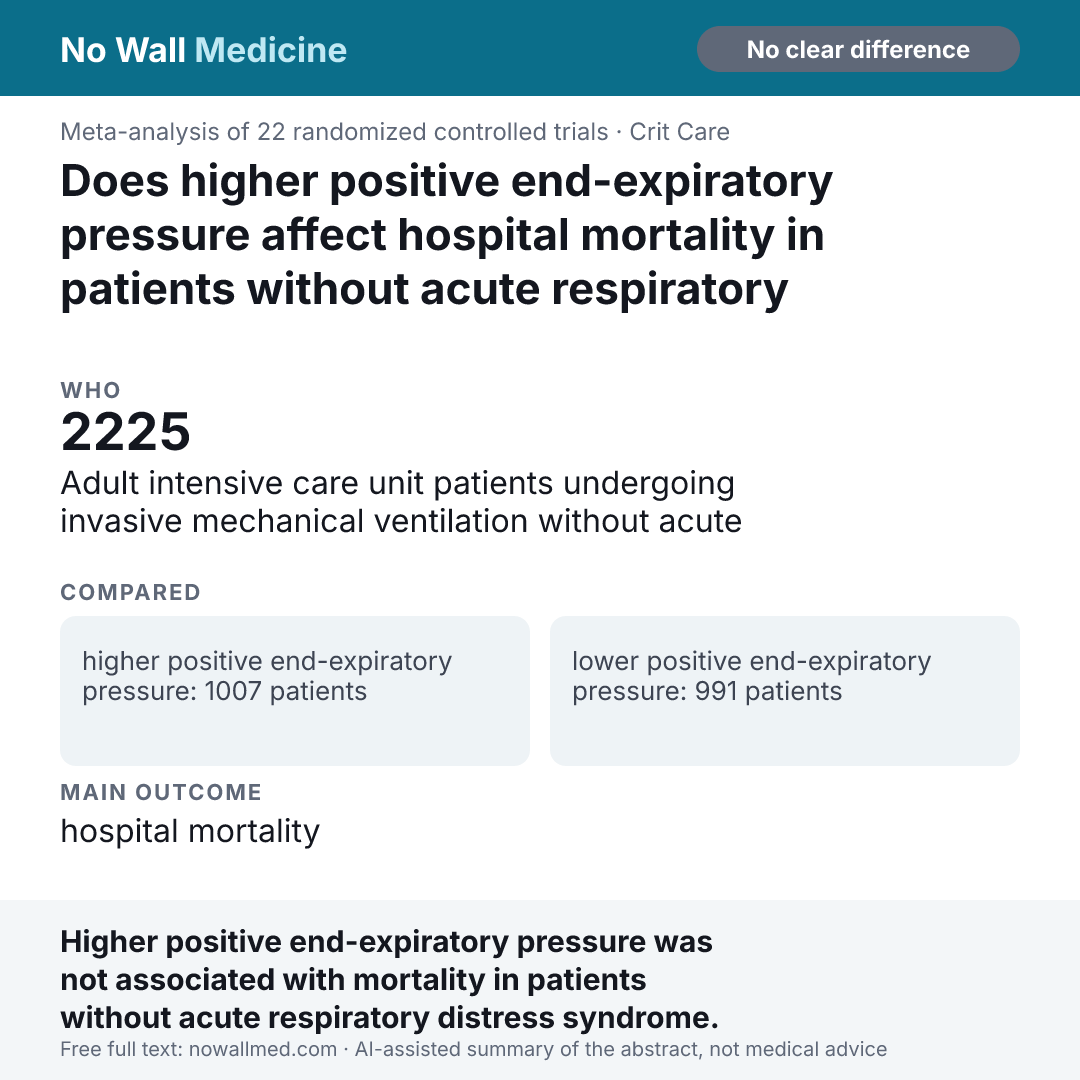
Clinical question: Does higher positive end-expiratory pressure affect hospital mortality in patients without acute respiratory distress syndrome?
Key points
- Researchers analyzed 22 randomized controlled trials involving 2225 adult intensive care unit patients receiving invasive mechanical ventilation for reasons other than acute respiratory distress syndrome.
- Higher positive end-expiratory pressure, which is the pressure maintained in the lungs at the end of a breath, was not associated with hospital mortality (risk ratio 1.02, 95% confidence interval 0.89-1.16).
- Higher pressure settings were associated with better oxygenation, higher respiratory system compliance, and a lower risk of hypoxemia and acute respiratory distress syndrome occurrence.
Headline and key points written with AI from the paper’s abstract, with every number checked against it. Read the paper before relying on them.
Was this summary helpful?
Abstract
Background
We conducted a systematic review and meta-analysis of randomized controlled trials (RCTs) to assess the association of higher positive end-expiratory pressure (PEEP), as opposed to lower PEEP, with hospital mortality in adult intensive care unit (ICU) patients undergoing invasive mechanical ventilation for reasons other than acute respiratory distress syndrome (ARDS). Methods
We performed an electronic search of MEDLINE, EMBASE, Scopus, Cochrane Central Register of Controlled Trials, CINAHL, and Web of Science from inception until June 16, 2021 with no language restrictions. In addition, a research-in-progress database and grey literature were searched. Results
We identified 22 RCTs (2225 patients) comparing higher PEEP (1007 patients) with lower PEEP (991 patients). No statistically significant association between higher PEEP and hospital mortality was observed (risk ratio 1.02, 95% confidence interval 0.89-1.16; I2 = 0%, p = 0.62; low certainty of evidence). Among secondary outcomes, higher PEEP was associated with better oxygenation, higher respiratory system compliance, and lower risk of hypoxemia and ARDS occurrence. Furthermore, barotrauma, hypotension, duration of ventilation, lengths of stay, and ICU mortality were similar between the two groups. Conclusions
In our meta-analysis of RCTs, higher PEEP, compared with lower PEEP, was not associated with mortality in patients without ARDS receiving invasive mechanical ventilation. Further large high-quality RCTs are required to confirm these findings.
Abstract reproduced under the article’s CC BY licence.
Subject terms
Headline, design, result, key points, caveat and citation as plain text.
Cite this article
Pettenuzzo T, Boscolo A, De Cassai A, et al. Higher versus lower positive end-expiratory pressure in patients without acute respiratory distress syndrome: a meta-analysis of randomized controlled trials. Crit Care. 2021. doi:10.1186/s13054-021-03669-4
Spotted a mistake? Suggest a correction