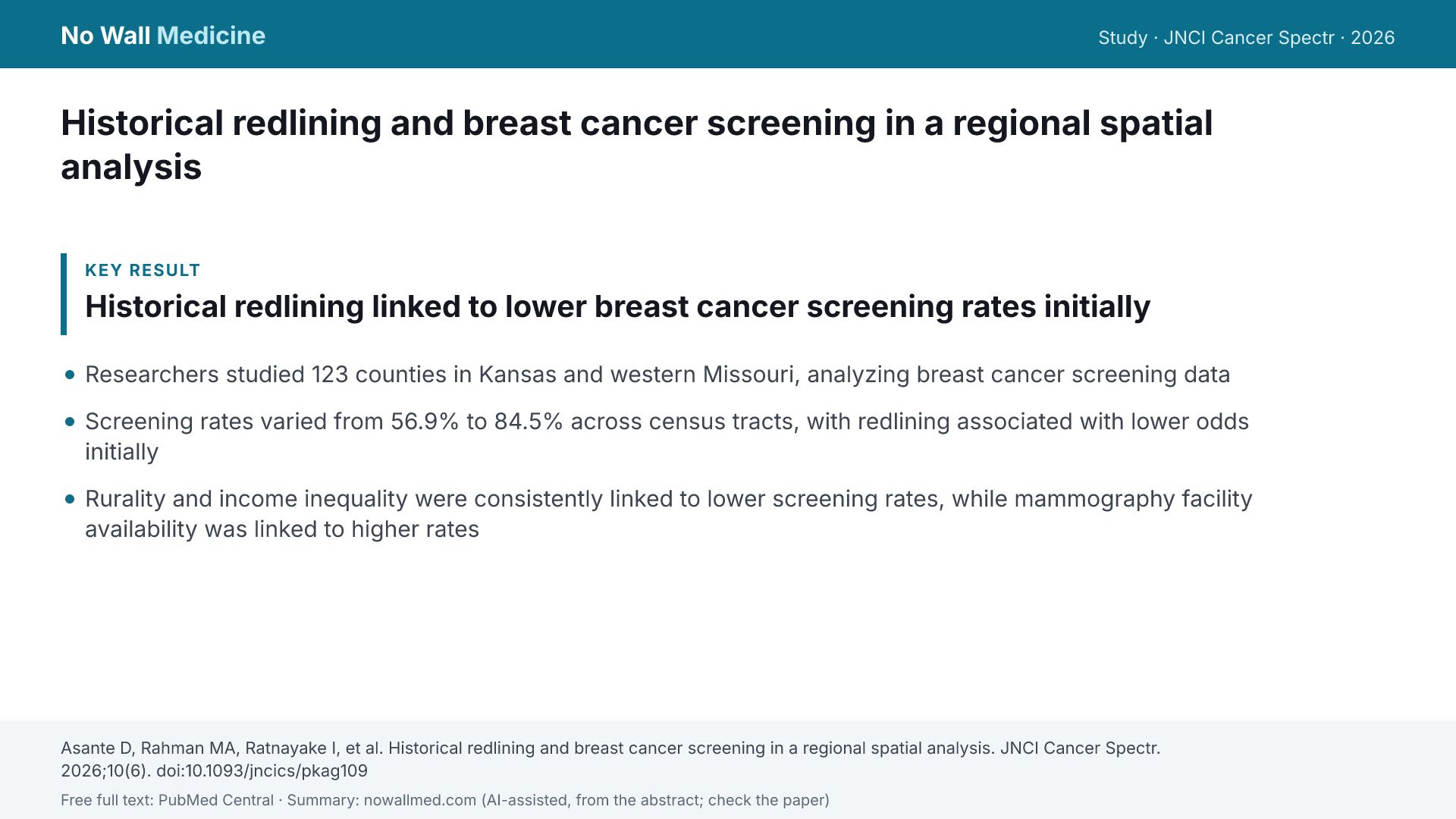
Historical redlining linked to lower breast cancer screening rates initially
Historical redlining and breast cancer screening in a regional spatial analysis
Why it matters: Doctors have had little understanding of how historical redlining affects breast cancer screening disparities
Key points
- Researchers studied 123 counties in Kansas and western Missouri, analyzing breast cancer screening data.
- Screening rates varied from 56.9% to 84.5% across census tracts, with redlining associated with lower odds initially.
- Rurality and income inequality were consistently linked to lower screening rates, while mammography facility availability was linked to higher rates.
Study type: Observational study: it can show a link, but not prove that one thing causes another.
Headline and key points written with AI from the paper’s abstract, with every number checked against it. Read the paper before relying on them.
Was this summary helpful?
Subject terms
Headline, design, result, key points, caveat and citation as plain text.
Cite this article
Asante D, Rahman MA, Ratnayake I, et al. Historical redlining and breast cancer screening in a regional spatial analysis. JNCI Cancer Spectr. 2026;10(6). doi:10.1093/jncics/pkag109
Spotted a mistake? Suggest a correction