Histotripsy shows high technical success and moderate tumor reduction for liver tumor treatment
Histotripsy for liver tumours: a systematic review and meta-analysis of current clinical evidence
Meta-analysis of 10 studiesBenefit found
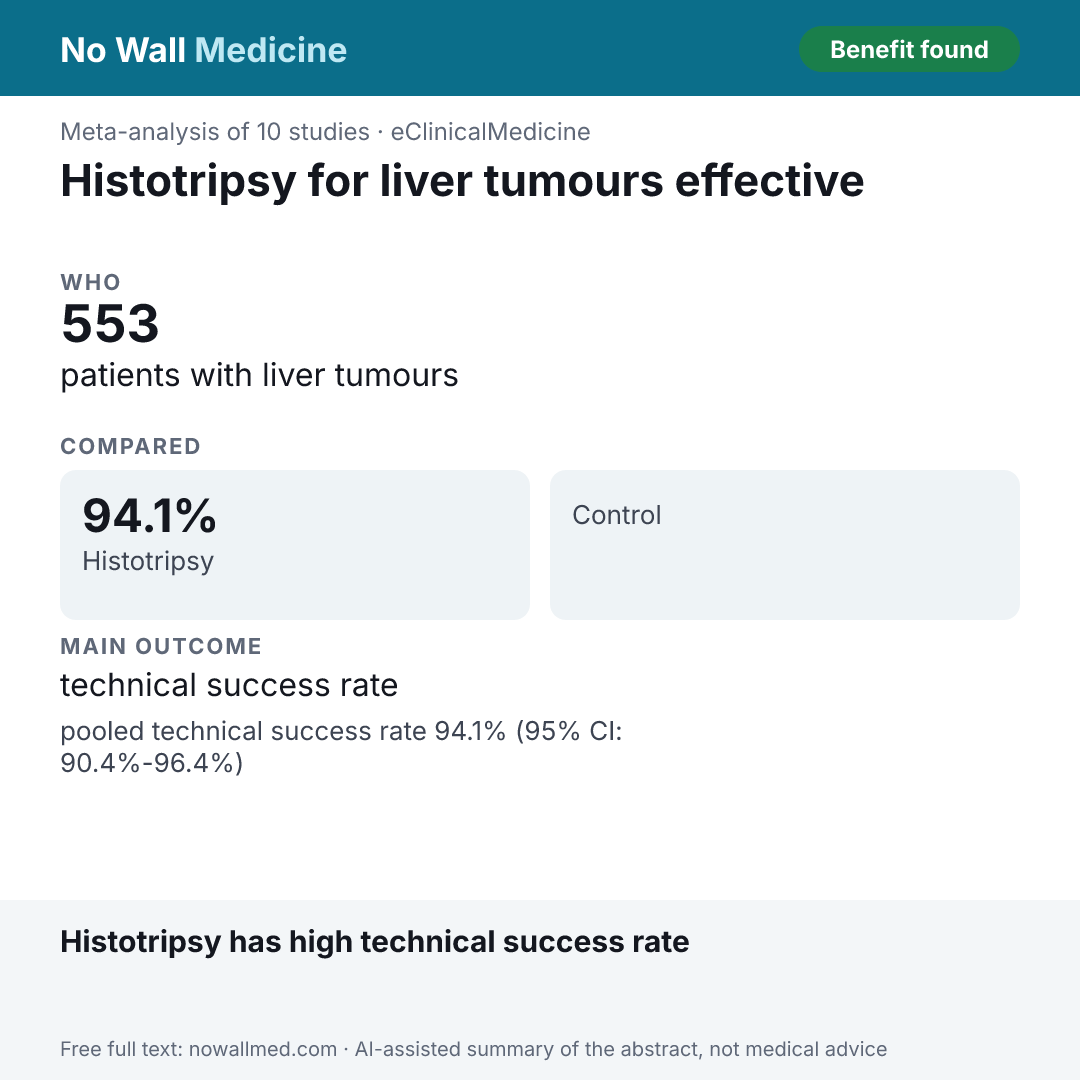
Histotripsy for liver tumours effective
Who
553
patients with liver tumours
Compared
94.1%Histotripsy (90.4%-96.4%)
Control
Main outcome
technical success rate
Result: pooled technical success rate 94.1% (95% CI: 90.4%-96.4%)
Bottom line: Histotripsy has high technical success rate
Limitation: small number of studies and variability
eClinicalMedicine · 2026-04-29 · Save PNG
Why it matters: Clinical evidence was needed to summarize the safety and outcomes of histotripsy for treating primary and secondary liver tumors.
Key points
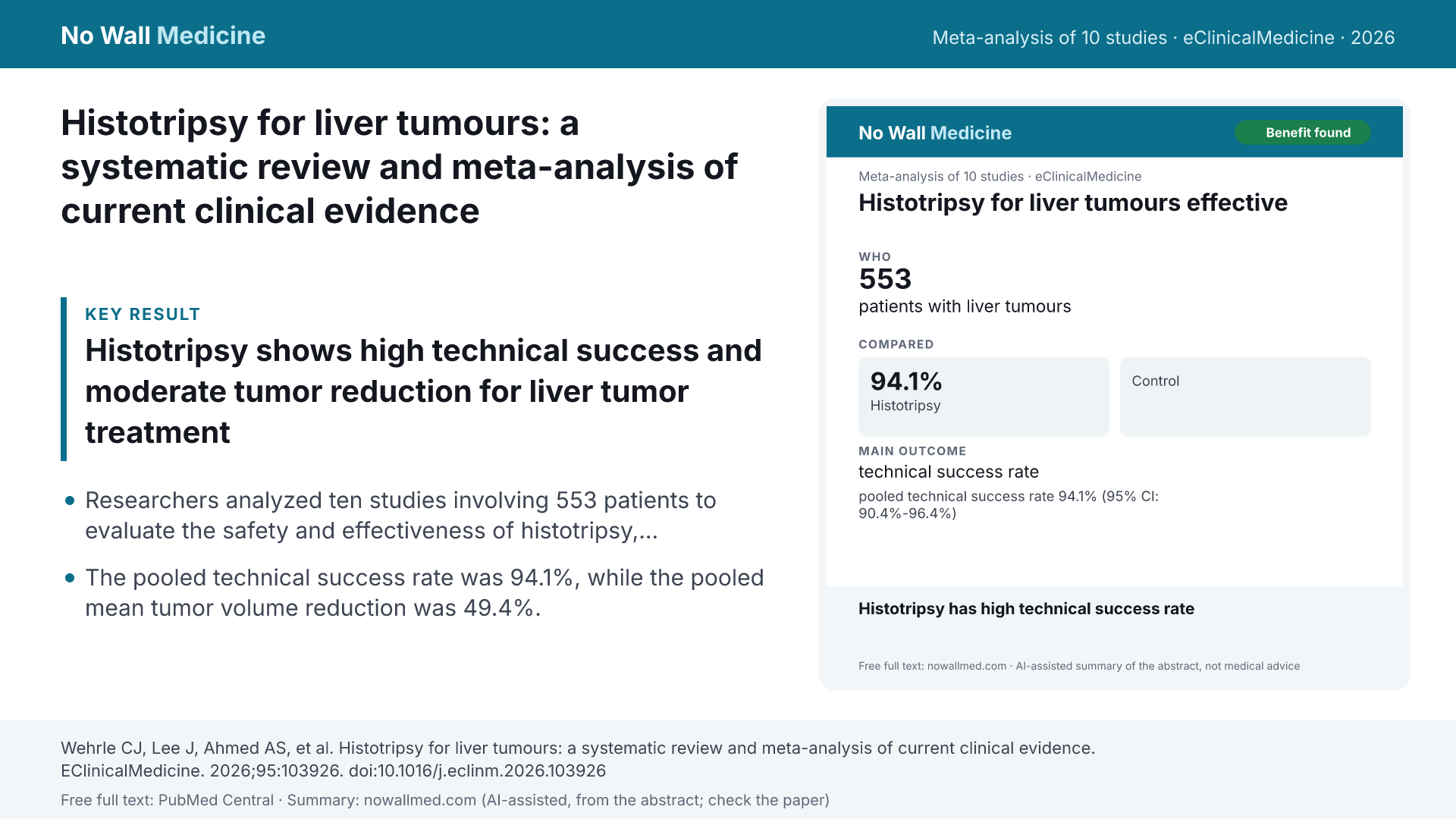
- Researchers analyzed ten studies involving 553 patients to evaluate the safety and effectiveness of histotripsy, a non-invasive mechanical tumor disruption method.
- The pooled technical success rate was 94.1%, while the pooled mean tumor volume reduction was 49.4%.
- Major complications occurred in 7.0% of cases, and the pooled rate for off-target tumor effects was 10.0%.
Limitation the authors note: The interpretation is limited by a small number of available studies, variability in outcome definitions, and short follow-up durations.
Headline and key points written with AI from the paper’s abstract, with every number checked against it. Read the paper before relying on them.
Was this summary helpful?
Headline, design, result, key points, caveat and citation as plain text.
Cite this article
Wehrle CJ, Lee J, Ahmed AS, et al. Histotripsy for liver tumours: a systematic review and meta-analysis of current clinical evidence. EClinicalMedicine. 2026;95:103926. doi:10.1016/j.eclinm.2026.103926
Spotted a mistake? Suggest a correction