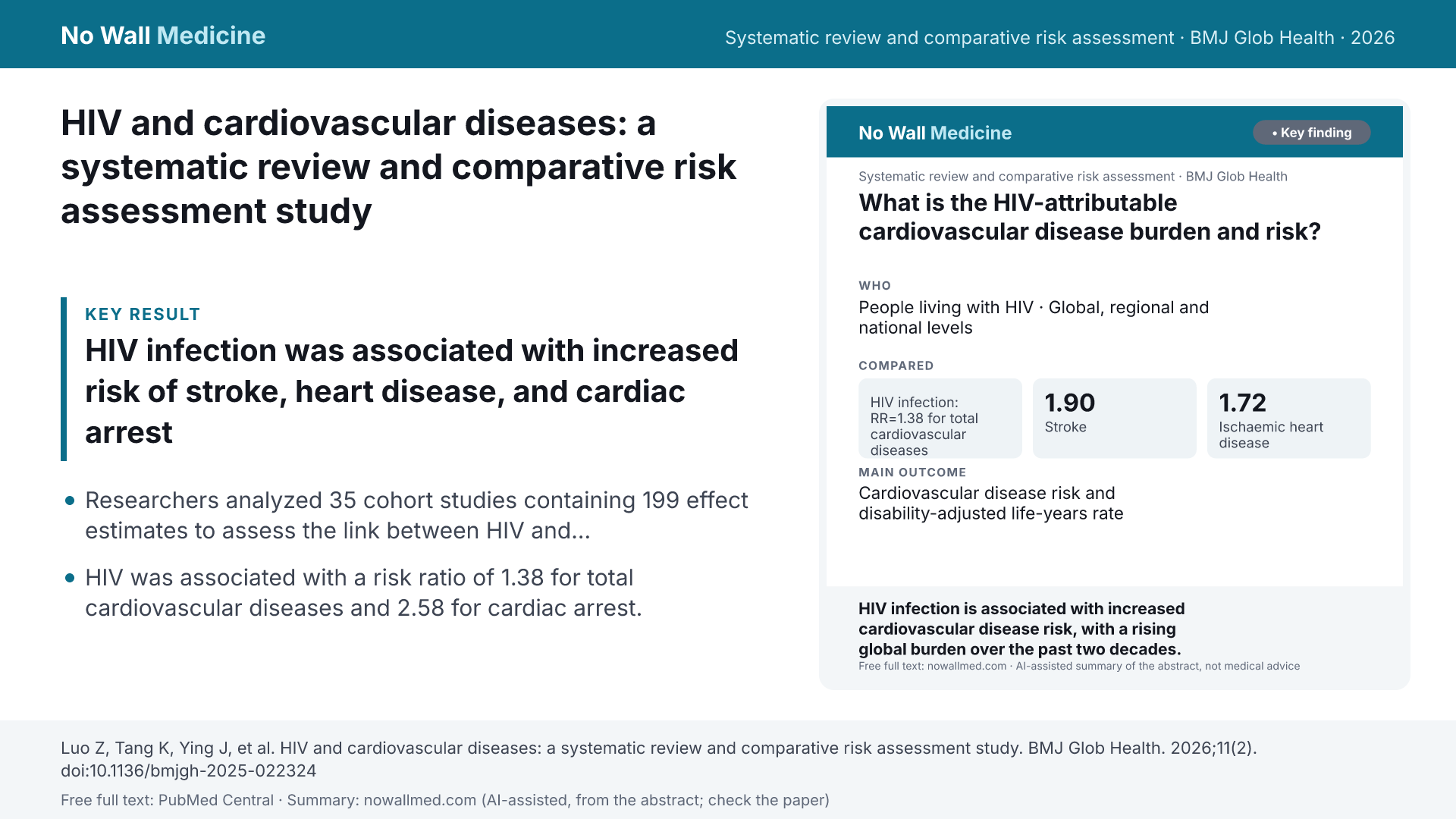
HIV infection was associated with increased risk of stroke, heart disease, and cardiac arrest
HIV and cardiovascular diseases: a systematic review and comparative risk assessment study
Systematic review and comparative risk assessmentHarm found
What is the HIV-attributable cardiovascular disease burden and risk?
Who
People living with HIV · Global, regional and national levels
Compared
HIV infection: RR=1.38 for total cardiovascular diseases
1.90Stroke
1.72Ischaemic heart disease
Main outcome
Cardiovascular disease risk and disability-adjusted life-years rate
Bottom line: HIV infection is associated with increased cardiovascular disease risk, with a rising global burden over the past two decades.
BMJ Glob Health · 2026-02-17Download image
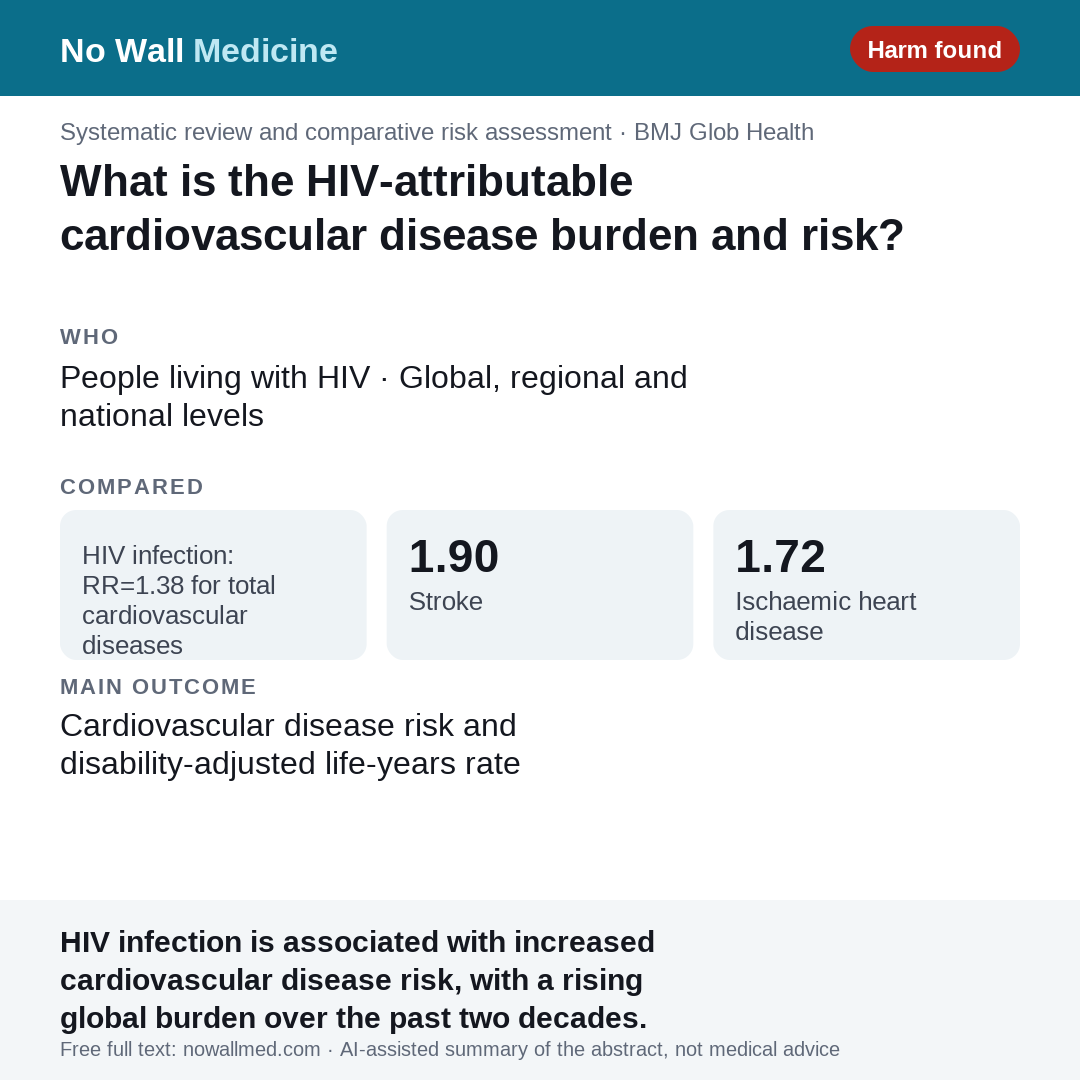
Clinical question: What is the HIV-attributable cardiovascular disease burden and risk?
Why it matters: The temporal trends in the global and regional burden of cardiovascular diseases specifically attributable to HIV were unknown.
Key points
- Researchers analyzed 35 cohort studies containing 199 effect estimates to assess the link between HIV and cardiovascular diseases.
- HIV was associated with a risk ratio of 1.38 for total cardiovascular diseases and 2.58 for cardiac arrest.
- The global age-standardized rate of disability-adjusted life-years, a measure of disease burden, rose from 3.45 to 9.26 per 100,000 population between 2000 and 2021.
Headline and key points written with AI from the paper’s abstract, with every number checked against it. Read the paper before relying on them.
Was this summary helpful?
Abstract
Background
People living with HIV (PLWH) face a significantly elevated risk of cardiovascular diseases (CVDs). This study aims to quantify temporal trends in HIV-attributable CVD burden at global, regional and national levels using a comparative risk assessment framework. Methods
We systematically searched PubMed, Embase and MEDLINE for cohort studies from inception to 28 October 2024, assessing HIV infection and CVD risk. Pooled risk ratios (RRs) for total and subtype-specific CVDs were estimated using random-effects meta-analysis. Based on pooled RRs and HIV prevalence data from the Global Burden of Disease (GBD) 2021 study, we calculated population attributable fractions (PAFs) from 1990 to 2011. These PAFs were applied to GBD disability-adjusted life-years (DALYs) to estimate the age-standardised DALYs rate (ASDRs) of CVDs attributable to HIV by sex, region and year between 2000 and 2021. Findings
35 cohort studies with 199 effect estimates were included. HIV infection was associated with increased risk of total CVDs (RR=1.38), stroke (1.90), ischaemic stroke (1.31), haemorrhagic stroke (2.04), ischaemic heart disease (1.72), myocardial infarction (1.60), heart failure (1.71), peripheral vascular disease (1.19) and cardiac arrest (2.58). Subgroup analyses showed higher ischaemic stroke risk in females and increased CVD risk among PLWH with low CD4+ or high viral load. From 1990 to 2011, the global PAF for total CVDs attributable to HIV rose from 0.0814% to 0.2244%. Global ASDR attributable to HIV nearly tripled, increasing from 3.45 to 9.26 per 100 000 population between 2000 and 2021, with stroke and ischaemic heart disease contributing most. The burden was highest in low-Sociodemographic Index regions, particularly southern Africa; in 2021, Lesotho and Eswatini had the highest ASDRs. Interpretation
HIV-attributable CVD burden has risen substantially over the past two decades, with marked concentration in the African Region. Integrating CVD screening and management into HIV care is urgently needed in high-prevalence settings.
Abstract reproduced under the article’s CC BY NC licence.
Subject terms
Cite this article
Luo Z, Tang K, Ying J, et al. HIV and cardiovascular diseases: a systematic review and comparative risk assessment study. BMJ Glob Health. 2026. doi:10.1136/bmjgh-2025-022324
Spotted a mistake? Suggest a correction