Home-based exercise programs were associated with lower disability and better physical function after heart valve replacement
Home-Based Rehabilitation After Transcatheter Aortic Valve Replacement (REHAB-TAVR): A Pilot Randomized Controlled Trial
Pilot randomized controlled trialBenefit found
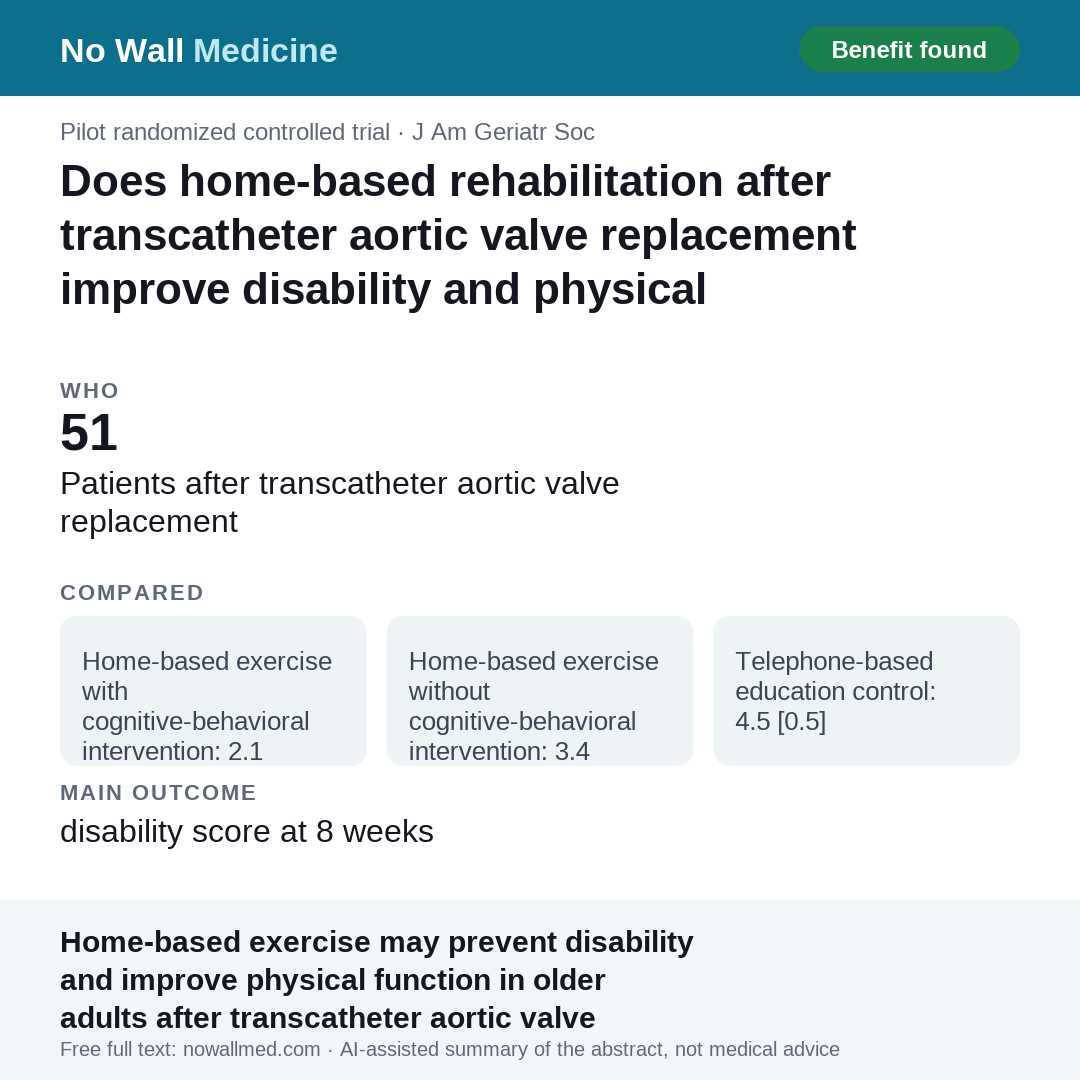
Does home-based rehabilitation after transcatheter aortic valve replacement improve disability and physical function?
Who
51
Patients after transcatheter aortic valve replacement
Compared
Home-based exercise with cognitive-behavioral intervention: 2.1 [0.4]
Home-based exercise without cognitive-behavioral intervention: 3.4 [0.5]
Telephone-based education control: 4.5 [0.5]
Main outcome
disability score at 8 weeks
Bottom line: Home-based exercise may prevent disability and improve physical function in older adults after transcatheter aortic valve replacement.
J Am Geriatr Soc · 2025-04-02Download image
Clinical question: Does home-based rehabilitation after transcatheter aortic valve replacement improve disability and physical function?
Why it matters: The benefit of early cardiac rehabilitation after transcatheter aortic valve replacement is not well established.
Key points
- Researchers randomized 51 patients after transcatheter aortic valve replacement to receive home exercise with cognitive-behavioral intervention, home exercise alone, or telephone-based education.
- At 8 weeks, combined home exercise groups had lower disability scores of 2.6 [0.3] and 4.5 [0.5] and higher physical function scores of 9.5 [0.6] and 6.5 [0.8] compared to education.
- Adherence to at least 5 of 8 sessions was 83.3% in the group with cognitive-behavioral intervention, 58.8% in the exercise-only group, and 52.6% in the education group.
Headline and key points written with AI from the paper’s abstract, with every number checked against it. Read the paper before relying on them.
Topics
Cite this article
Shi SM, Rapley FA, Margulis H, Laham RJ, Guibone K, Percy E. Home-Based Rehabilitation After Transcatheter Aortic Valve Replacement (REHAB-TAVR): A Pilot Randomized Controlled Trial. J Am Geriatr Soc. 2025. doi:10.1111/jgs.19456
Spotted a mistake? Suggest a correction
Top studies every Monday
The week’s key trials and guidelines in your specialties, plus any topics you follow. By email, free.
Get the weekly digest