Tailored home-based intervention reduced the rate of falls in people living in the community after stroke
Home based, tailored intervention to reduce rate of falls after stroke (FAST): randomised trial
Two armed, randomised trialBenefit found
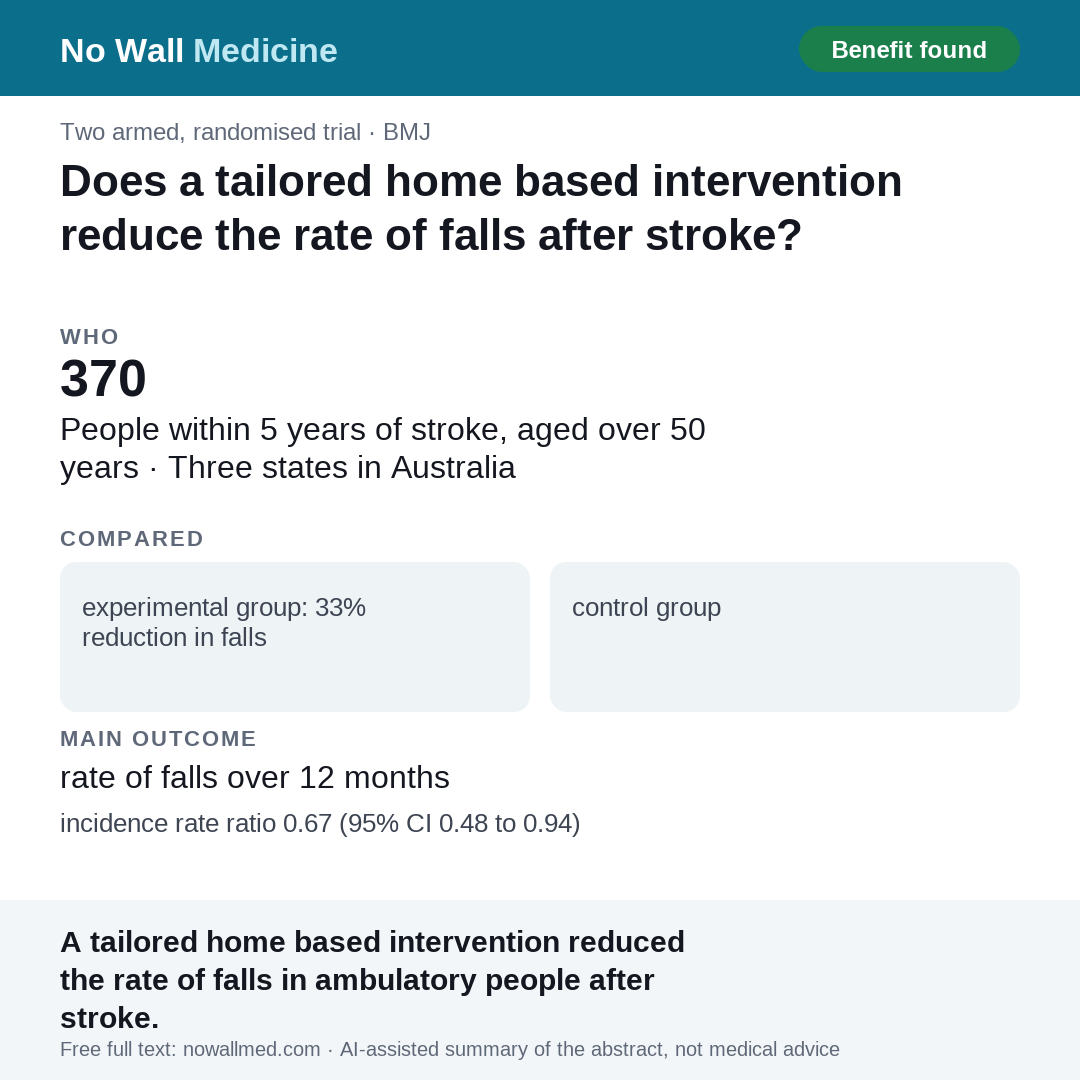
Does a tailored home based intervention reduce the rate of falls after stroke?
Who
370
People within 5 years of stroke, aged over 50 years · Three states in Australia
Compared
experimental group: 33% reduction in falls
control group
Main outcome
rate of falls over 12 months
Result: incidence rate ratio 0.67 (95% CI 0.48 to 0.94)
Bottom line: A tailored home based intervention reduced the rate of falls in ambulatory people after stroke.
BMJ · 2026-03-24Download image
Clinical question: Does a tailored home based intervention reduce the rate of falls after stroke?
Why it matters: There is a need to investigate if a multidisciplinary, home-based, tailored intervention can effectively reduce the rate of falls after a stroke.
Key points
- Researchers studied 370 people aged over 50 who were living in the community within 5 years of a stroke.
- The tailored home intervention resulted in a 33% reduction in the rate of falls over 12 months compared to usual care.
- The intervention also led to improvements in walking speed, balance, self-efficacy, and community participation.
Headline and key points written with AI from the paper’s abstract, with every number checked against it. Read the paper before relying on them.
Abstract
Objective
To investigate the effectiveness of a multidisciplinary, home based, tailored intervention to reduce falls after stroke. Design
Two armed, randomised trial. Setting
Three states in Australia. Participants
People within 5 years of stroke, aged >50 years, discharged from formal rehabilitation to the community, and able to walk 10 m across flat ground with or without an aid. Those with moderate-to-severe receptive aphasia or walking speed >1.4 m/s without falls in the previous year were excluded. Intervention
Over 6 months, the experimental group received a habit forming functional exercise, home fall hazard reduction, and goal directed community mobility coaching; the control group received usual care. Physiotherapist and occupational therapist dyadic teams worked collaboratively to deliver the intervention. Main outcome measures
The primary outcome was rate of falls over 12 months. Secondary outcomes were proportion of participants having a fall, community participation, self-efficacy, balance, mobility, physical activity, activities of daily living, depression, and health related quality of life. Results
Between August 2019 and December 2023, 370 people with stroke were enrolled. At 12 months, a significant between group difference was seen in the rate of falls in favour of the experimental group, representing a 33% reduction in falls (incidence rate ratio 0.67, 95% confidence interval (CI) 0.48 to 0.94; P=0.02). No significant between group difference was seen in the number of participants having a fall (absolute risk reduction 0.03, 95% CI -0.07 to 0.13; P=0.52). The main between group differences in favour of the experimental group were in community participation (Late Life Function and Disability Instrument disability limitation: mean difference 3% (95% CI 1% to 6%); P=0.02), self-efficacy (mean difference 0.6 (0.2 to 1.0); P=0.004), mobility (fast walking speed: mean difference 0.13 (0.06 to 0.19) m/s (P<0.001); preferred walking speed: 0.06 (0.02 to 0.10) m/s (P=0.02)), and balance (Step Test: mean difference 0.06 (0.01 to 0.12) steps/s; P=0.03). Conclusion
A tailored intervention prevented falls in community dwelling, ambulatory people with stroke. The decrease in the rate of falls was underpinned by clinically worthwhile improvements in self-efficacy, mobility, community participation, and balance. Trial registration
Australian New Zealand Clinical Trials Registry ACTRN12619001114134.
Abstract reproduced under the article’s CC BY NC licence.
Topics
Cite this article
Clemson L, Scrivener K, Lannin N, Ada L, Day S, Lin I. Home based, tailored intervention to reduce rate of falls after stroke (FAST): randomised trial. BMJ. 2026. doi:10.1136/bmj-2025-085519
Spotted a mistake? Suggest a correction