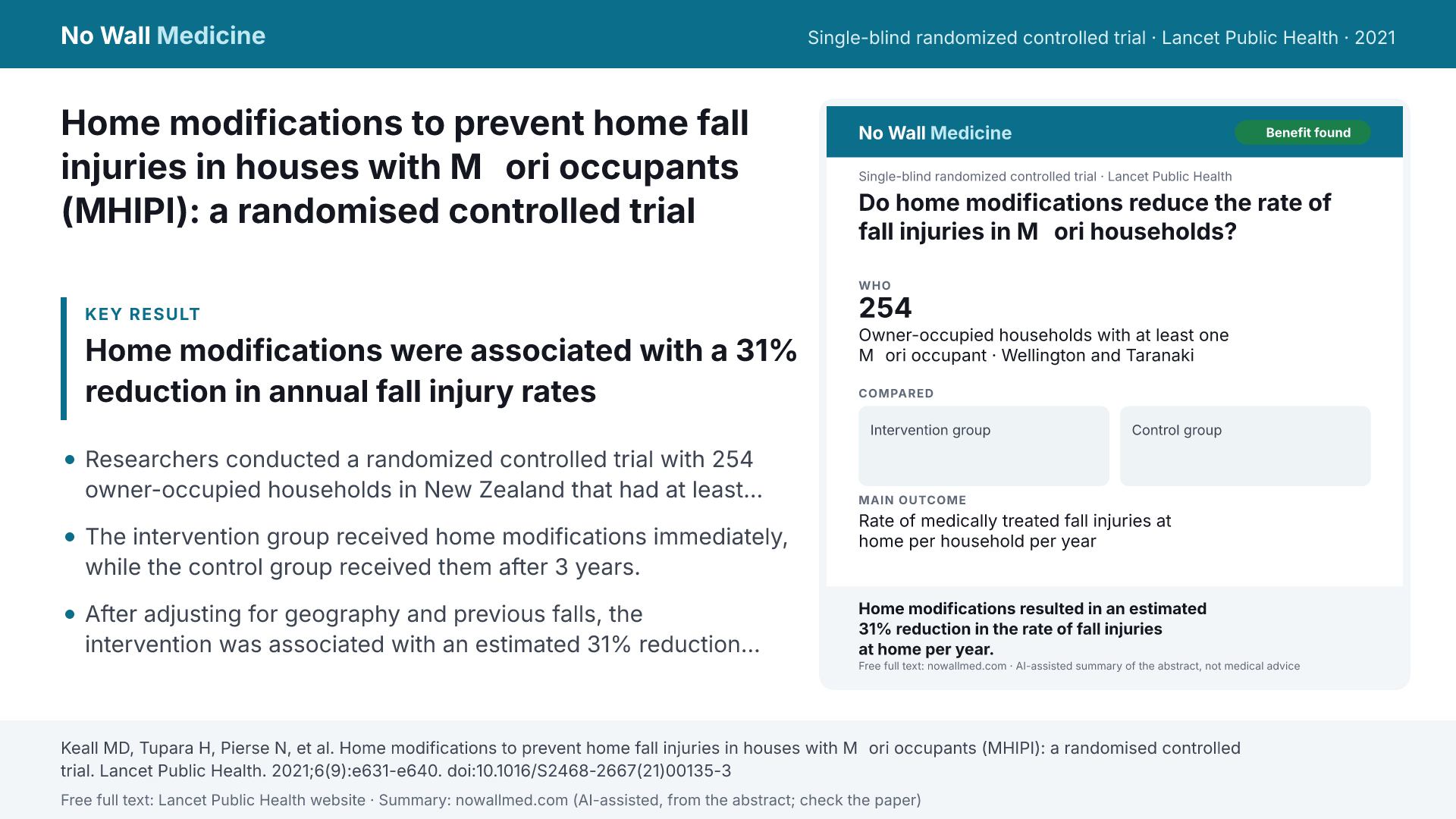
Home modifications were associated with a 31% reduction in annual fall injury rates
Home modifications to prevent home fall injuries in houses with Māori occupants (MHIPI): a randomised controlled trial
Single-blind randomized controlled trialBenefit found
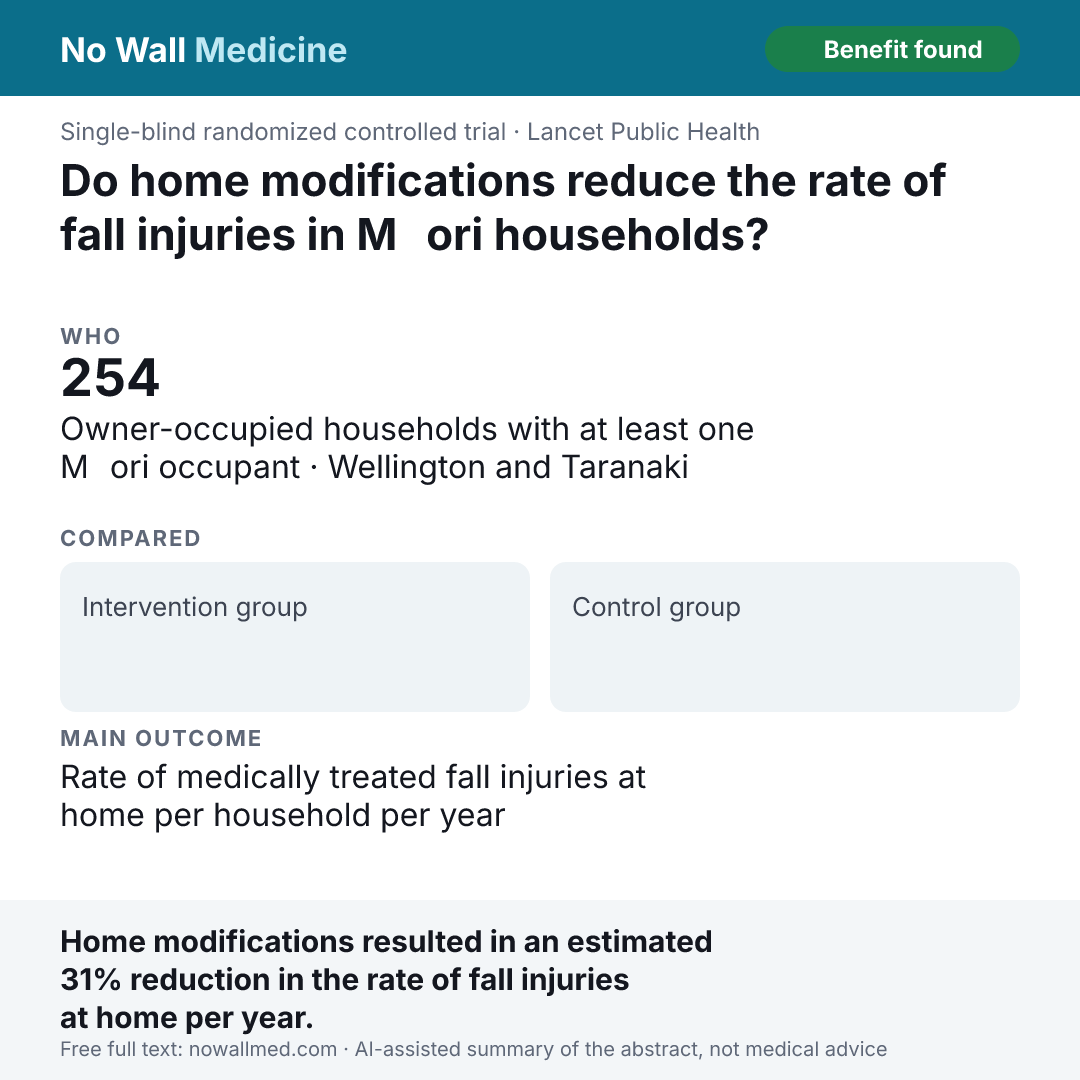
Do home modifications reduce the rate of fall injuries in Māori households?
Who
254
Owner-occupied households with at least one Māori occupant · Wellington and Taranaki regions of New Zealand
Compared
Intervention group
Control group
Main outcome
Rate of medically treated fall injuries at home per household per year
Result: adjusted relative rate 0·69 (95% CI 0·47-1·00)
Bottom line: Home modifications resulted in an estimated 31% reduction in the rate of fall injuries at home per year.
Lancet Public Health · 2021-08-07 · Funded by Health Research Council of New Zealand · ACTRN12613000148774
Headline and visual abstract written with AI from the paper’s abstract, with every number checked against it. Read the paper before relying on them.
Was this summary helpful?
Abstract
Background
As with many Indigenous populations internationally, Māori in New Zealand suffer health inequity. We aimed to assess the rate of fall injuries at home with and without home modifications in houses with Māori occupants. Methods
We did a single-blind randomised controlled trial in the Wellington and Taranaki regions of New Zealand and enrolled owner-occupied households with at least one Māori occupant. Only households who stated they intended to live at that address for the subsequent 3 years were eligible for participation. We randomly assigned (1:1) households to either the intervention group, who received home modifications (handrails for outside steps and internal stairs, grab rails for bathrooms, outside lighting, repairs to window catches, high-visibility and slip-resistant edging for outside steps, fixing of lifted edges of carpets and mats, non-slip bath mats, and slip-resistant surfacing for outside areas such as decks) immediately, or the control group, who received the modifications 3 years later. Data on home injuries were obtained from the Accident Compensation Corporation and coded by study team members, who were masked to study group allocation. The primary outcome was the rate of medically treated fall injuries at home per household per year, analysed according to intention to treat. This Māori Home Injury Prevention Intervention (MHIPI) trial is now completed, and is registered with the Australian New Zealand Clinical Trials Registry, ACTRN12613000148774. Findings
Between Sept 3, 2013, and Oct 1, 2014, 824 households were assessed for eligibility and 254 were enrolled, of which 126 (50%) were assigned to the intervention group and 128 (50%) were assigned to the control group. After adjustment for previous falls and geographical region, there was an estimated 31% reduction in the rate of fall injuries at home per year exposed to the intervention compared with households in the control group (adjusted relative rate 0·69 [95% CI 0·47-1·00]). Interpretation
Low-cost home modifications and repairs can be an effective means to reduce injury disparities. The high prevalence of modifiable safety issues in Māori homes merits considerable policy and community effort. Funding
Health Research Council of New Zealand.
Abstract reproduced under the article’s CC BY licence.
Subject terms
Cite this article
Keall MD, Tupara H, Pierse N, et al. Home modifications to prevent home fall injuries in houses with Māori occupants (MHIPI): a randomised controlled trial. Lancet Public Health. 2021;6(9):e631-e640. doi:10.1016/S2468-2667(21)00135-3
Spotted a mistake? Suggest a correction