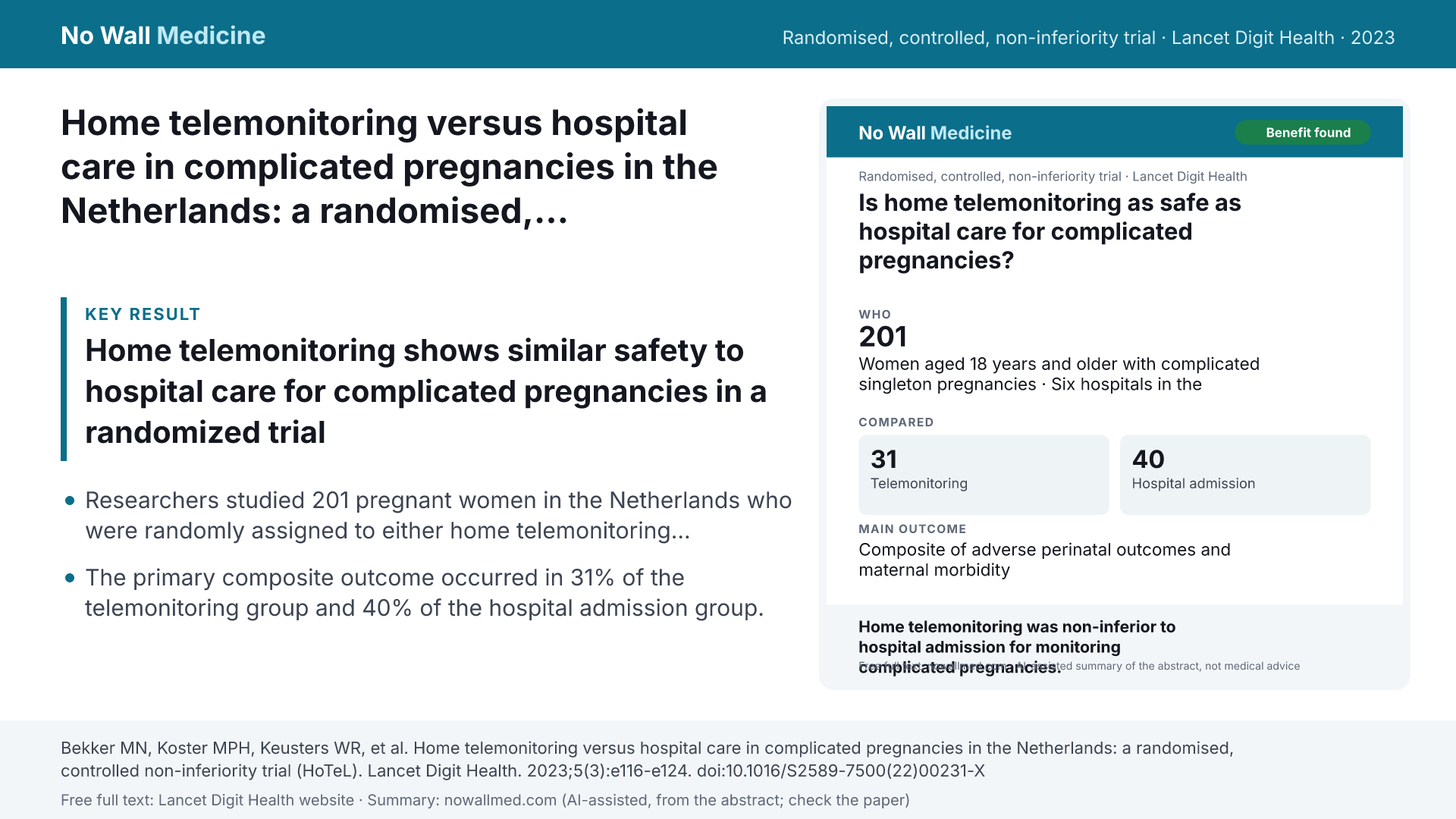
Home telemonitoring shows similar safety to hospital care for complicated pregnancies in a randomized trial
Home telemonitoring versus hospital care in complicated pregnancies in the Netherlands: a randomised, controlled non-inferiority trial (HoTeL)
Randomised, controlled, non-inferiority trialBenefit found
Is home telemonitoring as safe as hospital care for complicated pregnancies?
Who
201
Women aged 18 years and older with complicated singleton pregnancies · Six hospitals in the Netherlands
Compared
31Telemonitoring (31%)
40Hospital admission (40%)
Main outcome
Composite of adverse perinatal outcomes and maternal morbidity
Result: risk difference 10·3% (95% CI -22·4 to 2·2)
Bottom line: Home telemonitoring was non-inferior to hospital admission for monitoring complicated pregnancies.
Funded by: Stichting Achmea Gezondheidszorg and ICT Healthcare Technology Solutions
Lancet Digit Health · 2023-02-24 · Save PNG
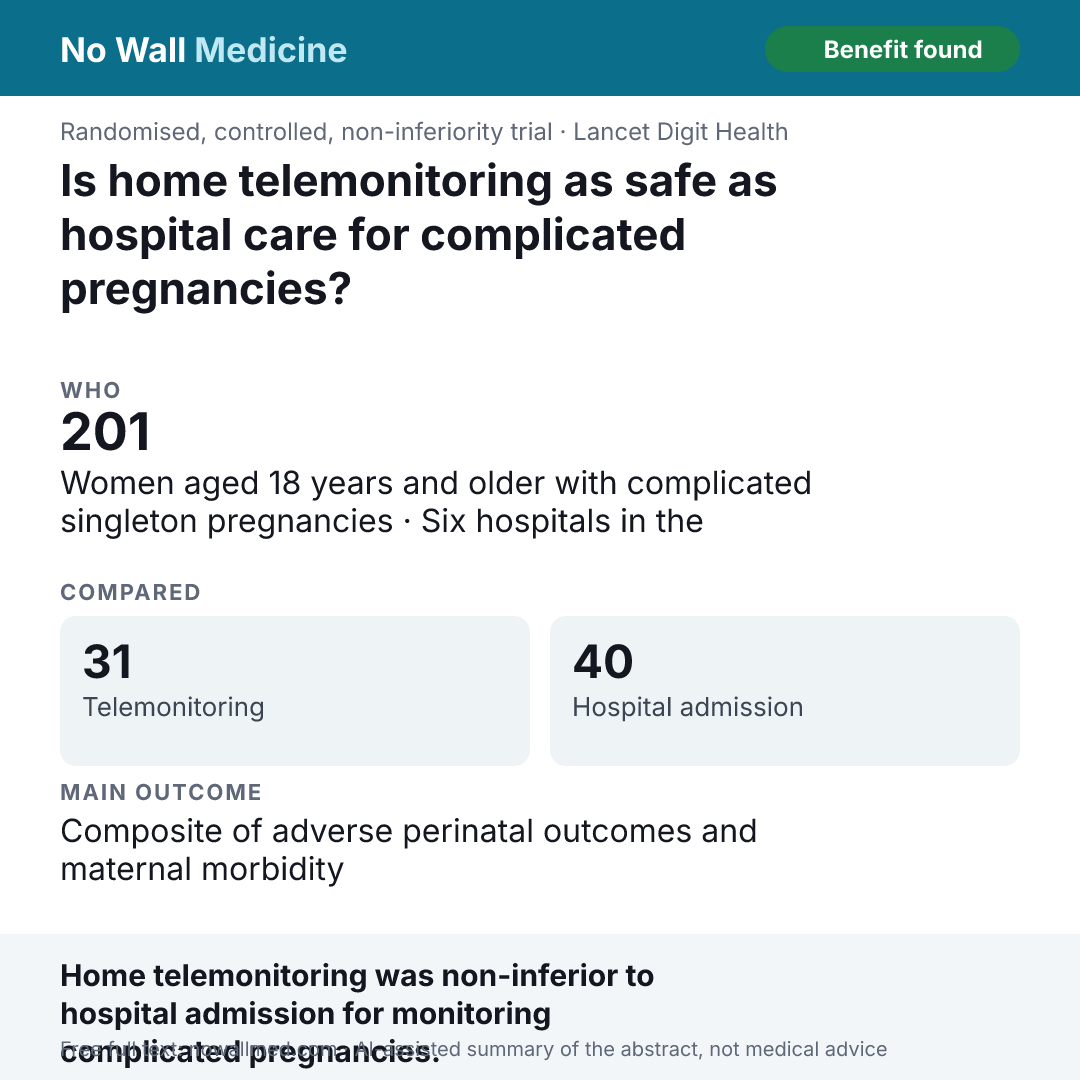
Clinical question: Is home telemonitoring as safe as hospital care for complicated pregnancies?
Key points
- Researchers studied 201 pregnant women in the Netherlands who were randomly assigned to either home telemonitoring or hospital admission for various pregnancy complications.
- The primary composite outcome occurred in 31% of the telemonitoring group and 40% of the hospital admission group.
- The adjusted risk difference for the primary outcome was 10.3% (95% CI -22.4 to 2.2) lower in the telemonitoring group, which was within the 10% non-inferiority margin.
Headline and key points written with AI from the paper’s abstract, with every number checked against it. Read the paper before relying on them.
Was this summary helpful?
Abstract
Background
Women with complicated pregnancies often require hospital admission. Telemonitoring at home is a promising alternative that fulfils a worldwide need in obstetric health care. Moreover, the COVID-19 pandemic has accelerated the transformation to digital care. The aim of this study was to evaluate safety, clinical effectiveness, patient satisfaction, and costs of home telemonitoring against hospital care in complicated pregnancies. Methods
We did a multicentre, randomised, controlled, non-inferiority trial in six hospitals (four general teaching hospitals and two university hospitals) in the Netherlands (located in Utrecht, Amsterdam, and Groningen). Women aged 18 years and older with singleton pregnancies (>26 weeks gestation) requiring monitoring for pre-eclampsia, fetal growth restriction, fetal anomaly, preterm rupture of membranes, reduced fetal movements, or history of fetal death were included in the study. Participants were randomly assigned to either hospital admission or telemonitoring in (1:1), stratified for the six diagnoses for inclusion and the six centres of inclusion, using block randomisation (block sizes of four and six). When assigned to telemonitoring, participants went home with devices for cardiotocography and blood pressure measurements and had daily contact with their care providers after digitally sending their home measurements. When assigned to hospital admission, participants received care as usual on the ward until the postpartum period. The primary outcome was a composite of adverse perinatal outcomes assessed after delivery, including mortality; an Apgar score below 7 after 5 min or an umbilical arterial pH at birth below 7·05; maternal morbidity; admission of the newborn to the neonatal intensive care unit; and rate of caesarean section. The primary outcome was assessed in the intention-to-treat population. The non-inferiority margin for the primary outcome was a 10% absolute increase in composite primary endpoint based on baseline 20% incidence. The study was registered at the Dutch Trial Registration (NL5888) and is now closed to new participants. Findings
From Dec 1, 2016, to Nov 30, 2019, 201 pregnant women were randomly assigned to an intervention procedure. 101 women were allocated to the telemonitoring group and 100 to the hospital admission group. One participant in the telemonitoring group withdrew consent before the intervention was initiated, and 100 participants were analysed for the primary outcome. In the hospital admission group, four participants did not receive the allocated intervention because they did not accept hospital admission. 100 participants in each group were analysed for the primary outcome according to the intention-to-treat principal. No participants were lost to follow-up. The primary outcome occurred in 31 (31%) of 100 participants in the telemonitoring group and in 40 (40%) of 100 participants in the hospital admission group. Adjusted for centre of inclusion, diagnosis, and nulliparity, the risk difference in primary outcome between both groups was 10·3% (95% CI -22·4 to 2·2) lower in the telemonitoring group, below the pre-defined non-inferiority margin of 10% absolute increase. A similar distribution for each of the individual components within the composite primary outcome was seen between groups. Five serious adverse events were reported: one neonatal death in the hospital admission group, in addition to one intra-uterine fetal death, two neonatal deaths, and one case of eclampsia in the telemonitoring group, all unrelated to the study. Interpretation
This non-inferiority trial shows the first evidence that telemonitoring might be as safe as hospital admission for monitoring complicated pregnancies. Funding
Stichting Achmea Gezondheidszorg and ICT Healthcare Technology Solutions.
Abstract reproduced under the article’s CC BY licence.
Subject terms
Headline, design, result, key points, caveat and citation as plain text.
Cite this article
Bekker MN, Koster MPH, Keusters WR, et al. Home telemonitoring versus hospital care in complicated pregnancies in the Netherlands: a randomised, controlled non-inferiority trial (HoTeL). Lancet Digit Health. 2023;5(3):e116-e124. doi:10.1016/S2589-7500(22)00231-X
Spotted a mistake? Suggest a correction