Systematic review shows ethnic minorities and rural residents are under-represented in hospice care
Hospice care access inequalities: a systematic review and narrative synthesis
Systematic literature review and narrative synthesisHarm found
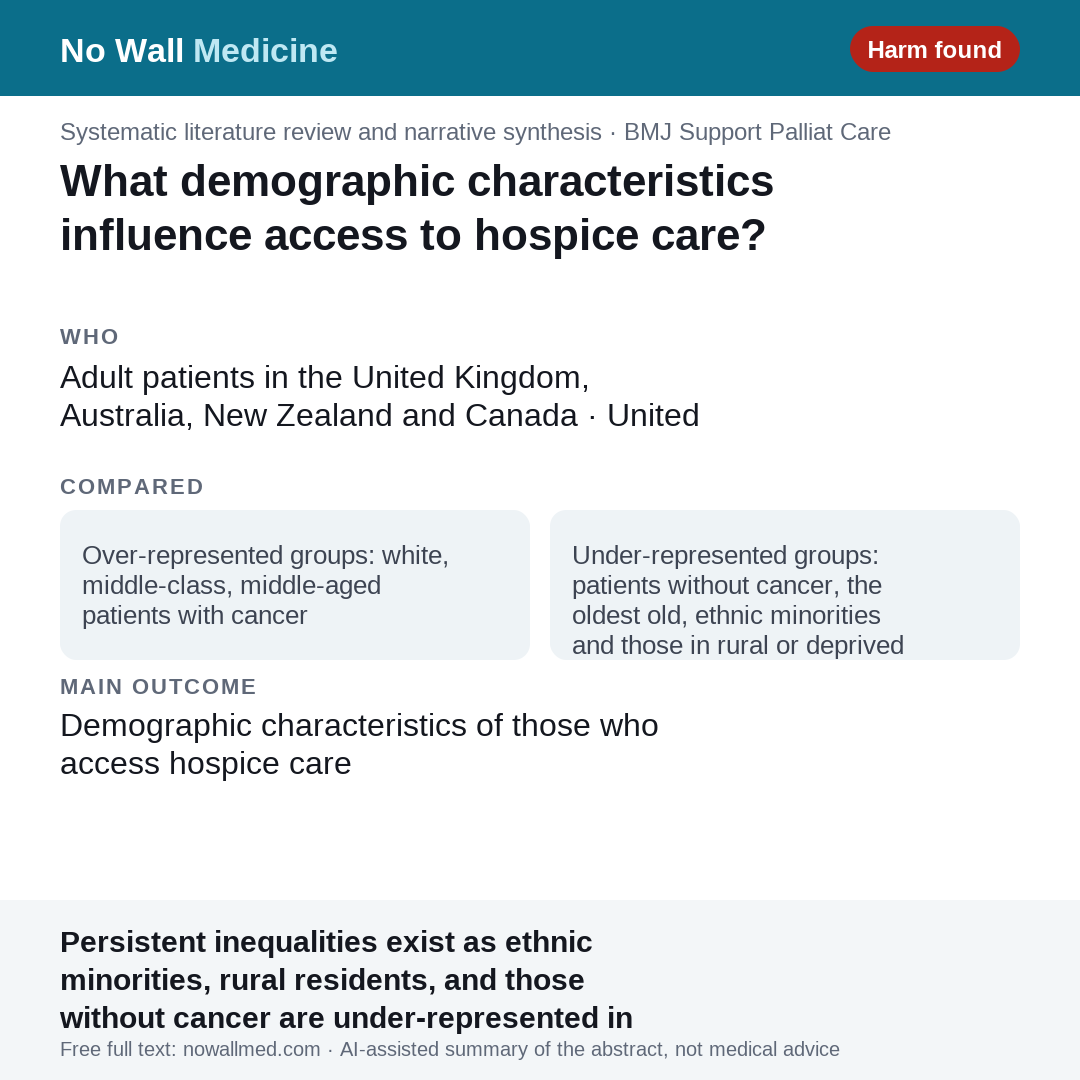
What demographic characteristics influence access to hospice care?
Who
Adult patients in the United Kingdom, Australia, New Zealand and Canada · United Kingdom, Australia, New Zealand and Canada
Compared
Over-represented groups: white, middle-class, middle-aged patients with cancer
Under-represented groups: patients without cancer, the oldest old, ethnic minorities and those in rural or deprived areas
Main outcome
Demographic characteristics of those who access hospice care
Bottom line: Persistent inequalities exist as ethnic minorities, rural residents, and those without cancer are under-represented in hospice care.
Limitation: Limited literature concerning access for LGBTQ+ community, homeless people, and specific medical conditions.
BMJ Support Palliat Care · 2021-02-19Download image
Clinical question: What demographic characteristics influence access to hospice care?
Why it matters: It is unknown which specific demographic characteristics are linked to higher or lower rates of hospice care access across different global regions.
Key points
- Researchers reviewed 130 peer-reviewed studies from the United Kingdom, Australia, New Zealand, and Canada published between January 1987 and September 2019.
- Hospice use was associated with being white, middle-class, middle-aged, and having a cancer diagnosis.
- Patients without cancer, the oldest old, ethnic minorities, and those in rural or deprived areas were under-represented in hospice populations.
Headline and key points written with AI from the paper’s abstract, with every number checked against it. Read the paper before relying on them.
Was this summary helpful?
Abstract
Background
Inequalities in access to hospice care is a source of considerable concern; white, middle-class, middle-aged patients with cancer have traditionally been over-represented in hospice populations. Objective
To identify from the literature the demographic characteristics of those who access hospice care more often, focusing on: diagnosis, age, gender, marital status, ethnicity, geography and socioeconomic status. Design
Systematic literature review and narrative synthesis. Method
Searches of Medline, PsycINFO, CINAHL, Web of Science, Assia and Embase databases from January 1987 to end September 2019 were conducted. Inclusion criteria were peer-reviewed studies of adult patients in the UK, Australia, New Zealand and Canada, receiving inpatient, day, outpatient and community hospice care. Of the 45 937 titles retrieved, 130 met the inclusion criteria. Narrative synthesis of extracted data was conducted. Results
An extensive literature search demonstrates persistent inequalities in hospice care provision: patients without cancer, the oldest old, ethnic minorities and those living in rural or deprived areas are under-represented in hospice populations. The effect of gender and marital status is inconsistent. There is a limited literature concerning hospice service access for the LGBTQ+ community, homeless people and those living with HIV/AIDS, diabetes and cystic fibrosis. Conclusion
Barriers of prognostic uncertainty, institutional cultures, particular needs of certain groups and lack of public awareness of hospice services remain substantial challenges to the hospice movement in ensuring equitable access for all.
Abstract reproduced under the article’s CC BY NC licence.
Subject terms
Cite this article
Tobin J, Rogers A, Winterburn I, Tullie S, Kalyanasundaram A, Kuhn I. Hospice care access inequalities: a systematic review and narrative synthesis. BMJ Support Palliat Care. 2021. doi:10.1136/bmjspcare-2020-002719
Spotted a mistake? Suggest a correction
Top studies every Monday
The week’s key trials and guidelines in your specialties, plus any topics you follow. By email, free.
Get the weekly digest