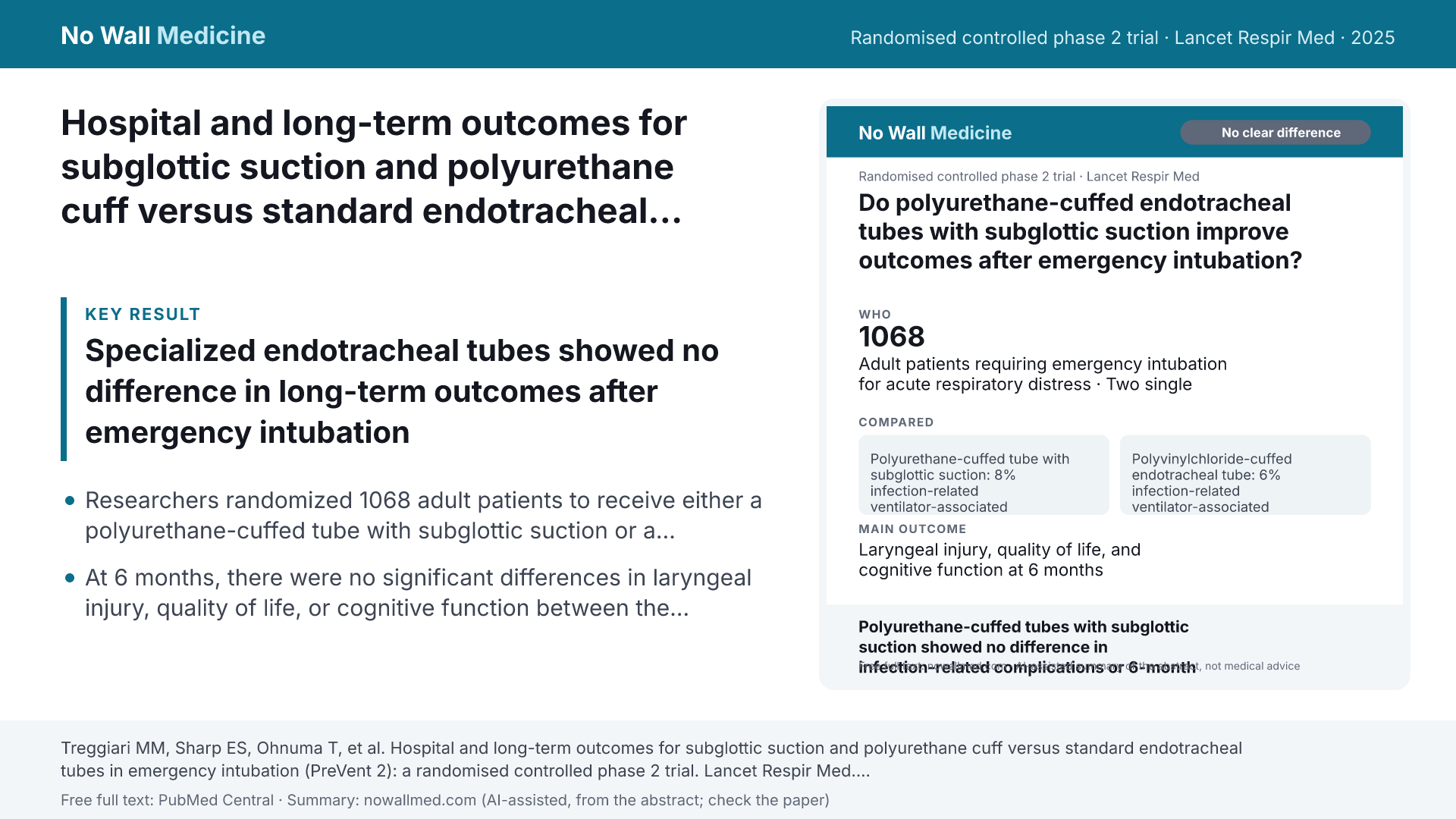
Specialized endotracheal tubes showed no difference in long-term outcomes after emergency intubation
Hospital and long-term outcomes for subglottic suction and polyurethane cuff versus standard endotracheal tubes in emergency intubation (PreVent 2): a randomised controlled phase 2 trial
Randomised controlled phase 2 trialNo clear difference
Do polyurethane-cuffed endotracheal tubes with subglottic suction improve outcomes after emergency intubation?
Who
1068
Adult patients requiring emergency intubation for acute respiratory distress · Two single centres in the United States
Compared
Polyurethane-cuffed tube with subglottic suction: 8% infection-related ventilator-associated complications
Polyvinylchloride-cuffed endotracheal tube: 6% infection-related ventilator-associated complications
Main outcome
Laryngeal injury, quality of life, and cognitive function at 6 months
Result: risk difference 0·02 [95% CI -0·01 to 0·05] for infection-related ventilator-associated complications
Bottom line: Polyurethane-cuffed tubes with subglottic suction showed no difference in infection-related complications or 6-month long-term outcomes.
Limitation: Small number of survivors who provided information on physical and mental status limits conclusions.
Funded by: National Institutes of Health and National Heart, Lung, and Blood Institute
Lancet Respir Med · 2025-11-27 · Save PNG
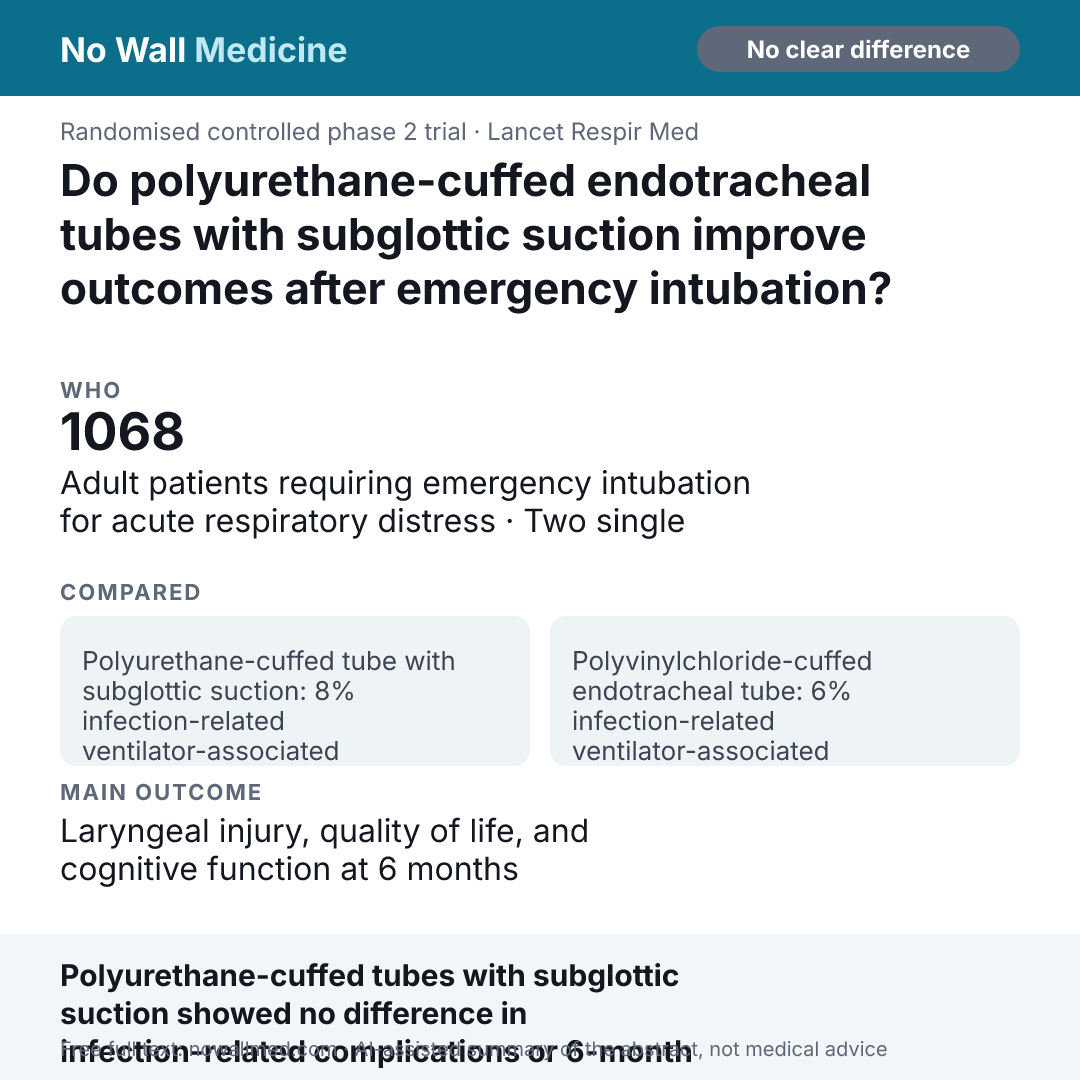
Clinical question: Do polyurethane-cuffed endotracheal tubes with subglottic suction improve outcomes after emergency intubation?
Why it matters: The long-term safety and efficacy of tubes with subglottic suction and polyurethane cuffs are uncertain following emergency intubation.
Key points
- Researchers randomized 1068 adult patients to receive either a polyurethane-cuffed tube with subglottic suction or a standard polyvinylchloride-cuffed tube.
- At 6 months, there were no significant differences in laryngeal injury, quality of life, or cognitive function between the two groups.
- Infection-related ventilator-associated complications occurred in 8% of the suction group and 6% of the standard group.
Limitation the authors note: The small number of survivors who provided information on their physical and mental status limits the conclusions that can be drawn regarding long-term outcome differences.
Headline and key points written with AI from the paper’s abstract, with every number checked against it. Read the paper before relying on them.
Was this summary helpful?
Subject terms
Headline, design, result, key points, caveat and citation as plain text.
Cite this article
Treggiari MM, Sharp ES, Ohnuma T, et al. Hospital and long-term outcomes for subglottic suction and polyurethane cuff versus standard endotracheal tubes in emergency intubation (PreVent 2): a randomised controlled phase 2 trial. Lancet Respir Med. 2026;14(2):141-150. doi:10.1016/S2213-2600(25)00294-2
Spotted a mistake? Suggest a correction