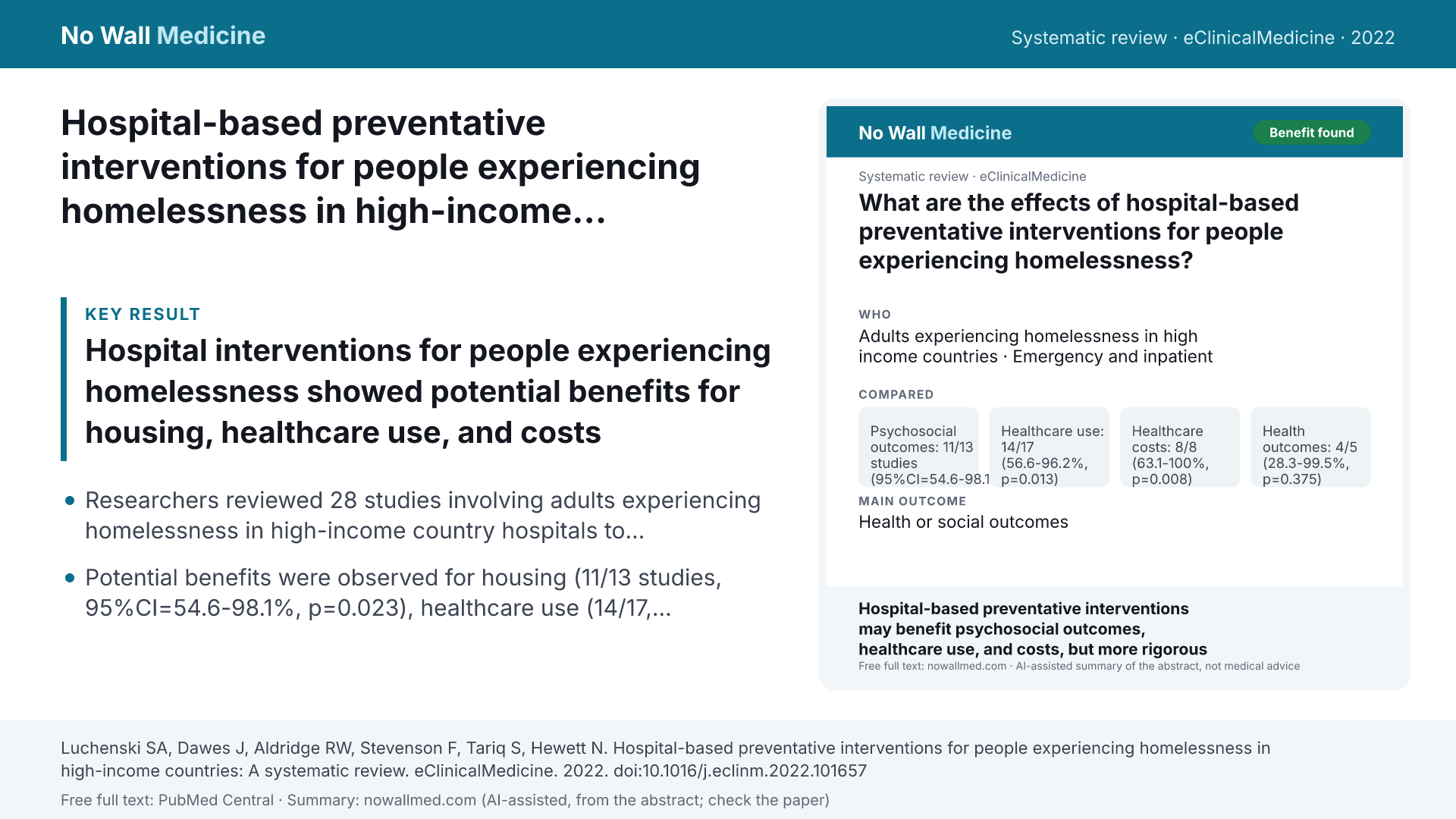
Hospital interventions for people experiencing homelessness showed potential benefits for housing, healthcare use, and costs
Hospital-based preventative interventions for people experiencing homelessness in high-income countries: A systematic review
Systematic reviewBenefit found
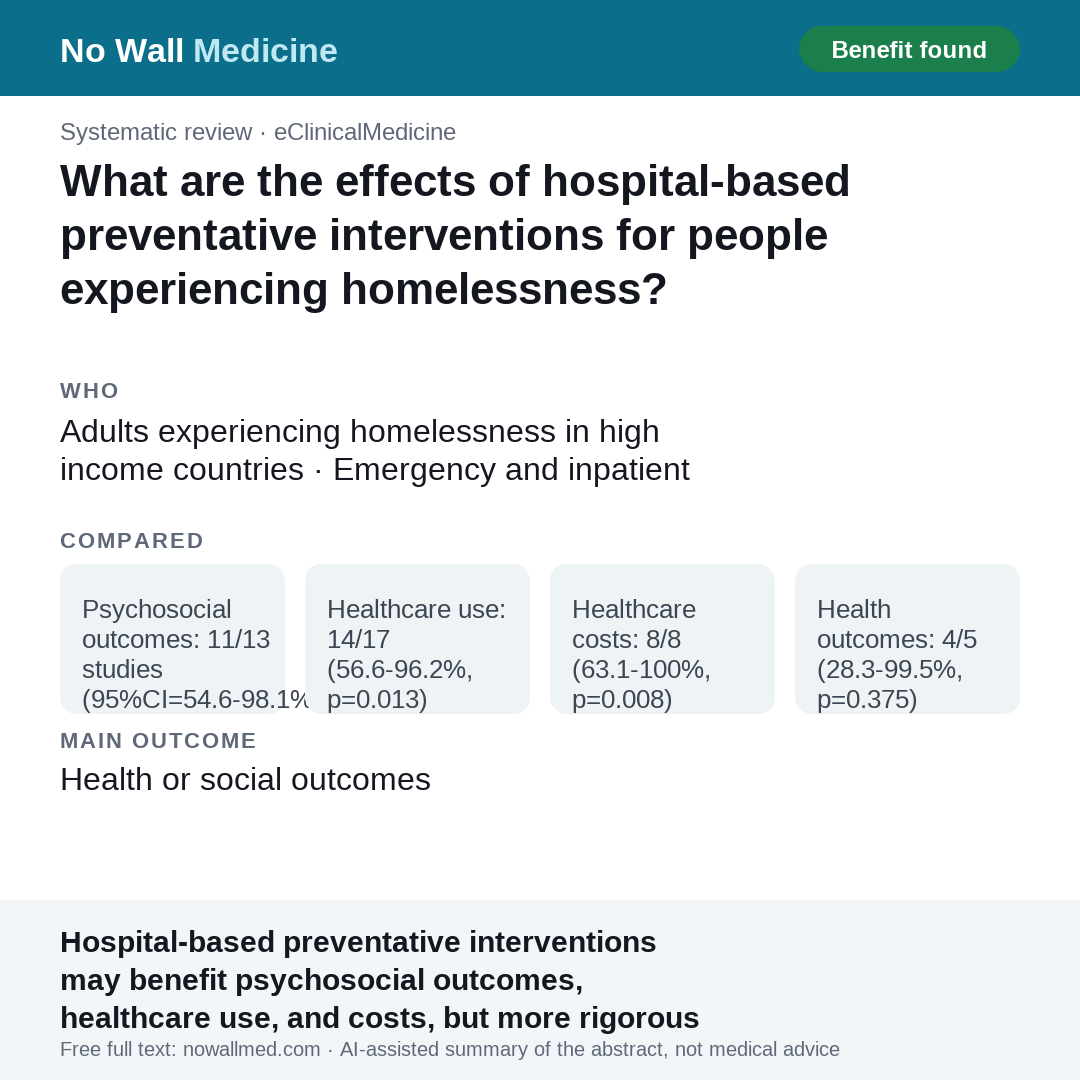
What are the effects of hospital-based preventative interventions for people experiencing homelessness?
Who
Adults experiencing homelessness in high income countries · Emergency and inpatient settings in high income countries
Compared
Psychosocial outcomes: 11/13 studies (95%CI=54.6-98.1%, p=0.023)
Healthcare use: 14/17 (56.6-96.2%, p=0.013)
Healthcare costs: 8/8 (63.1-100%, p=0.008)
Health outcomes: 4/5 (28.3-99.5%, p=0.375)
Main outcome
Health or social outcomes
Bottom line: Hospital-based preventative interventions may benefit psychosocial outcomes, healthcare use, and costs, but more rigorous research is needed.
Funded by: NIHR and Wellcome Trust
eClinicalMedicine · 2022-10-22Download image
Clinical question: What are the effects of hospital-based preventative interventions for people experiencing homelessness?
Why it matters: The effectiveness and types of hospital-based preventative interventions for people experiencing homelessness were not clearly mapped or assessed.
Key points
- Researchers reviewed 28 studies involving adults experiencing homelessness in high-income country hospitals to evaluate various preventative interventions.
- Potential benefits were observed for housing (11/13 studies, 95%CI=54.6-98.1%, p=0.023), healthcare use (14/17, 56.6-96.2%, p=0.013), and healthcare costs (8/8, 63.1-100%, p=0.008).
- Benefits were less likely for health outcomes (4/5, 28.3-99.5%, p=0.375), integration with onward care (2/4, 6.8-93.2%, p=1.000), and feasibility or acceptability (5/6, 35.9-99.6%, p=0.219).
Headline and key points written with AI from the paper’s abstract, with every number checked against it. Read the paper before relying on them.
Was this summary helpful?
Cite this article
Luchenski SA, Dawes J, Aldridge RW, Stevenson F, Tariq S, Hewett N. Hospital-based preventative interventions for people experiencing homelessness in high-income countries: A systematic review. eClinicalMedicine. 2022. doi:10.1016/j.eclinm.2022.101657
Spotted a mistake? Suggest a correction