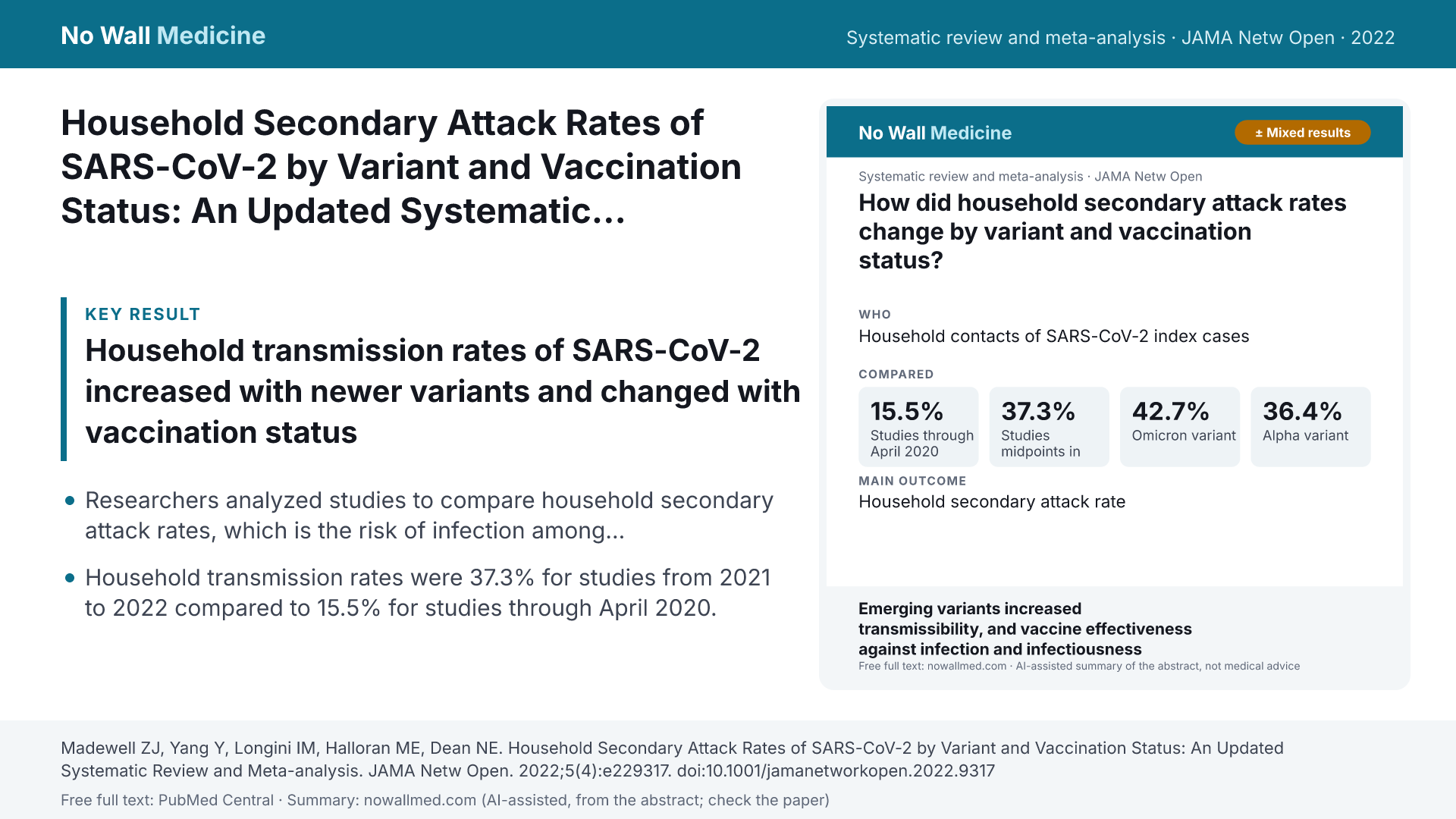
Household transmission rates of SARS-CoV-2 increased with newer variants and changed with vaccination status
Household Secondary Attack Rates of SARS-CoV-2 by Variant and Vaccination Status: An Updated Systematic Review and Meta-analysis
Systematic review and meta-analysisMixed results
How did household secondary attack rates change by variant and vaccination status?
Who
Household contacts of SARS-CoV-2 index cases
Compared
15.5%Studies through April 2020 (95% CI, 13.2% to 18.2%)
37.3%Studies midpoints in 2021 to 2022 (95% CI, 32.7% to 42.1%)
42.7%Omicron variant (95% CI, 35.4% to 50.4%)
36.4%Alpha variant (95% CI, 33.4% to 39.5%)
Main outcome
Household secondary attack rate
Bottom line: Emerging variants increased transmissibility, and vaccine effectiveness against infection and infectiousness decreased from Alpha to Omicron.
JAMA Netw Open · 2022-04-01 · Save PNG
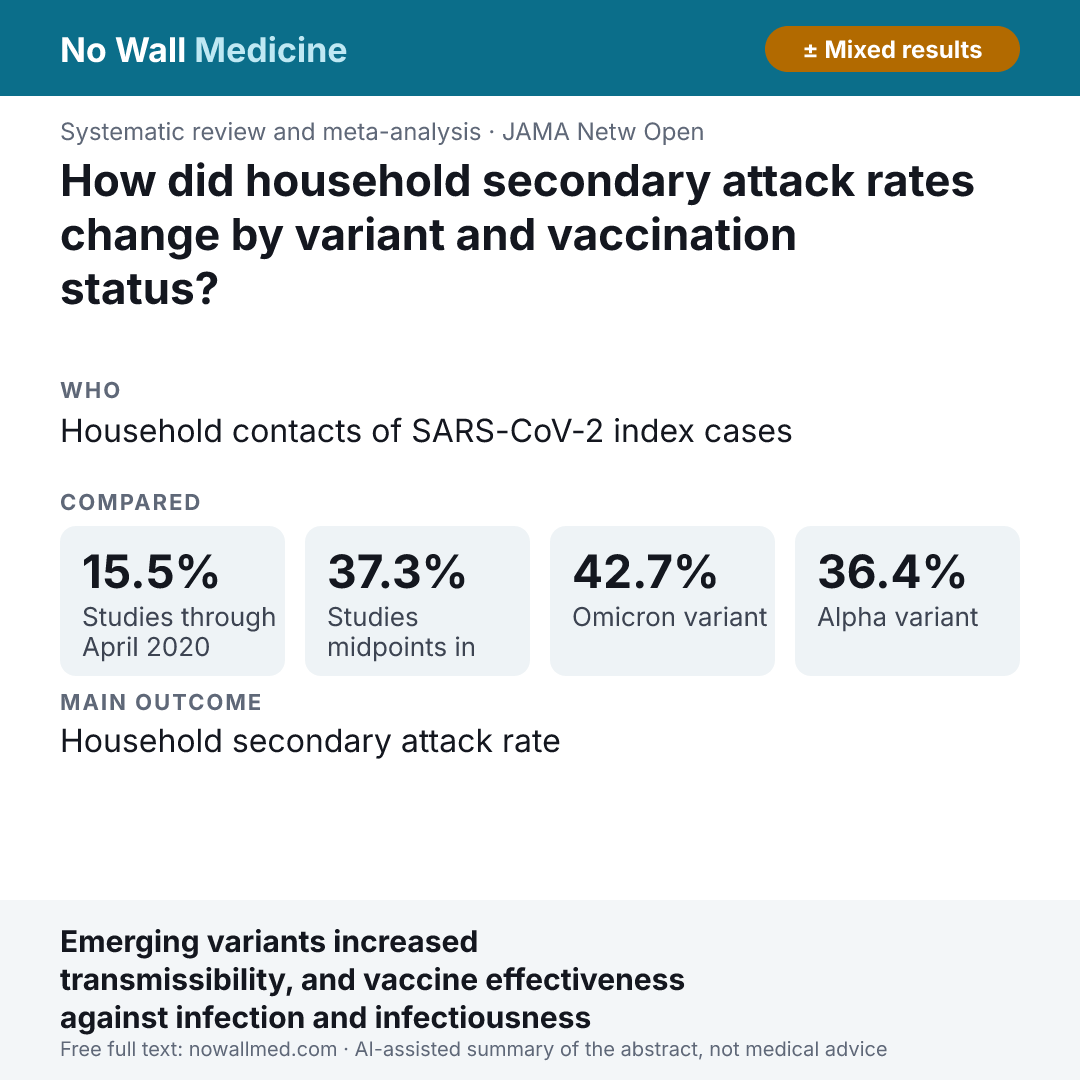
Clinical question: How did household secondary attack rates change by variant and vaccination status?
Key points
- Researchers analyzed studies to compare household secondary attack rates, which is the risk of infection among household members, across different viral variants and vaccination statuses.
- Household transmission rates were 37.3% for studies from 2021 to 2022 compared to 15.5% for studies through April 2020.
- The secondary attack rate was 42.7% for Omicron, 36.4% for Alpha, 29.7% for Delta, and 22.5% for Beta.
Headline and key points written with AI from the paper’s abstract, with every number checked against it. Read the paper before relying on them.
Was this summary helpful?
Subject terms
Headline, design, result, key points, caveat and citation as plain text.
Cite this article
Madewell ZJ, Yang Y, Longini IM, Halloran ME, Dean NE. Household Secondary Attack Rates of SARS-CoV-2 by Variant and Vaccination Status: An Updated Systematic Review and Meta-analysis. JAMA Netw Open. 2022;5(4):e229317. doi:10.1001/jamanetworkopen.2022.9317
Spotted a mistake? Suggest a correction