Housing and Support Intervention and Mortality Among Homeless Adults With Mental Illnesses: A Secondary Analysis of a Randomized Clinical Trial
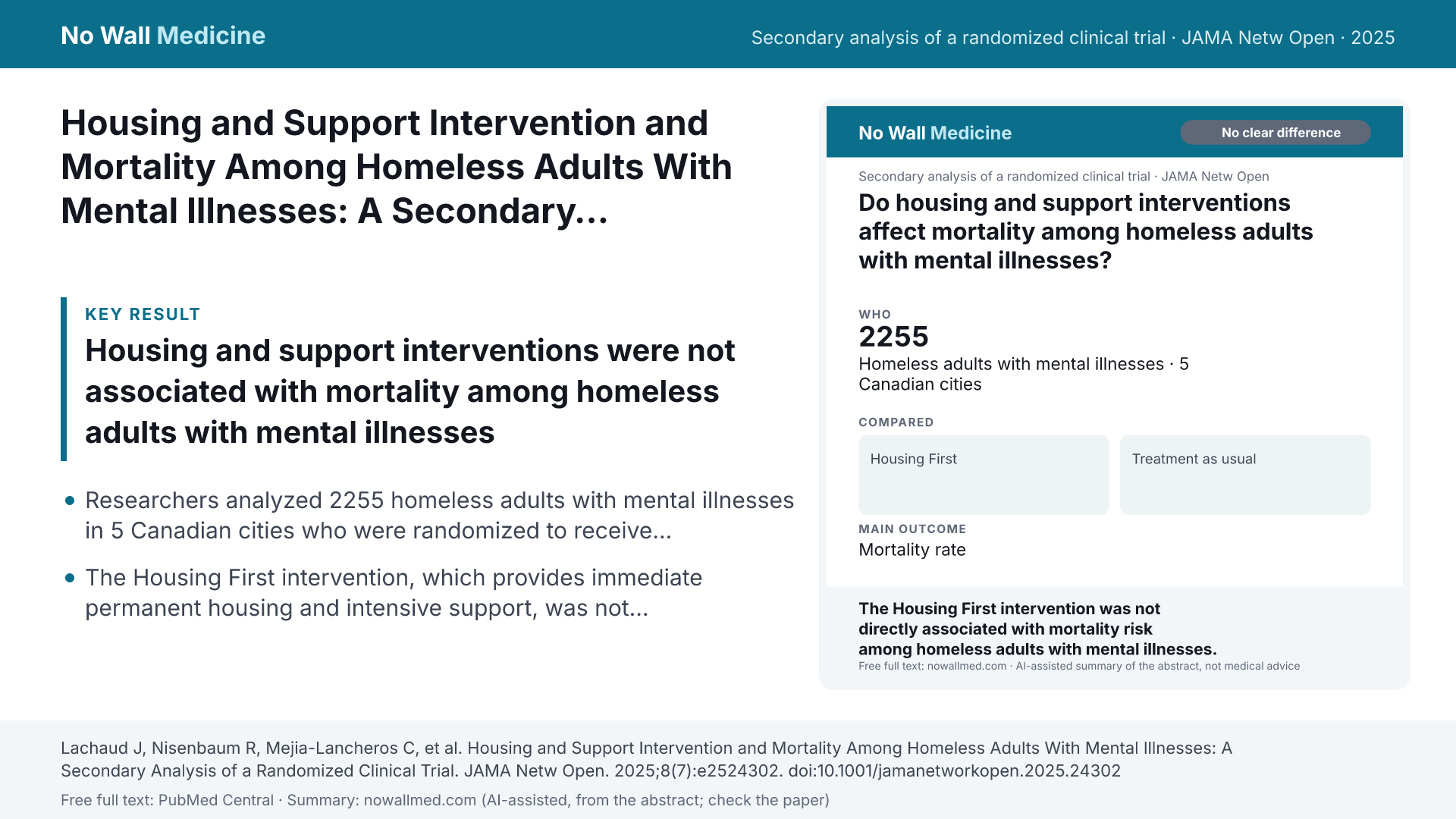
Key result: Housing and support interventions were not associated with mortality among homeless adults with mental illnesses
Secondary analysis of a randomized clinical trialNo clear difference
Do housing and support interventions affect mortality among homeless adults with mental illnesses?
Who
2255
Homeless adults with mental illnesses · 5 Canadian cities
Compared
Housing First
Treatment as usual
Main outcome
Mortality rate
Result: adjusted hazard ratio 0.83 (95% CI 0.43-1.22)
Bottom line: The Housing First intervention was not directly associated with mortality risk among homeless adults with mental illnesses.
JAMA Netw Open · 2025-07-01
Key points
- Researchers analyzed 2255 homeless adults with mental illnesses in 5 Canadian cities who were randomized to receive either Housing First or treatment as usual.
- The Housing First intervention, which provides immediate permanent housing and intensive support, was not associated with different mortality rates compared to treatment as usual.
- Among the 2108 participants successfully linked to health data, the pooled adjusted hazard ratio for mortality was 0.83 (95% CI, 0.43-1.22).
Discussion prompts
- Would these patients look like yours? Who was left out?
- Is the main outcome one that matters to patients?
- Is the difference large enough to change what you do?
Cite: Lachaud J, Nisenbaum R, Mejia-Lancheros C, et al. Housing and Support Intervention and Mortality Among Homeless Adults With Mental Illnesses: A Secondary Analysis of a Randomized Clinical Trial. JAMA Netw Open. 2025;8(7):e2524302. doi:10.1001/jamanetworkopen.2025.24302
Free full text: PubMed Central · Summary and visual abstract: nowallmed.com/a/housing-and-support-intervention-and-mortality-among-homeless-adults-19v4oha/ (AI-assisted from the abstract; check the paper before relying on it).