Housing instability is linked to financial toxicity and medication nonadherence in adults with uncontrolled diabetes
Housing Instability Associated With Cost-Related Nonadherence and Financial Toxicity in People With Uncontrolled Diabetes
Analysis of baseline randomized controlled trial dataHarm found
Is housing instability associated with cost-related nonadherence and financial toxicity in uncontrolled diabetes?
Who
600
Adults with uncontrolled diabetes and cost-related barriers to care
Compared
Housing instability: adjusted odds ratio 1.64 (95% CI 1.05, 2.56) for nonadherence
No housing instability
Main outcome
Cost-related nonadherence and financial toxicity
Result: adjusted odds ratio 1.64 (95% CI 1.05, 2.56)
Bottom line: Housing instability is associated with financial toxicity and cost-related nonadherence in adults with uncontrolled diabetes.
Diabetes Care · 2026-08-13Download image
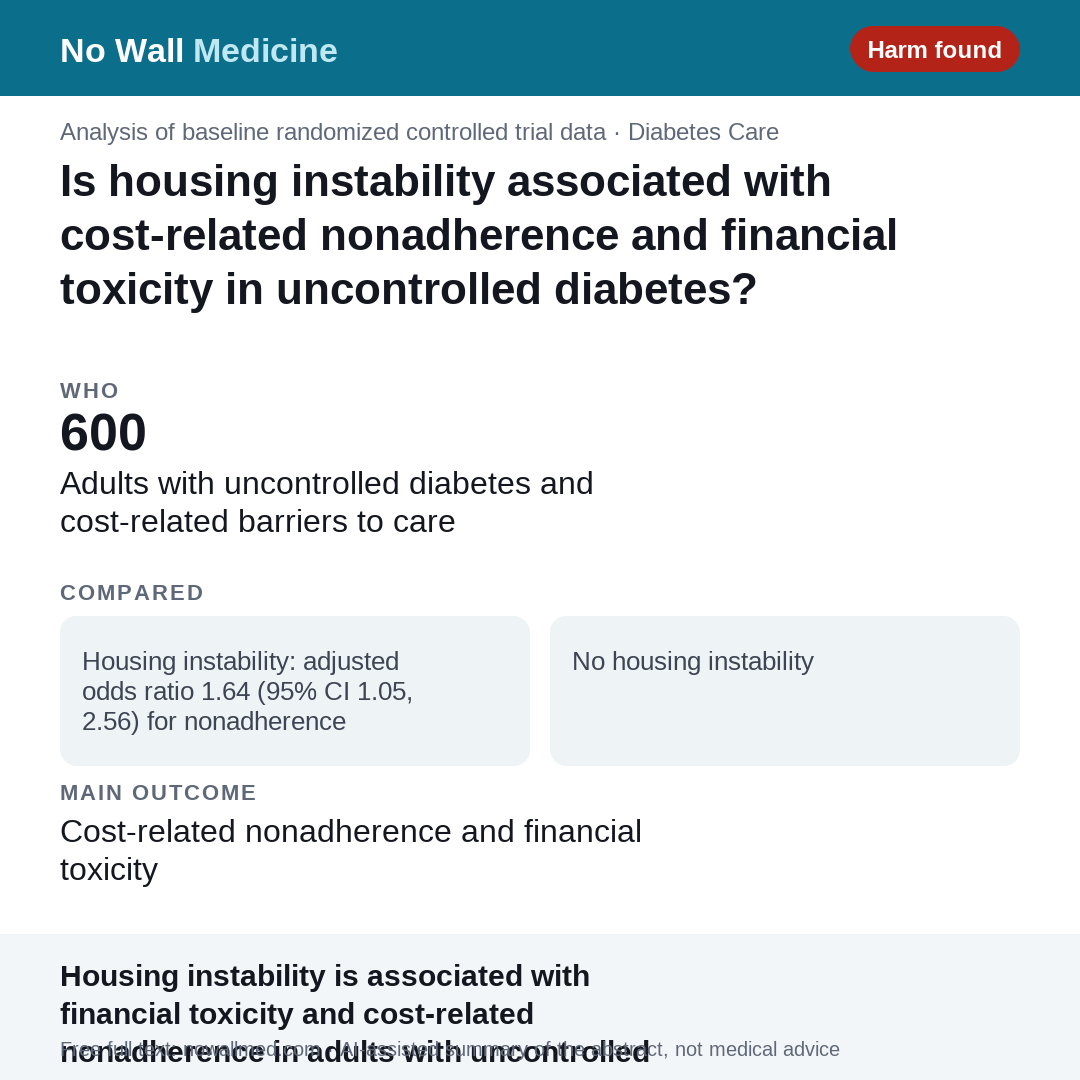
Clinical question: Is housing instability associated with cost-related nonadherence and financial toxicity in uncontrolled diabetes?
Why it matters: Researchers sought to understand how housing instability relates to the inability to afford medications and the financial burden experienced by people with uncontrolled diabetes.
Key points
- Researchers analyzed data from 600 adults with uncontrolled diabetes who faced cost-related barriers to medical care.
- Half of the participants reported housing instability, which was associated with higher odds of cost-related nonadherence and worse financial toxicity.
- Financial toxicity remained significant even after adjusting for diabetes distress and symptoms of depression and anxiety.
Headline and key points written with AI from the paper’s abstract, with every number checked against it. Read the paper before relying on them.
Topics
Spotted a mistake? Suggest a correction