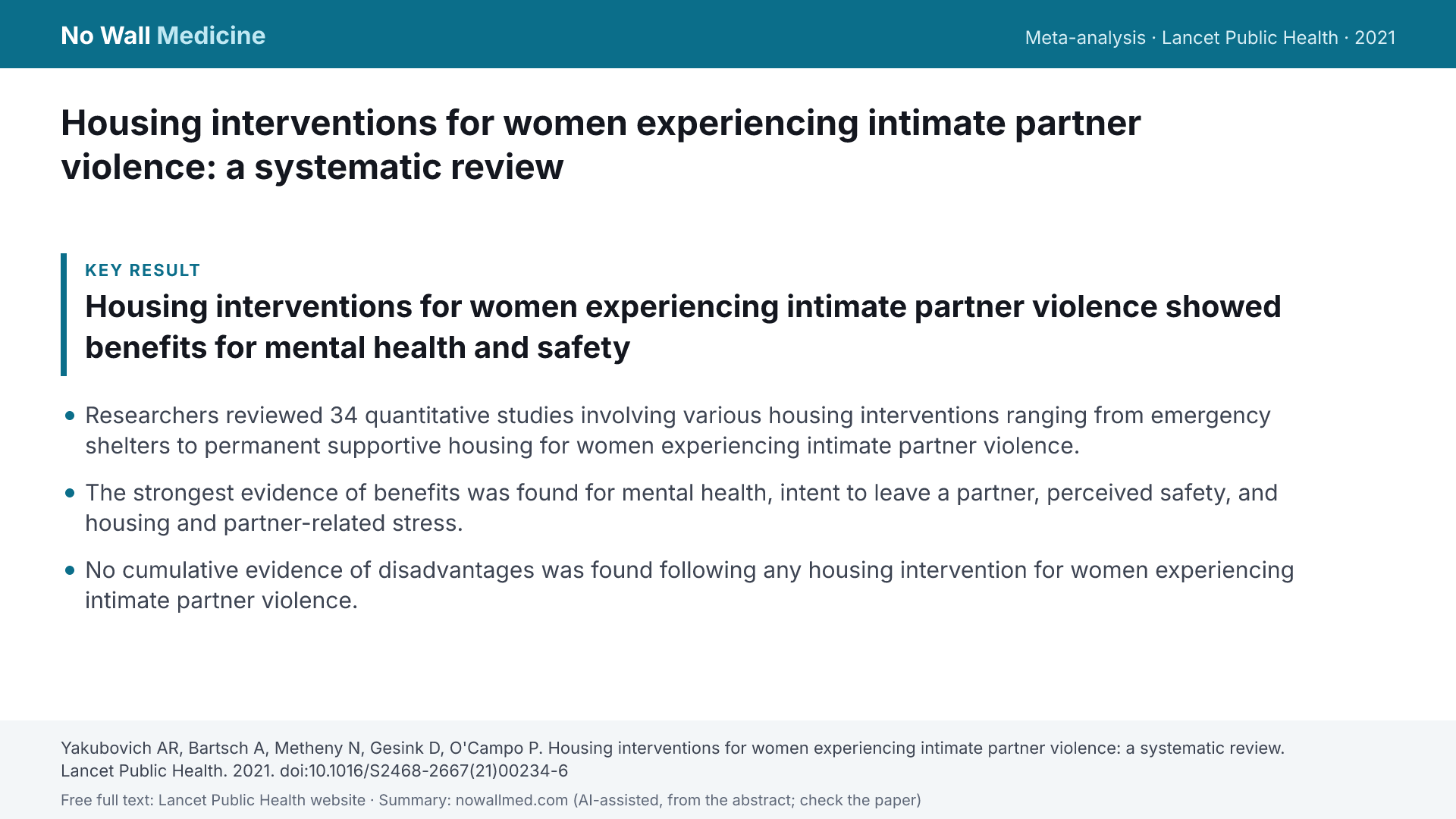
Housing interventions for women experiencing intimate partner violence showed benefits for mental health and safety
Housing interventions for women experiencing intimate partner violence: a systematic review
Key points
- Researchers reviewed 34 quantitative studies involving various housing interventions ranging from emergency shelters to permanent supportive housing for women experiencing intimate partner violence.
- The strongest evidence of benefits was found for mental health, intent to leave a partner, perceived safety, and housing and partner-related stress.
- No cumulative evidence of disadvantages was found following any housing intervention for women experiencing intimate partner violence.
Limitation the authors note: Included studies were at high risk of bias across most domains, such as confounding, and more research is needed on long-term housing solutions and outside of the USA.
Headline and key points written with AI from the paper’s abstract, with every number checked against it. Read the paper before relying on them.
Was this summary helpful?
Abstract
Background
Intimate partner violence (IPV) is the leading cause of women's homelessness. However, what works best to respond to the needs of women experiencing IPV and homelessness remains unclear. We aimed to systematically review the effects of housing interventions on the physical, psychosocial, and economic wellbeing of women experiencing IPV. Methods
In this systematic review, we searched 15 electronic databases and conducted an extensive grey literature and hand reference search between Jan 29, 2020, and May 31, 2021. We included controlled quantitative studies of housing interventions (from emergency shelter to permanent supportive housing) that were reported in English, without time restrictions, and examined any physical, psychosocial, or economic outcomes among women experiencing IPV. We critically appraised included studies using the Cochrane Effective Practice and Organisation of Care criteria and extracted data using a piloted extraction form. We synthesised our results using harvest plots to summarise whether the weight of the evidence suggested benefits, disadvantages, or null effects; patterns by study quality; and evidence gaps. This study is registered with PROSPERO, CRD42020176705. Findings
We screened 23 902 unique records and identified 34 eligible studies with quantitative data on the outcomes of housing interventions among women experiencing IPV. Most studies evaluated the outcomes of either shelter interventions (18 studies [53%]) or shelter plus some other programming (eight [24%]). The remaining eight studies evaluated longer-term housing solutions, including supportive housing (five studies [15%]), critical time interventions (one [3%]), transitional housing (one [3%]), and stay-at-home models (one [3%]). There was no cumulative evidence of disadvantages following any IPV-housing intervention. Evidence of benefits was strongest for mental health outcomes, intent to leave partner, perceived safety, and housing and partner-related stress. Included studies were at high risk of bias across most domains (eg, confounding). Interpretation
There is promising evidence on the continuum of IPV-housing services for women, especially in terms of proximal outcomes, such as mental health, intent to leave partner, safety, and housing stress. However, more research of higher quality is needed, particularly on long-term housing solutions and from outside of the USA. Funding
The Social Sciences and Humanities Research Council (430-2021-01176) and Canadian Institutes of Health Research (HSI-166388).
Abstract reproduced under the article’s CC BY licence.
Subject terms
Headline, design, result, key points, caveat and citation as plain text.
Cite this article
Yakubovich AR, Bartsch A, Metheny N, Gesink D, O'Campo P. Housing interventions for women experiencing intimate partner violence: a systematic review. Lancet Public Health. 2021. doi:10.1016/S2468-2667(21)00234-6
Spotted a mistake? Suggest a correction