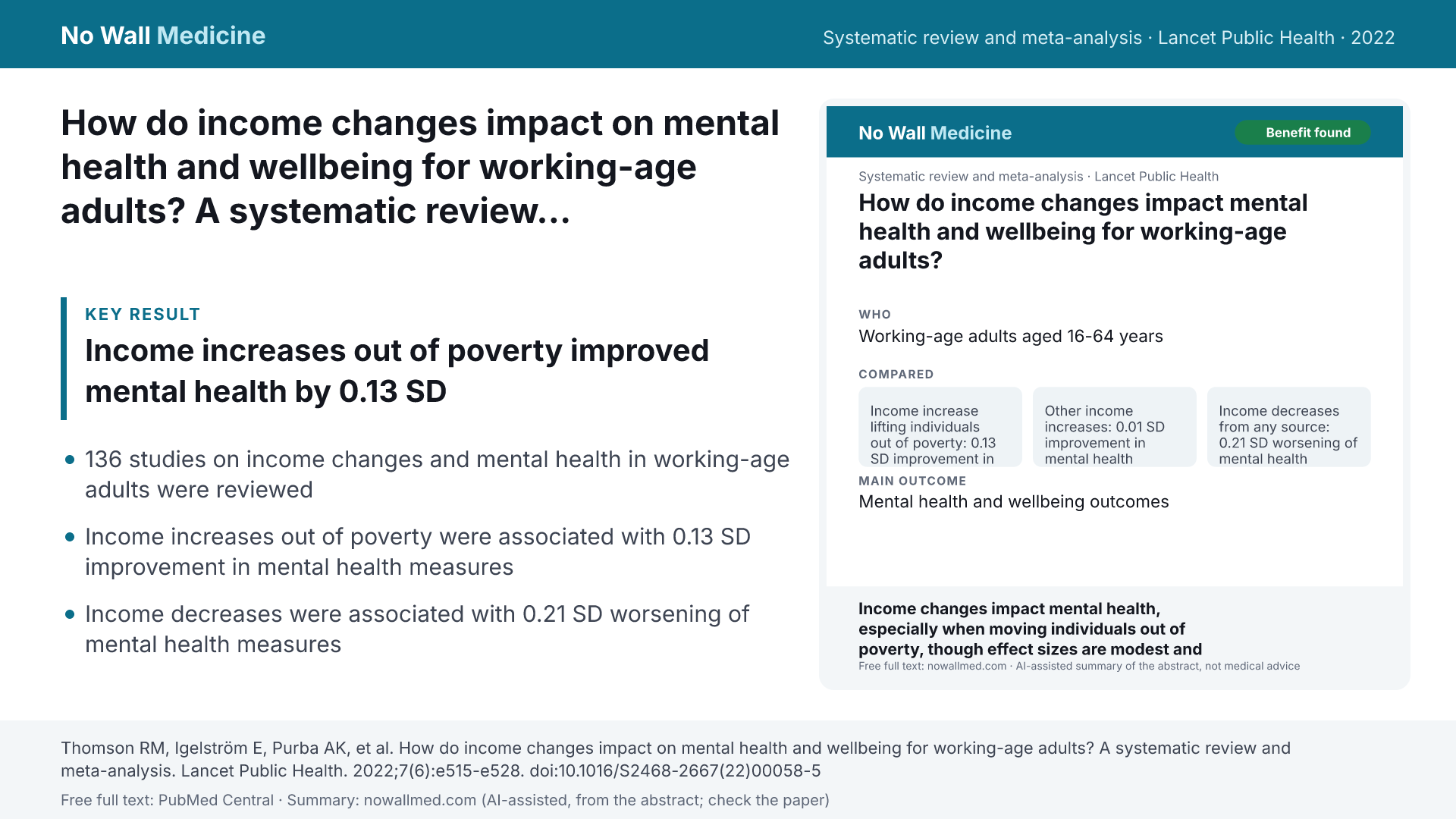
Income increases out of poverty improved mental health by 0.13 SD
How do income changes impact on mental health and wellbeing for working-age adults? A systematic review and meta-analysis
Systematic review and meta-analysisBenefit found
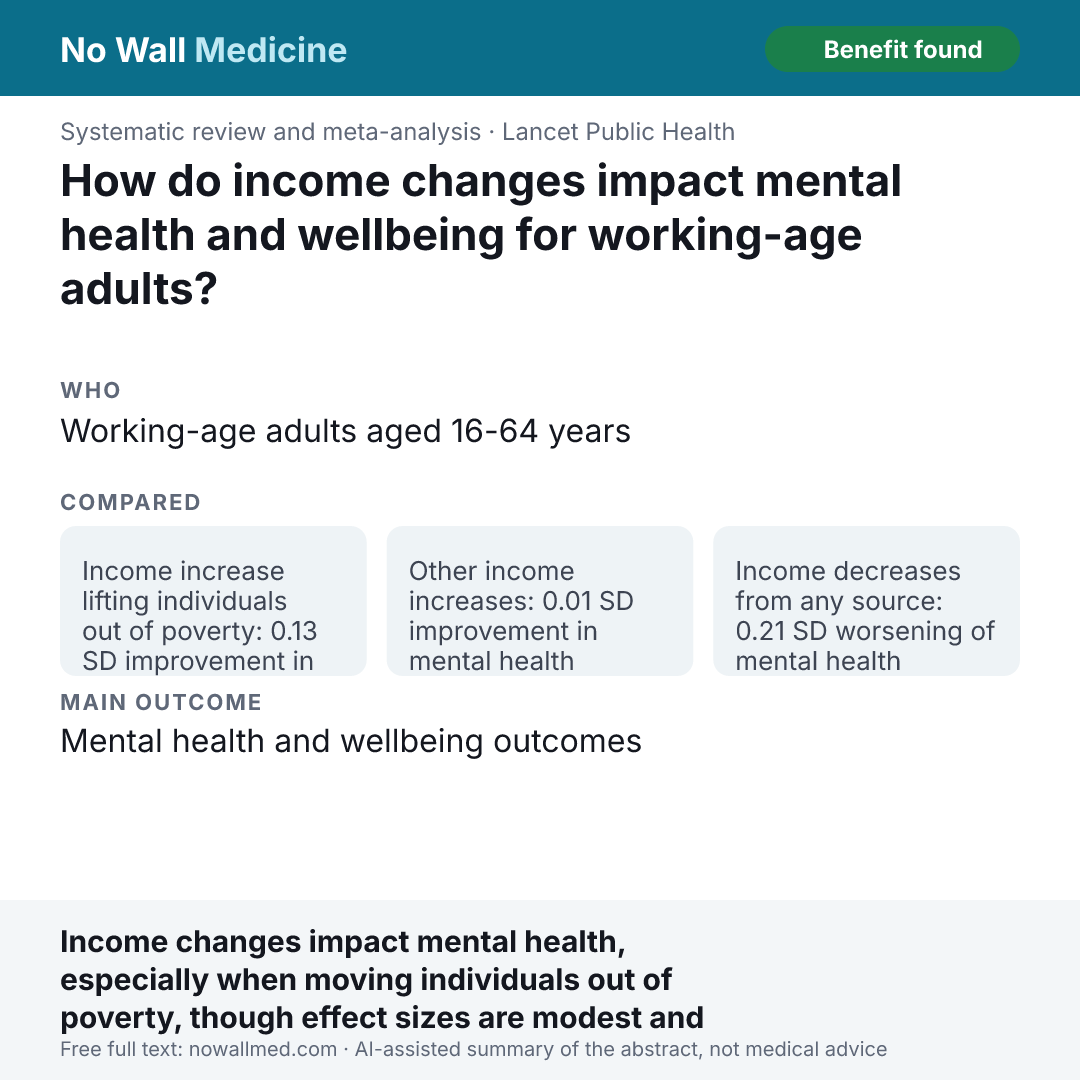
How do income changes impact mental health and wellbeing for working-age adults?
Who
Working-age adults aged 16-64 years
Compared
Income increase lifting individuals out of poverty: 0.13 SD improvement in mental health
Other income increases: 0.01 SD improvement in mental health
Income decreases from any source: 0.21 SD worsening of mental health
Main outcome
Mental health and wellbeing outcomes
Bottom line: Income changes impact mental health, especially when moving individuals out of poverty, though effect sizes are modest and certainty is low.
Limitation: High heterogeneity and low or very low certainty of evidence according to GRADE.
Funded by: Wellcome Trust, Medical Research Council, Chief Scientist Office, and European Research Council
Lancet Public Health · 2022-06-06 · Save PNG
Clinical question: How do income changes impact mental health and wellbeing for working-age adults?
Why it matters: The extent to which income has a causal effect on mental health is debated
Key points
- 136 studies on income changes and mental health in working-age adults were reviewed.
- Income increases out of poverty were associated with 0.13 SD improvement in mental health measures.
- Income decreases were associated with 0.21 SD worsening of mental health measures.
Limitation the authors note: GRADE certainty was low or very low due to high risk of bias and heterogeneity
Headline and key points written with AI from the paper’s abstract, with every number checked against it. Read the paper before relying on them.
Was this summary helpful?
Abstract
Background
Lower incomes are associated with poorer mental health and wellbeing, but the extent to which income has a causal effect is debated. We aimed to synthesise evidence from studies measuring the impact of changes in individual and household income on mental health and wellbeing outcomes in working-age adults (aged 16-64 years). Methods
For this systematic review and meta-analysis, we searched MEDLINE, Embase, Web of Science, PsycINFO, ASSIA, EconLit, and RePEc on Feb 5, 2020, for randomised controlled trials (RCTs) and quantitative non-randomised studies. We had no date limits for our search. We included English-language studies measuring effects of individual or household income change on any mental health or wellbeing outcome. We used Cochrane risk of bias (RoB) tools. We conducted three-level random-effects meta-analyses, and explored heterogeneity using meta-regression and stratified analyses. Synthesis without meta-analysis was based on effect direction. Critical RoB studies were excluded from primary analyses. Certainty of evidence was assessed using Grading of Recommendations Assessment, Development and Evaluation (GRADE). This study is registered with PROSPERO, CRD42020168379. Findings
Of 16 521 citations screened, 136 were narratively synthesised (12·5% RCTs) and 86 meta-analysed. RoB was high: 30·1% were rated critical and 47·1% serious or high. A binary income increase lifting individuals out of poverty was associated with 0·13 SD improvement in mental health measures (95% CI 0·07 to 0·20; n=42 128; 18 studies), considerably larger than other income increases (0·01 SD improvement, 0·002 to 0·019; n=216 509, 14 studies). For wellbeing, increases out of poverty were associated with 0·38 SD improvement (0·09 to 0·66; n=101 350, 8 studies) versus 0·16 for other income increases (0·07 to 0·25; n=62 619, 11 studies). Income decreases from any source were associated with 0·21 SD worsening of mental health measures (-0·30 to -0·13; n=227 804, 11 studies). Effect sizes were larger in low-income and middle-income settings and in higher RoB studies. Heterogeneity was high (I2=79-87%). GRADE certainty was low or very low. Interpretation
Income changes probably impact mental health, particularly where they move individuals out of poverty, although effect sizes are modest and certainty low. Effects are larger for wellbeing outcomes, and potentially for income losses. To best support population mental health, welfare policies need to reach the most socioeconomically disadvantaged. Funding
Wellcome Trust, Medical Research Council, Chief Scientist Office, and European Research Council.
Abstract reproduced under the article’s CC BY licence.
Subject terms
Headline, design, result, key points, caveat and citation as plain text.
Cite this article
Thomson RM, Igelström E, Purba AK, et al. How do income changes impact on mental health and wellbeing for working-age adults? A systematic review and meta-analysis. Lancet Public Health. 2022;7(6):e515-e528. doi:10.1016/S2468-2667(22)00058-5
Spotted a mistake? Suggest a correction