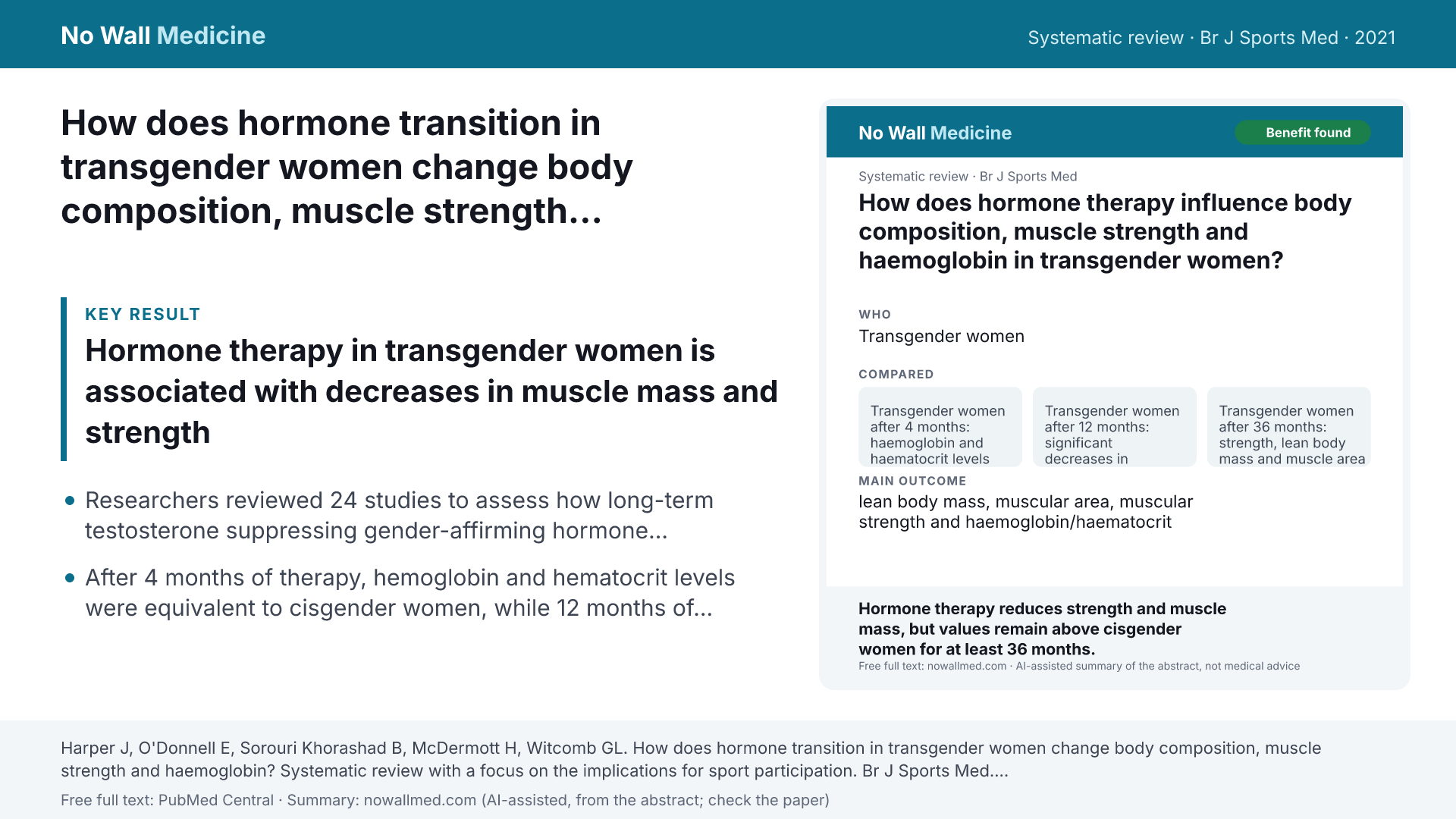
Hormone therapy in transgender women is associated with decreases in muscle mass and strength
How does hormone transition in transgender women change body composition, muscle strength and haemoglobin? Systematic review with a focus on the implications for sport participation
Systematic reviewBenefit found
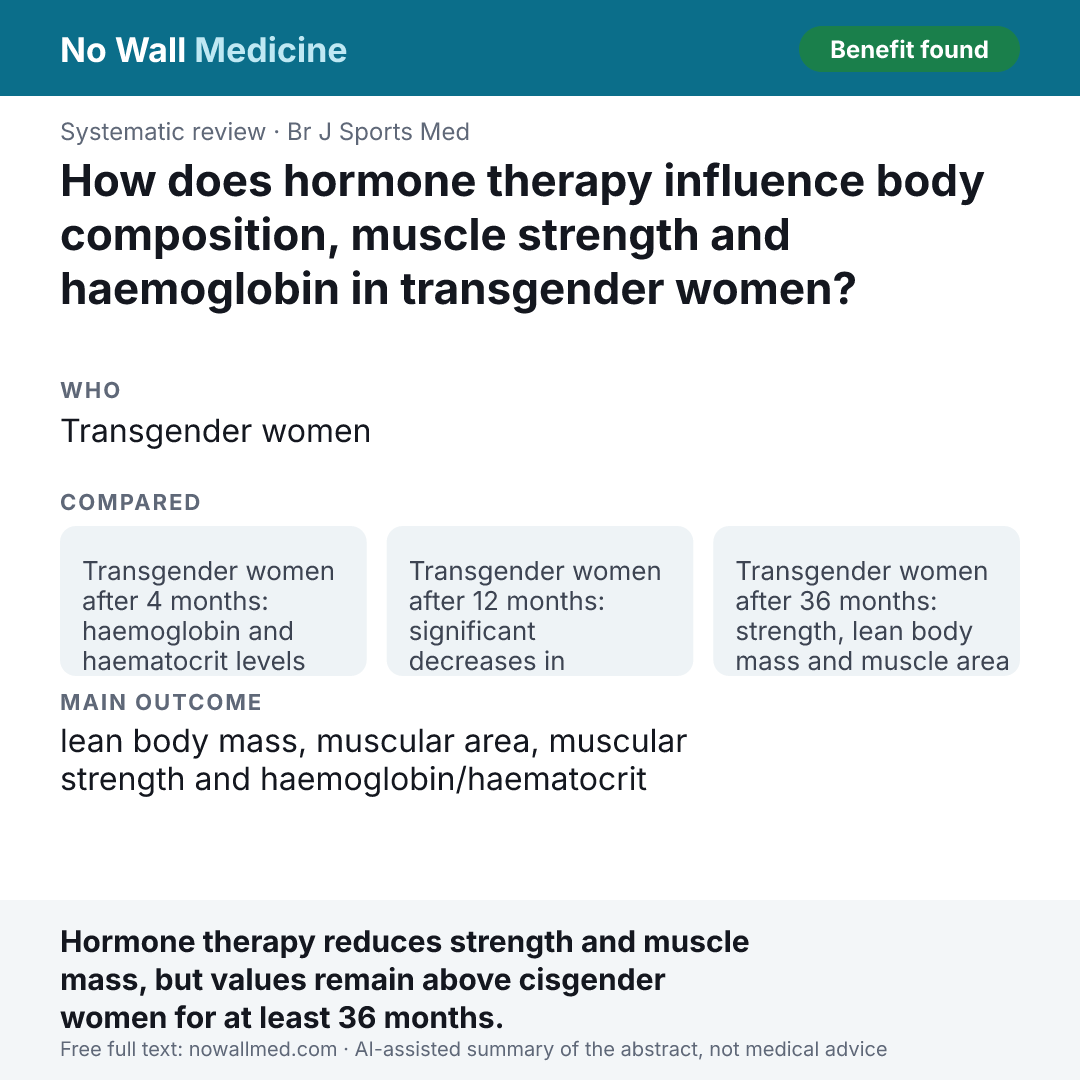
How does hormone therapy influence body composition, muscle strength and haemoglobin in transgender women?
Who
Transgender women
Compared
Transgender women after 4 months: haemoglobin and haematocrit levels equivalent to cisgender women
Transgender women after 12 months: significant decreases in strength, lean body mass and muscle area
Transgender women after 36 months: strength, lean body mass and muscle area remain above cisgender women
Main outcome
lean body mass, muscular area, muscular strength and haemoglobin/haematocrit
Bottom line: Hormone therapy reduces strength and muscle mass, but values remain above cisgender women for at least 36 months.
Br J Sports Med · 2021-03-01 · Save PNG
Clinical question: How does hormone therapy influence body composition, muscle strength and haemoglobin in transgender women?
Key points
- Researchers reviewed 24 studies to assess how long-term testosterone suppressing gender-affirming hormone therapy affects lean body mass, muscle area, strength, and hemoglobin.
- After 4 months of therapy, hemoglobin and hematocrit levels were equivalent to cisgender women, while 12 months of therapy was associated with significant decreases in strength, lean body mass, and muscle area.
- Even after 36 months of hormone therapy, values for strength, lean body mass, and muscle area remained above those observed in cisgender women.
Headline and key points written with AI from the paper’s abstract, with every number checked against it. Read the paper before relying on them.
Was this summary helpful?
Abstract
Objectives
We systemically reviewed the literature to assess how long-term testosterone suppressing gender-affirming hormone therapy influenced lean body mass (LBM), muscular area, muscular strength and haemoglobin (Hgb)/haematocrit (HCT). Design
Systematic review. Data sources
Four databases (BioMed Central, PubMed, Scopus and Web of Science) were searched in April 2020 for papers from 1999 to 2020. Eligibility criteria for selecting studies
Eligible studies were those that measured at least one of the variables of interest, included transwomen and were written in English. Results
Twenty-four studies were identified and reviewed. Transwomen experienced significant decreases in all parameters measured, with different time courses noted. After 4 months of hormone therapy, transwomen have Hgb/HCT levels equivalent to those of cisgender women. After 12 months of hormone therapy, significant decreases in measures of strength, LBM and muscle area are observed. The effects of longer duration therapy (36 months) in eliciting further decrements in these measures are unclear due to paucity of data. Notwithstanding, values for strength, LBM and muscle area in transwomen remain above those of cisgender women, even after 36 months of hormone therapy. Conclusion
In transwomen, hormone therapy rapidly reduces Hgb to levels seen in cisgender women. In contrast, hormone therapy decreases strength, LBM and muscle area, yet values remain above that observed in cisgender women, even after 36 months. These findings suggest that strength may be well preserved in transwomen during the first 3 years of hormone therapy.
Abstract reproduced under the article’s CC BY NC licence.
Subject terms
Headline, design, result, key points, caveat and citation as plain text.
Cite this article
Harper J, O'Donnell E, Sorouri Khorashad B, McDermott H, Witcomb GL. How does hormone transition in transgender women change body composition, muscle strength and haemoglobin? Systematic review with a focus on the implications for sport participation. Br J Sports Med. 2021;55(15):865-872. doi:10.1136/bjsports-2020-103106
Spotted a mistake? Suggest a correction