Virtual reality was associated with improvements in pain, tiredness, and psychological well-being in palliative care
How effective is virtual reality technology in palliative care? A systematic review and meta-analysis
Systematic review and meta-analysisMixed results
Is virtual reality technology effective in a palliative care setting?
Who
Adults with a terminal illness
Compared
Virtual reality
Control
Main outcome
Pain, tiredness, drowsiness, shortness of breath, depression, and psychological well-being
Bottom line: Virtual reality is feasible and improves several symptoms, but evidence quality is very low.
Limitation: Small sample sizes, non-randomisation methods, and a lack of a comparator arm.
Palliat Med · 2022-05-30Download image
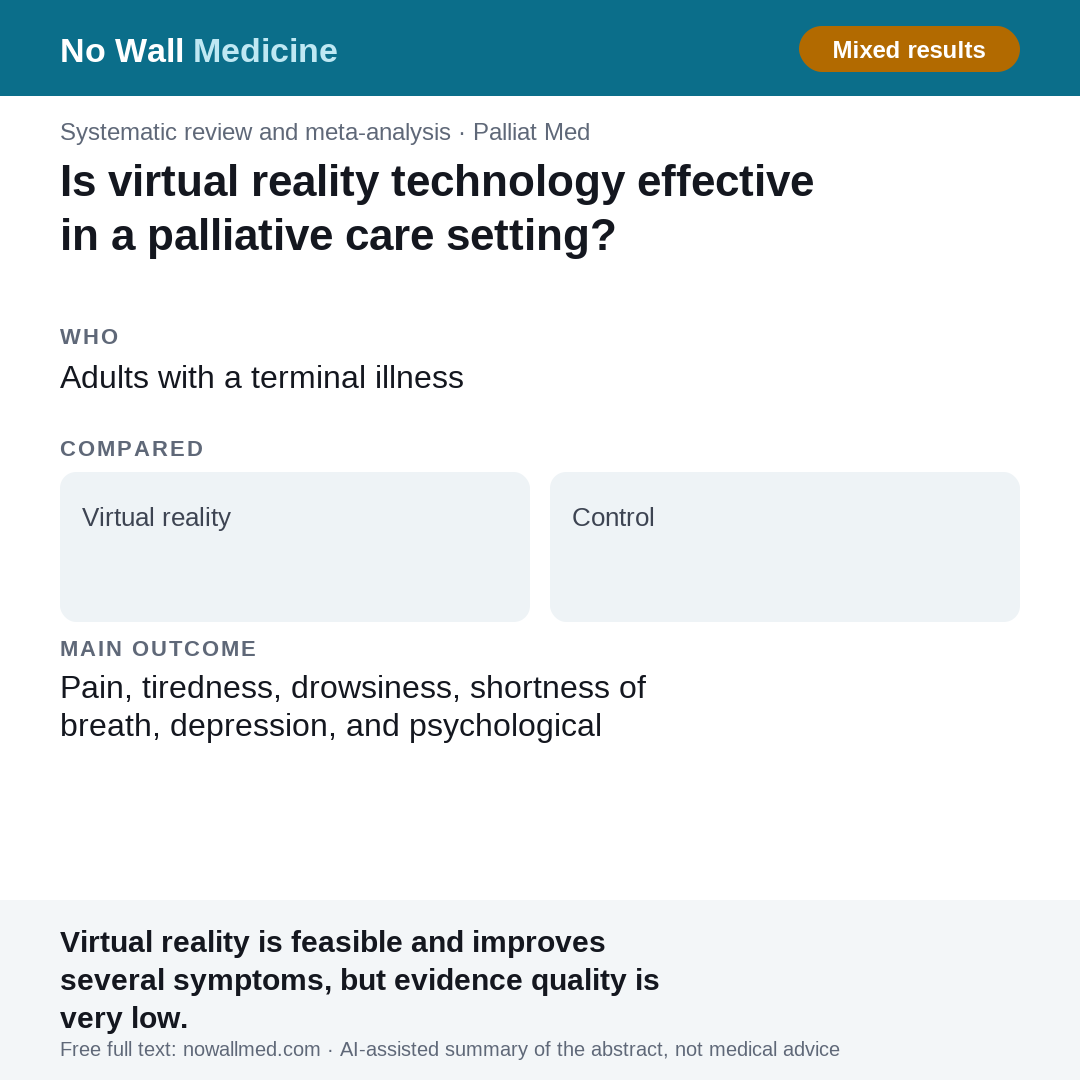
Clinical question: Is virtual reality technology effective in a palliative care setting?
Why it matters: The efficacy of virtual reality technology for people living with a terminal illness is currently unclear.
Key points
- Researchers conducted a systematic review and meta-analysis of eight studies involving adults with terminal illnesses using virtual reality technology.
- Virtual reality was associated with statistically significant improvements in pain (p = 0.0363), tiredness (p = 0.0030), drowsiness (p = 0.0051), shortness of breath (p = 0.0284), depression (p = 0.0091), and psychological well-being (p = 0.0201).
- The technology was found to be feasible and acceptable for use in palliative care settings.
Limitation the authors note: The quality of the evidence was graded as very low due to small sample sizes, non-randomisation methods and a lack of a comparator arm.
Headline and key points written with AI from the paper’s abstract, with every number checked against it. Read the paper before relying on them.
Topics
Cite this article
Mo J, Vickerstaff V, Minton O, Tavabie S, Taubert M, Stone P. How effective is virtual reality technology in palliative care? A systematic review and meta-analysis. Palliat Med. 2022. doi:10.1177/02692163221099584
Spotted a mistake? Suggest a correction
Top studies every Monday
The week’s key trials and guidelines in your specialties, plus any topics you follow. By email, free.
Get the weekly digest