Three-dimensional modeling shows accuracy for measuring stomach volume and abdominal circumference in metabolic surgery
How is 3D modeling in metabolic surgery utilized and what is its clinical benefit: a systematic review and meta-analysis
Systematic review and meta-analysisBenefit found
How is 3D modeling utilized and what is its clinical benefit in metabolic surgery?
Who
29
Patients undergoing metabolic surgery
Compared
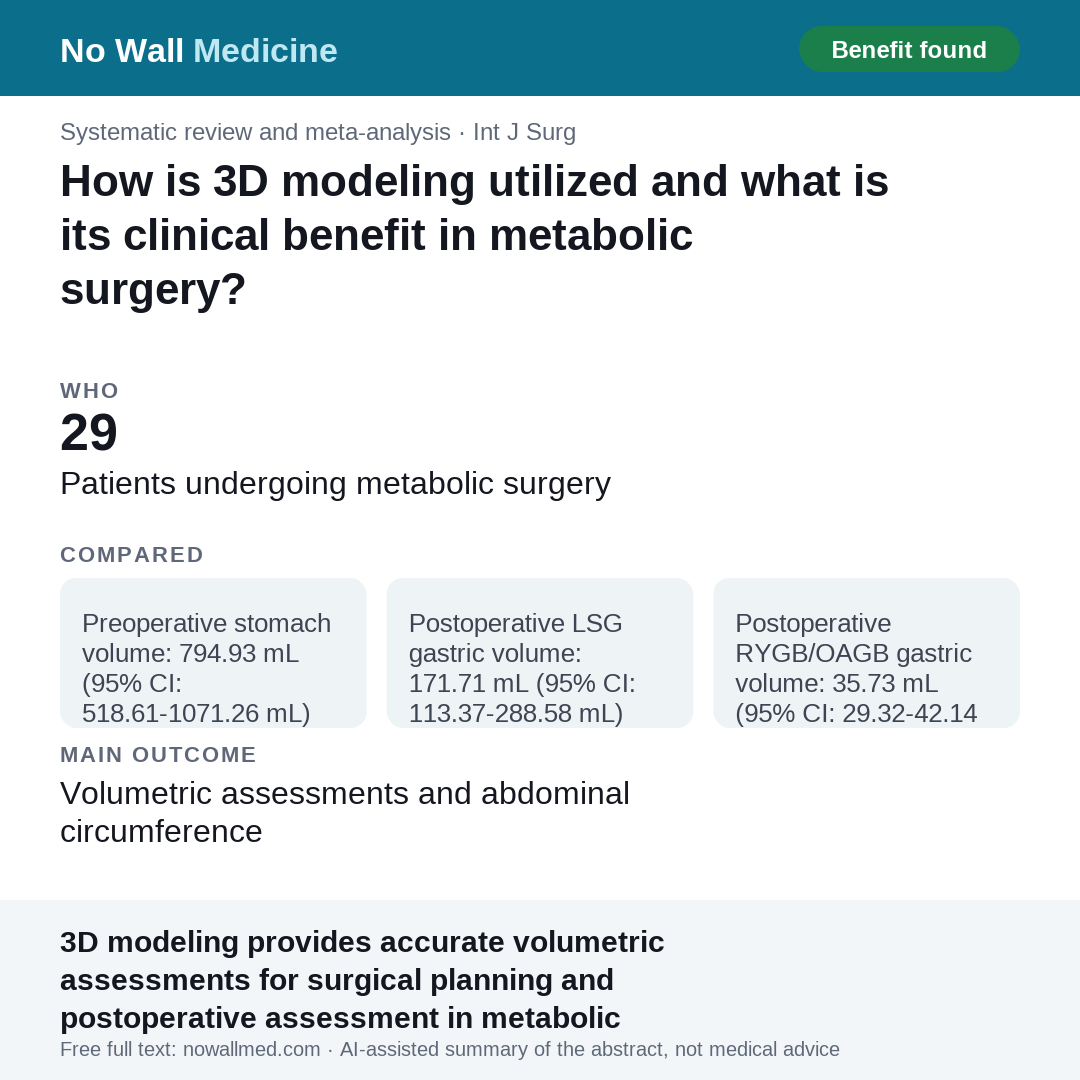
Preoperative stomach volume: 794.93 mL (95% CI: 518.61-1071.26 mL)
Postoperative LSG gastric volume: 171.71 mL (95% CI: 113.37-288.58 mL)
Postoperative RYGB/OAGB gastric volume: 35.73 mL (95% CI: 29.32-42.14 mL)
Main outcome
Volumetric assessments and abdominal circumference
Bottom line: 3D modeling provides accurate volumetric assessments for surgical planning and postoperative assessment in metabolic surgery.
Limitation: Potential benefits in augmented reality, 3D printing, or patient education remain underutilized.
Int J Surg · 2025-05-01Download image
Clinical question: How is 3D modeling utilized and what is its clinical benefit in metabolic surgery?
Why it matters: The use of three-dimensional modeling in metabolic surgery for patient education and addressing surgical debates remains underutilized.
Key points
- Researchers analyzed 29 studies to evaluate how three-dimensional modeling is used for planning and assessing outcomes in metabolic surgery for obesity.
- The average preoperative stomach volume was 794.93 mL, while postoperative volumes were 171.71 mL for sleeve gastrectomy and 35.73 mL for gastric bypass.
- Most studies focused on operative planning and surgical practice, while only 10% of the research addressed surgical education.
Headline and key points written with AI from the paper’s abstract, with every number checked against it. Read the paper before relying on them.
Topics
Cite this article
Robb HD, Arif A, Narendranath RM, Das B, Alyaqout K, Lynn W. How is 3D modeling in metabolic surgery utilized and what is its clinical benefit: a systematic review and meta-analysis. Int J Surg. 2025. doi:10.1097/JS9.0000000000002301
Spotted a mistake? Suggest a correction
Top studies every Monday
The week’s key trials and guidelines in your specialties, plus any topics you follow. By email, free.
Get the weekly digest