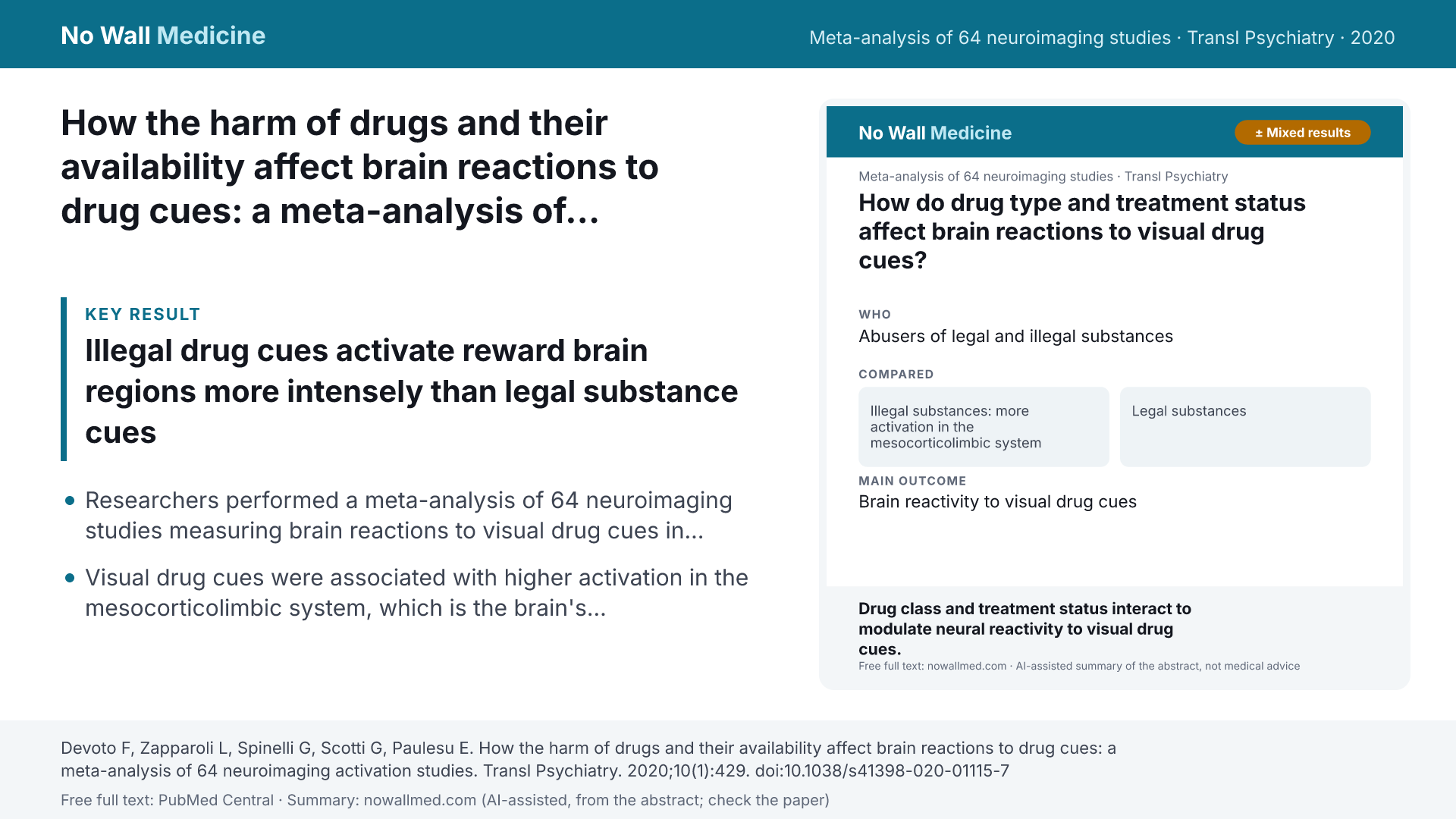
Illegal drug cues activate reward brain regions more intensely than legal substance cues
How the harm of drugs and their availability affect brain reactions to drug cues: a meta-analysis of 64 neuroimaging activation studies
Meta-analysis of 64 neuroimaging studiesMixed results
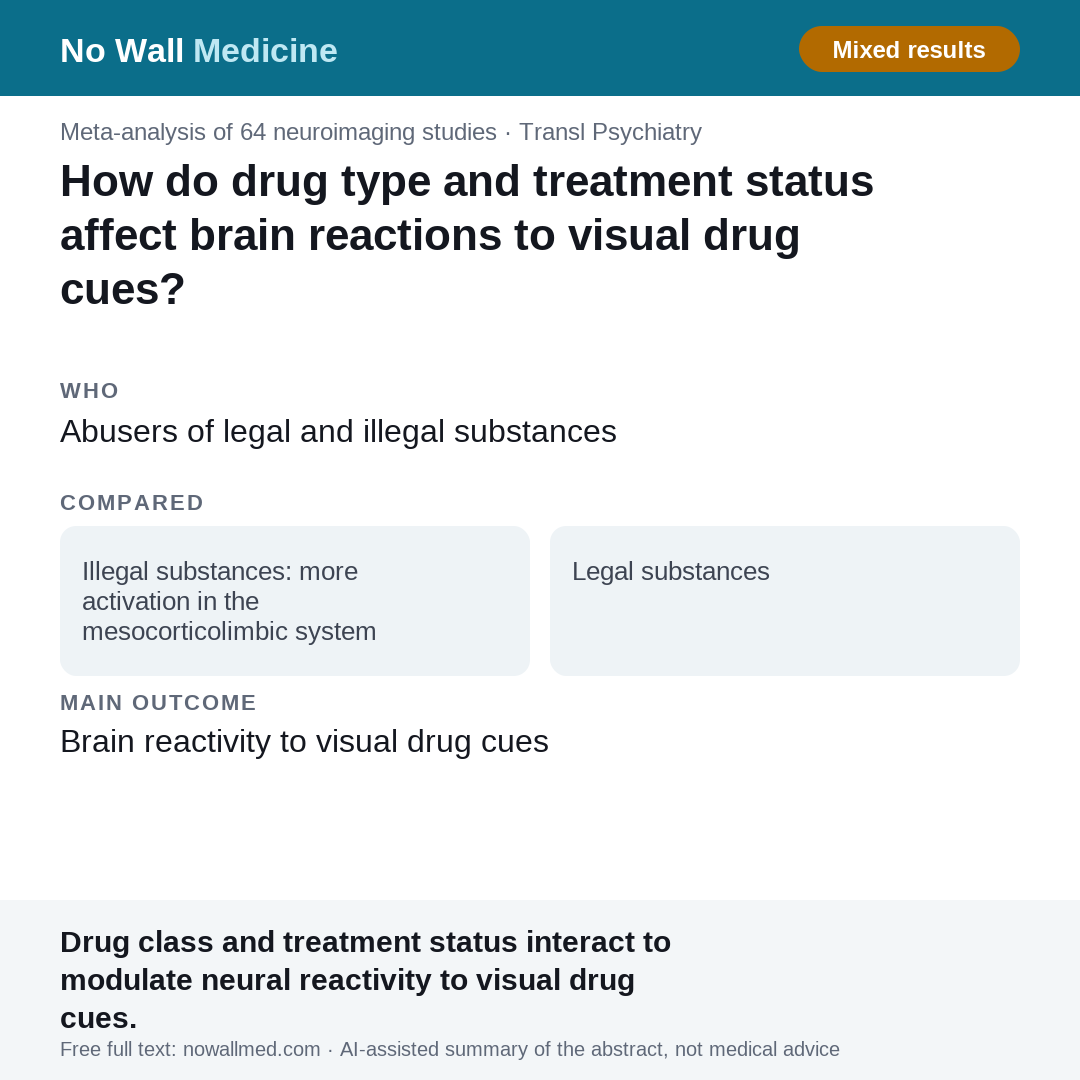
How do drug type and treatment status affect brain reactions to visual drug cues?
Who
Abusers of legal and illegal substances
Compared
Illegal substances: more activation in the mesocorticolimbic system
Legal substances
Main outcome
Brain reactivity to visual drug cues
Bottom line: Drug class and treatment status interact to modulate neural reactivity to visual drug cues.
Transl Psychiatry · 2020-12-14Download image
Clinical question: How do drug type and treatment status affect brain reactions to visual drug cues?
Why it matters: It was unknown if the specific type of drug or a person's treatment status changes how the brain reacts to visual triggers.
Key points
- Researchers performed a meta-analysis of 64 neuroimaging studies measuring brain reactions to visual drug cues in people using legal or illegal substances.
- Visual drug cues were associated with higher activation in the mesocorticolimbic system, which is the brain's reward circuitry, for users of illegal substances compared to legal ones.
- Treatment status was associated with different brain activity in the anterior cingulate and orbitofrontal cortex, areas involved in making decisions over time.
Headline and key points written with AI from the paper’s abstract, with every number checked against it. Read the paper before relying on them.
Was this summary helpful?
Subject terms
Cite this article
Devoto F, Zapparoli L, Spinelli G, Scotti G, Paulesu E. How the harm of drugs and their availability affect brain reactions to drug cues: a meta-analysis of 64 neuroimaging activation studies. Transl Psychiatry. 2020. doi:10.1038/s41398-020-01115-7
Spotted a mistake? Suggest a correction