Artificial intelligence tools show short-term benefits for swallowing rehabilitation but face significant implementation barriers
Human-AI collaboration for dysphagia rehabilitation from effectiveness to implementation complexity: a systematic review
Systematic review of 31 studiesMixed results
Does AI-augmented swallowing rehabilitation improve outcomes for adults with oropharyngeal dysphagia?
Who
1012
Adults with oropharyngeal dysphagia or healthy volunteers
Compared
AI-augmented interventions: short-term gains in functional oral intake and physiological measures
Control
Main outcome
functional oral intake and physiological measures
Bottom line: AI-augmented interventions show short-term functional gains, but effects attenuate and adherence declines without clinician supervision.
Limitation: AI algorithm performance is rated at very low certainty and validation is largely confined to healthy volunteers.
NPJ Digit Med · 2026-06-10Download image
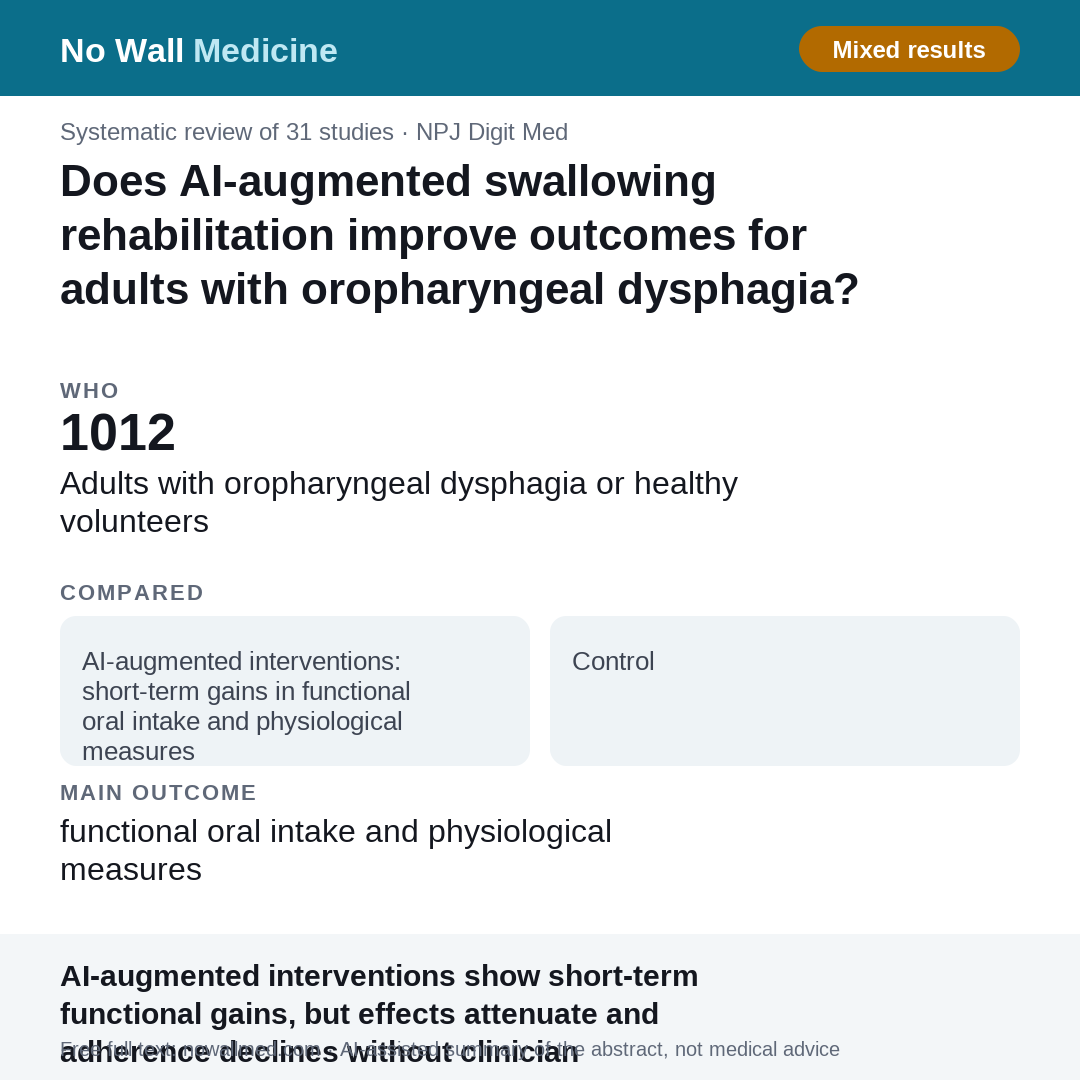
Clinical question: Does AI-augmented swallowing rehabilitation improve outcomes for adults with oropharyngeal dysphagia?
Why it matters: A global shortage of therapists constrains rehabilitation for oropharyngeal dysphagia, yet it is unclear if human-artificial intelligence collaboration effectively addresses this problem.
Key points
- Researchers reviewed 31 studies involving 1012 participants to evaluate artificial intelligence-augmented swallowing rehabilitation in adults or healthy volunteers.
- Artificial intelligence interventions produced short-term improvements in physiological measures and oral intake, but these effects decreased within weeks of stopping the treatment.
- Implementation was hindered by digital literacy, cognitive impairment, and interface usability, which were rated as high barriers by 61.3% of the analyzed data.
Limitation the authors note: The certainty of evidence for artificial intelligence algorithm performance is rated as very low, with validation largely confined to healthy volunteers.
Headline and key points written with AI from the paper’s abstract, with every number checked against it. Read the paper before relying on them.
Spotted a mistake? Suggest a correction