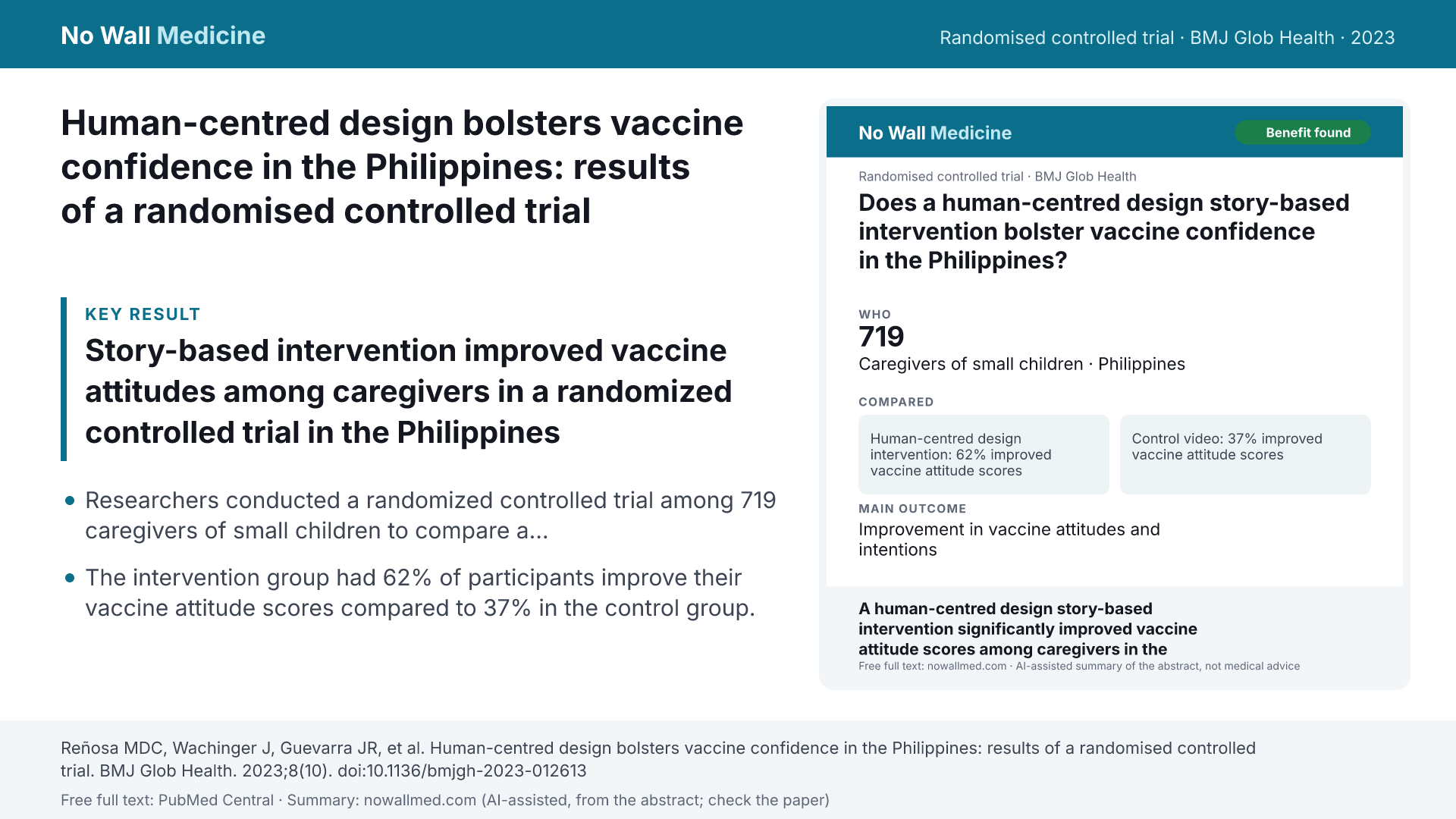
Story-based intervention improved vaccine attitudes among caregivers in a randomized controlled trial in the Philippines
Human-centred design bolsters vaccine confidence in the Philippines: results of a randomised controlled trial
Randomised controlled trialBenefit found
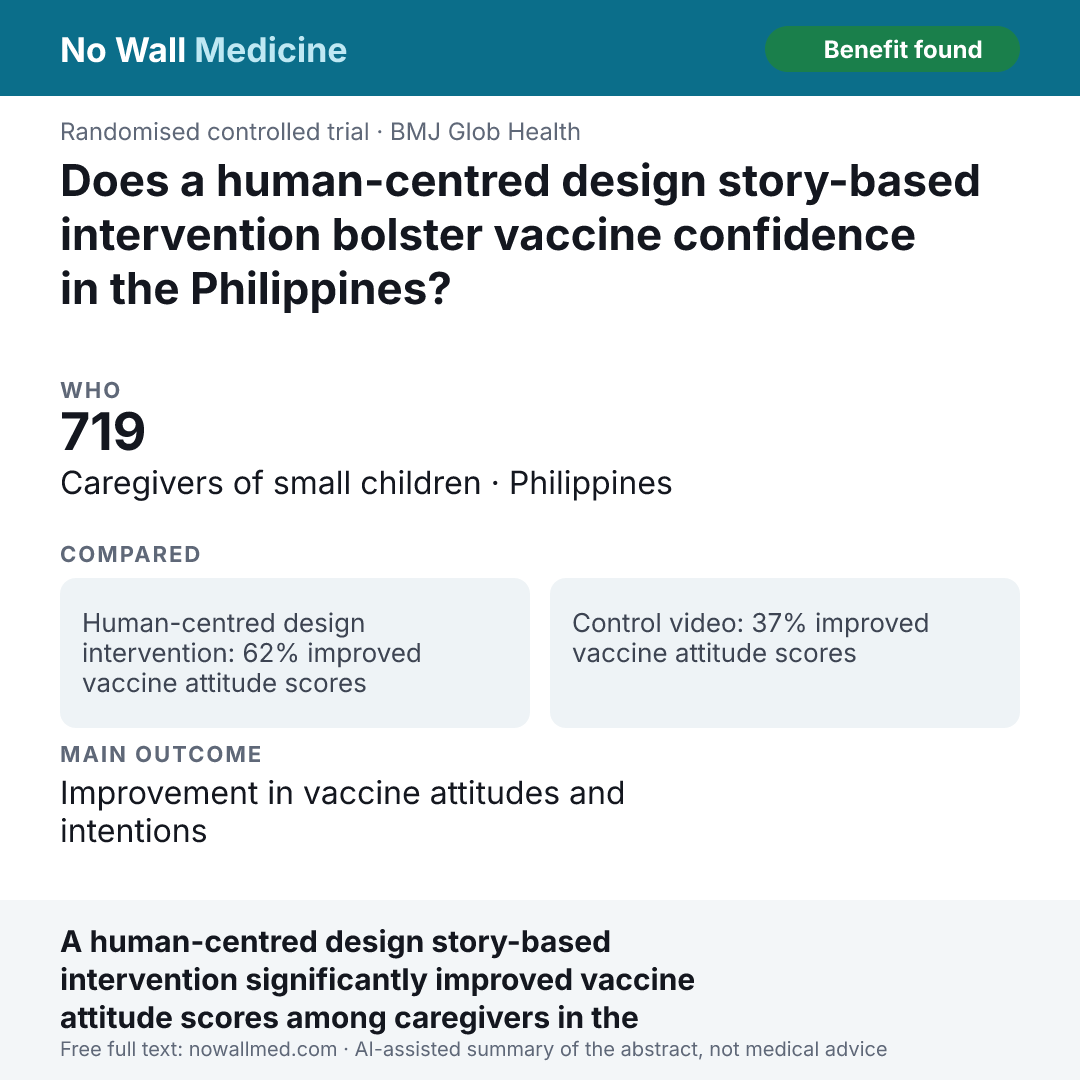
Does a human-centred design story-based intervention bolster vaccine confidence in the Philippines?
Who
719
Caregivers of small children · Philippines
Compared
Human-centred design intervention: 62% improved vaccine attitude scores
Control video: 37% improved vaccine attitude scores
Main outcome
Improvement in vaccine attitudes and intentions
Result: Cohen's d=0.32 (95% CI 0.10 to 0.54)
Bottom line: A human-centred design story-based intervention significantly improved vaccine attitude scores among caregivers in the Philippines.
BMJ Glob Health · 2023-10-22 · Save PNG
Clinical question: Does a human-centred design story-based intervention bolster vaccine confidence in the Philippines?
Why it matters: Public confidence in vaccinations has eroded and anti-vaccination movements have gained traction in the Philippines.
In absolute numbers
Human-centred design intervention: 62% · Control video: 37% → a difference of 25 percentage points, so about 4 people would need the treatment for 1 more to benefit (number needed to treat) over the trial’s follow-up.
Worked out by us from the two group results above, not reported by the authors. Check the paper for the exact outcome and timing.
Key points
- Researchers conducted a randomized controlled trial among 719 caregivers of small children to compare a story-based intervention against a control video.
- The intervention group had 62% of participants improve their vaccine attitude scores compared to 37% in the control group.
- Among those who previously delayed or refused a vaccine, 67% of 74 participants in the intervention group improved their scores versus 42% of 54 in the control group.
Headline and key points written with AI from the paper’s abstract, with every number checked against it. Read the paper before relying on them.
Was this summary helpful?
Abstract
Background
The public's confidence in vaccinations has eroded, and anti-vaccination movements have gained traction around the world, including in the Philippines. 'Salubong', a Filipino term, refers to welcoming someone back into one's life and elicits ideas about friendship and family relationships. We extended this concept to vaccines in efforts to design an intervention that would re-welcome vaccines into homes. Methods
Using human-centred design, we developed and refined a story-based intervention that engages Filipino families, community leaders and community health workers. We conducted a randomised controlled trial among 719 caregivers of small children to test the developed intervention against a control video. We assessed the binary improvement (improvement vs no improvement) and the amount of improvement in vaccine attitudes and intentions after intervention exposure. Results
Although the intervention group began with marginally higher baseline vaccine attitude scores, we found that 62% of the intervention group improved their vaccine attitude scores versus 37% of the control group (Fisher's exact, p<0.001). Among individuals whose scores improved after watching the assigned video, the intervention group saw higher mean attitude score improvements on the 5-point scale (Cohen's d=0.32 with 95% CI 0.10 to 0.54, two-sided t-test, p<0.01). We observed similar patterns among participants who stated that they had previously delayed or refused a vaccine for their child: 67% of 74 in the intervention group improved their vaccine attitude scores versus 42% of 54 in the control group (Fisher's exact, p<0.001). Among the subset of these individuals whose scores improved after watching the assigned video, the intervention group saw higher mean attitude score improvements on the 5-point scale that were marginally significant (Cohen's d=0.35 with 95% CI -0.01 to 0.70, two-sided t-test, p=0.06). Conclusions
Our results provide solid evidence for the potential of co-designed vaccine confidence campaigns and regulations.
Abstract reproduced under the article’s CC BY licence.
Subject terms
Headline, design, result, key points, caveat and citation as plain text.
Cite this article
Reñosa MDC, Wachinger J, Guevarra JR, et al. Human-centred design bolsters vaccine confidence in the Philippines: results of a randomised controlled trial. BMJ Glob Health. 2023;8(10). doi:10.1136/bmjgh-2023-012613
Spotted a mistake? Suggest a correction