Three days of fasting changes blood metabolites and macrophage function in humans
Human fasting modulates macrophage function and upregulates multiple bioactive metabolites that extend lifespan in Caenorhabditis elegans: a pilot clinical study
Pilot clinical studyBenefit found
How does periodic prolonged fasting affect metabolic, immune, and longevity markers?
Who
20
Young males and females
Compared
36-h fasted state: robustly altered the plasma metabolome
C. elegans with metabolites: extended the median lifespan by as much as 96%
Main outcome
metabolic and immune health markers and plasma metabolites
Bottom line: Periodic prolonged fasting alters the plasma metabolome and identifies metabolites that extend lifespan in Caenorhabditis elegans.
Limitation: pilot clinical study
Am J Clin Nutr · 2022-12-20Download image
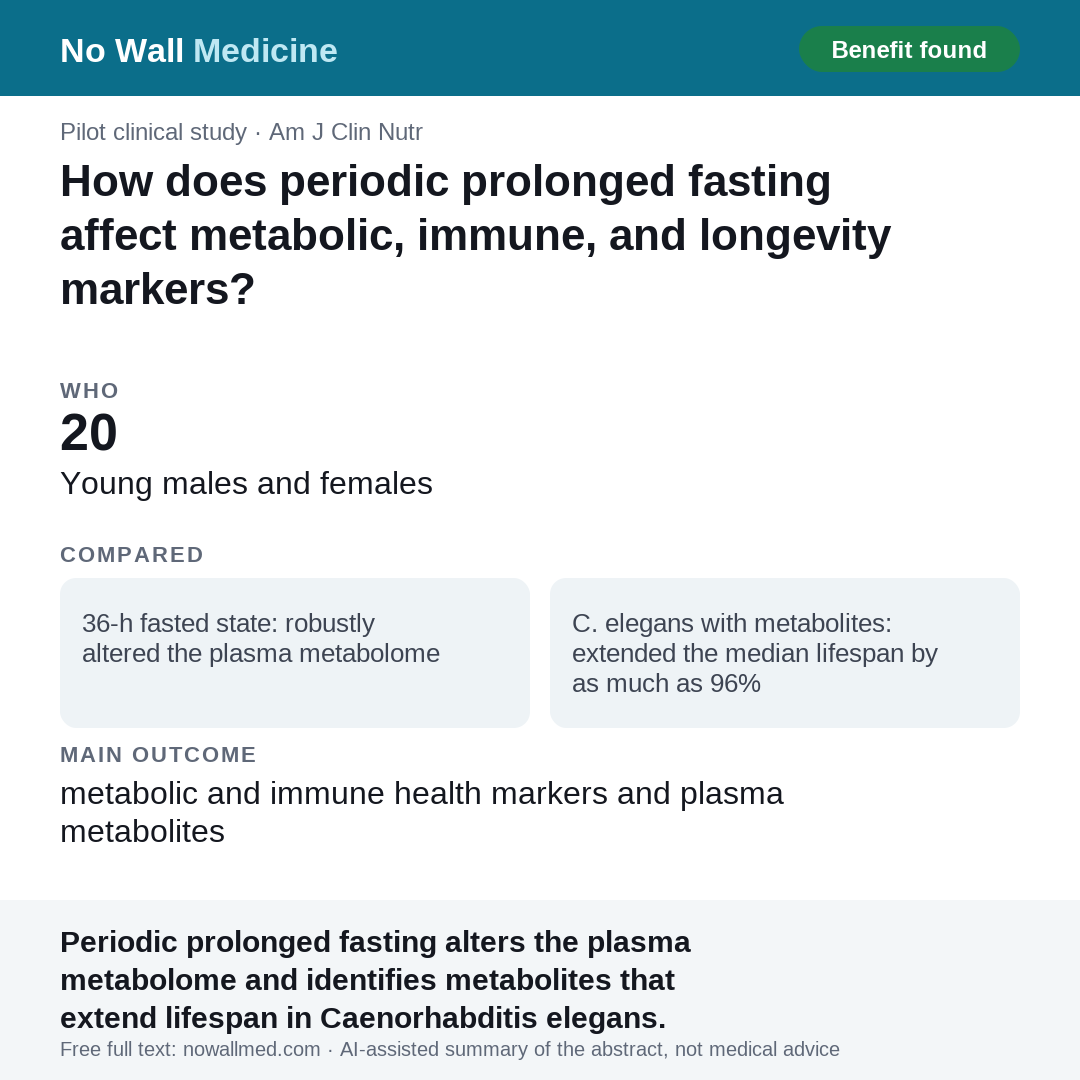
Clinical question: How does periodic prolonged fasting affect metabolic, immune, and longevity markers?
Why it matters: The relationship between metabolic factors, immunity, and longevity during periodic prolonged fasting in humans remains poorly characterized.
Key points
- Researchers studied 20 young males and females across four metabolic states including overnight fasting, a fed state, a 36-h fast, and a re-fed state.
- A 36-h fast was associated with increased levels of four metabolites: spermidine, 1-methylnicotinamide, palmitoylethanolamide, and oleoylethanolamide.
- These four metabolites and their combination were associated with extending the median lifespan of C. elegans by as much as 96%.
Headline and key points written with AI from the paper’s abstract, with every number checked against it. Read the paper before relying on them.
Topics
Cite this article
Rhodes CH, Zhu C, Agus J, Tang X, Li Q, Engebrecht J. Human fasting modulates macrophage function and upregulates multiple bioactive metabolites that extend lifespan in Caenorhabditis elegans: a pilot clinical study. Am J Clin Nutr. 2022. doi:10.1016/j.ajcnut.2022.10.015
Spotted a mistake? Suggest a correction
Top studies every Monday
The week’s key trials and guidelines in your specialties, plus any topics you follow. By email, free.
Get the weekly digest