Human-milk vitamin B-3 (niacin and vitamer) concentrations: secondary analysis of a randomized, placebo-controlled trial of maternal nicotinamide supplementation in rural Tanzania
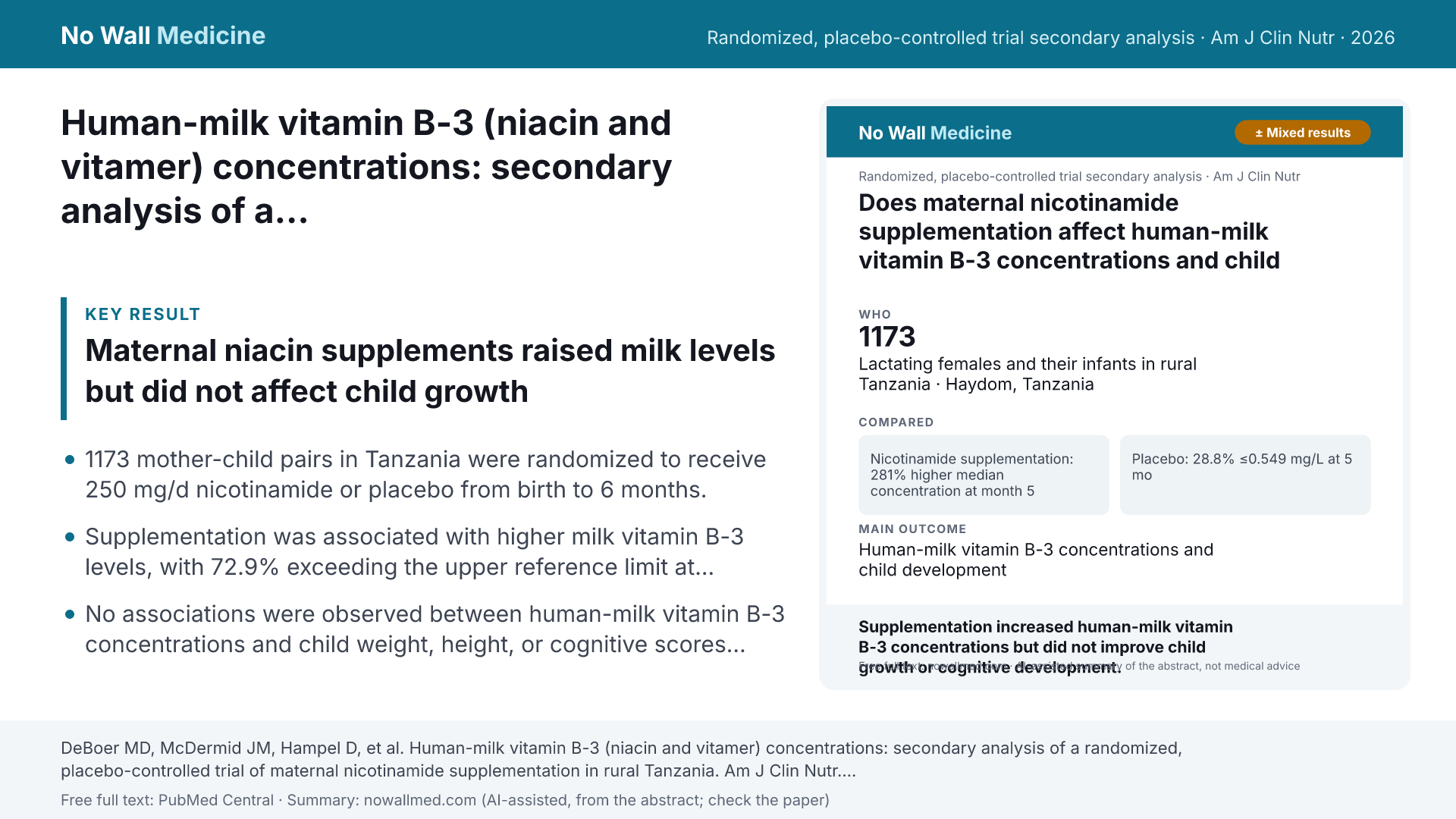
Key result: Maternal niacin supplements raised milk levels but did not affect child growth
Randomized, placebo-controlled trial secondary analysisMixed results
Does maternal nicotinamide supplementation affect human-milk vitamin B-3 concentrations and child outcomes?
Who
1173
Lactating females and their infants in rural Tanzania · Haydom, Tanzania
Compared
Nicotinamide supplementation: 281% higher median concentration at month 5
Placebo: 28.8% ≤0.549 mg/L at 5 mo
Main outcome
Human-milk vitamin B-3 concentrations and child development
Bottom line: Supplementation increased human-milk vitamin B-3 concentrations but did not improve child growth or cognitive development.
Am J Clin Nutr · 2026-06-17
Key points
- 1173 mother-child pairs in Tanzania were randomized to receive 250 mg/d nicotinamide or placebo from birth to 6 months.
- Supplementation was associated with higher milk vitamin B-3 levels, with 72.9% exceeding the upper reference limit at 1 month.
- No associations were observed between human-milk vitamin B-3 concentrations and child weight, height, or cognitive scores at 18 months.
Discussion prompts
- Would these patients look like yours? Who was left out?
- Is the main outcome one that matters to patients?
- Is the difference large enough to change what you do?
Cite: DeBoer MD, McDermid JM, Hampel D, et al. Human-milk vitamin B-3 (niacin and vitamer) concentrations: secondary analysis of a randomized, placebo-controlled trial of maternal nicotinamide supplementation in rural Tanzania. Am J Clin Nutr. 2026;124(2):101397. doi:10.1016/j.ajcnut.2026.101397
Free full text: PubMed Central · Summary and visual abstract: nowallmed.com/a/human-milk-vitamin-b-3-niacin-and-vitamer-concentrations-secondary-c5vg4x/ (AI-assisted from the abstract; check the paper before relying on it).