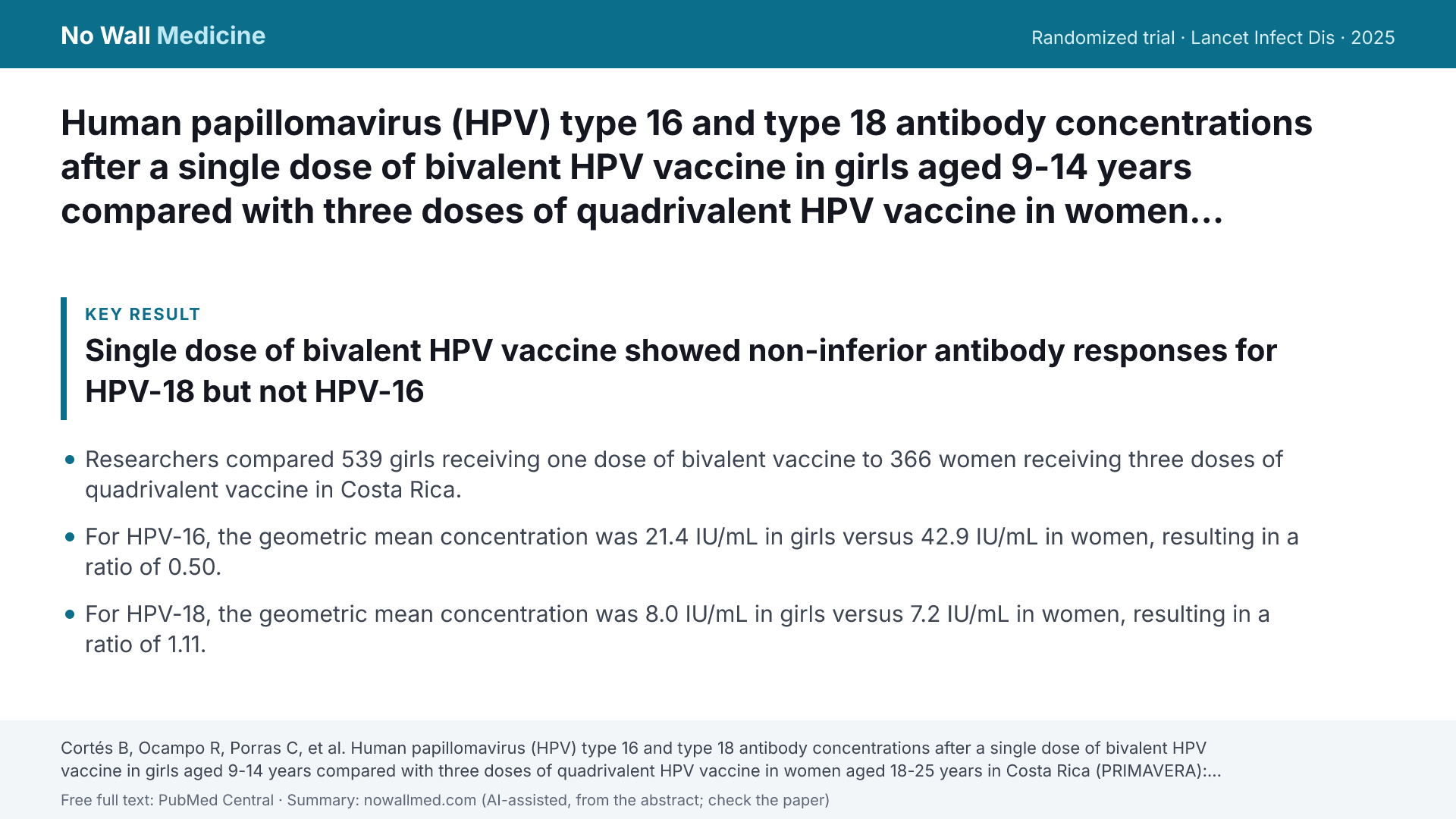
Single dose of bivalent HPV vaccine showed non-inferior antibody responses for HPV-18 but not HPV-16
Human papillomavirus (HPV) type 16 and type 18 antibody concentrations after a single dose of bivalent HPV vaccine in girls aged 9-14 years compared with three doses of quadrivalent HPV vaccine in women aged 18-25 years in Costa Rica (PRIMAVERA): a non-randomised, open-label, immunobridging, non-inferiority trial
Why it matters: The World Health Organization recommended single-dose human papillomavirus vaccination as an alternative to multidose regimens, requiring evidence for the bivalent vaccine.
Key points
- Researchers compared 539 girls receiving one dose of bivalent vaccine to 366 women receiving three doses of quadrivalent vaccine in Costa Rica.
- For HPV-16, the geometric mean concentration was 21.4 IU/mL in girls versus 42.9 IU/mL in women, resulting in a ratio of 0.50.
- For HPV-18, the geometric mean concentration was 8.0 IU/mL in girls versus 7.2 IU/mL in women, resulting in a ratio of 1.11.
Headline and key points written with AI from the paper’s abstract, with every number checked against it. Read the paper before relying on them.
Was this summary helpful?
Abstract
Background
In 2022, WHO recommended single-dose human papillomavirus (HPV) vaccination as an alternative schedule to multidose regimens. To provide evidence to support approval of a single-dose indication for the AS04-adjuvanted bivalent HPV vaccine (Cervarix, GlaxoSmithKline), we investigated whether the immune response to a single dose of the bivalent vaccine in girls aged 9-14 years was non-inferior to the immune response to three doses of the quadrivalent HPV vaccine (Gardasil-4, Merck) in women aged 18-25 years, a dose and population combination with demonstrated efficacy. Methods
This non-randomised, open-label, immunobridging trial enrolled girls aged 9-14 years and women aged 18-25 years in Guanacaste Province, Costa Rica. Healthy girls aged 9-14 years received one dose of bivalent HPV vaccine, whereas healthy women aged 18-25 years received three doses of quadrivalent HPV vaccine at 0, 2, and 6 months. The primary endpoint was geometric mean concentrations (GMCs) of HPV-specific serum antibodies measured by a validated virus-like-particle-based ELISA assay at 36 months. The per-protocol cohort included participants who received the correct number of doses within the predefined vaccination windows, had blood collected at the 36-month study visit for the final analysis, were seronegative at baseline for the specified HPV type, and did not receive additional HPV vaccine doses outside the study. Non-inferiority was declared when the lower bound of the 96% CI for the GMC ratio was greater than or equal to 0·67 for HPV-16 and HPV-18. Seropositivity was a secondary objective. Safety was analysed in the total vaccinated population. This trial is registered with ClinicalTrials.gov, NCT03728881, and is complete. Findings
Between April 1 and Aug 16, 2019, 620 girls and 620 women were enrolled and received their first HPV vaccination. After exclusions, 539 girls and 366 women were HPV-16 seronegative at enrolment and were included in the HPV-16 per-protocol cohort; 523 girls and 373 women were HPV-18 seronegative at enrolment and were included in the HPV-18 per-protocol cohort. At 36 months, the HPV-16 GMC was 21·4 international units (IU)/mL (95% CI 19·7-23·3) in girls in the single-dose bivalent vaccine group and 42·9 IU/mL (95% CI 38·9-47·3) in women in the three-dose quadrivalent vaccine group, resulting in a GMC ratio of 0·50 (96% CI 0·44-0·57); the HPV-18 GMC was 8·0 IU/mL (95% CI 7·4-8·8) in girls in the single-dose bivalent vaccine group and 7·2 IU/mL (95% CI 6·4-8·1) in women in the three-dose quadrivalent vaccine group, resulting in a GMC ratio of 1·11 (96% CI 0·95-1·29). At 36 months, 538 (99·8%, 95% CI 99·1-100) of 539 girls in the single-dose bivalent vaccine group were seropositive for HPV-16 compared with 366 (100%, 99·2-100) of 366 women in the three-dose quadrivalent vaccine group (p=1·00). The proportion of participants who were seropositive for HPV-18 was higher in the single-dose bivalent vaccine group (517 [98·9%, 95% CI 97·6-99·5] of 523 girls) than in the three-dose quadrivalent vaccine group (358 [96·0%, 93·6-97·6] of 373 women; p=0·0065). Two serious adverse events were reported in 620 girls and 13 serious adverse events were reported in 620 women; all serious adverse events were deemed to be unrelated to HPV vaccination. Interpretation
Non-inferior antibody responses for the single-dose bivalent HPV vaccine were seen for HPV-18 but not HPV-16, which would be insufficient evidence to motivate regulatory change, even though seropositivity approached 100% in the follow-up phase and the observed antibody concentrations were similar to protective levels seen in previous trials. Trials that directly evaluate protection afforded by single-dose HPV vaccination against persistent HPV infection will definitively address the level of protection afforded by single-dose HPV vaccination. Funding
National Cancer Institute, Cancer Research UK, and the Gates Foundation. Translation
For the Spanish translation of the abstract see Supplementary Materials section.
Abstract reproduced under the article’s CC BY licence.
Subject terms
Cite this article
Cortés B, Ocampo R, Porras C, et al. Human papillomavirus (HPV) type 16 and type 18 antibody concentrations after a single dose of bivalent HPV vaccine in girls aged 9-14 years compared with three doses of quadrivalent HPV vaccine in women aged 18-25 years in Costa Rica (PRIMAVERA): a non-randomised, open-label, immunobridging, non-inferiority trial. Lancet Infect Dis. 2025. doi:10.1016/S1473-3099(25)00284-1
Spotted a mistake? Suggest a correction