ChatGPT showed modest accuracy in screening studies but high accuracy in meta-analysis data pooling
Human versus artificial intelligence: evaluating ChatGPT's performance in conducting published systematic reviews with meta-analysis in chronic pain research
Validation studyMixed results
How accurate is ChatGPT in conducting systematic reviews and meta-analyses?
Who
Published meta-analysis on emotional functioning after spinal cord stimulation
Compared
ChatGPT-4o title and abstract screening: accuracy 70.4%
ChatGPT-4o full-text screening: accuracy 68.4%
ChatGPT-4o data pooling: 100% accuracy in calculating pooled mean differences
Main outcome
Accuracy, sensitivity, specificity, and meta-analytic calculation precision
Bottom line: ChatGPT shows modest accuracy in screening tasks but performs well in data pooling and meta-analytic calculations.
Reg Anesth Pain Med · 2026-04-02Download image
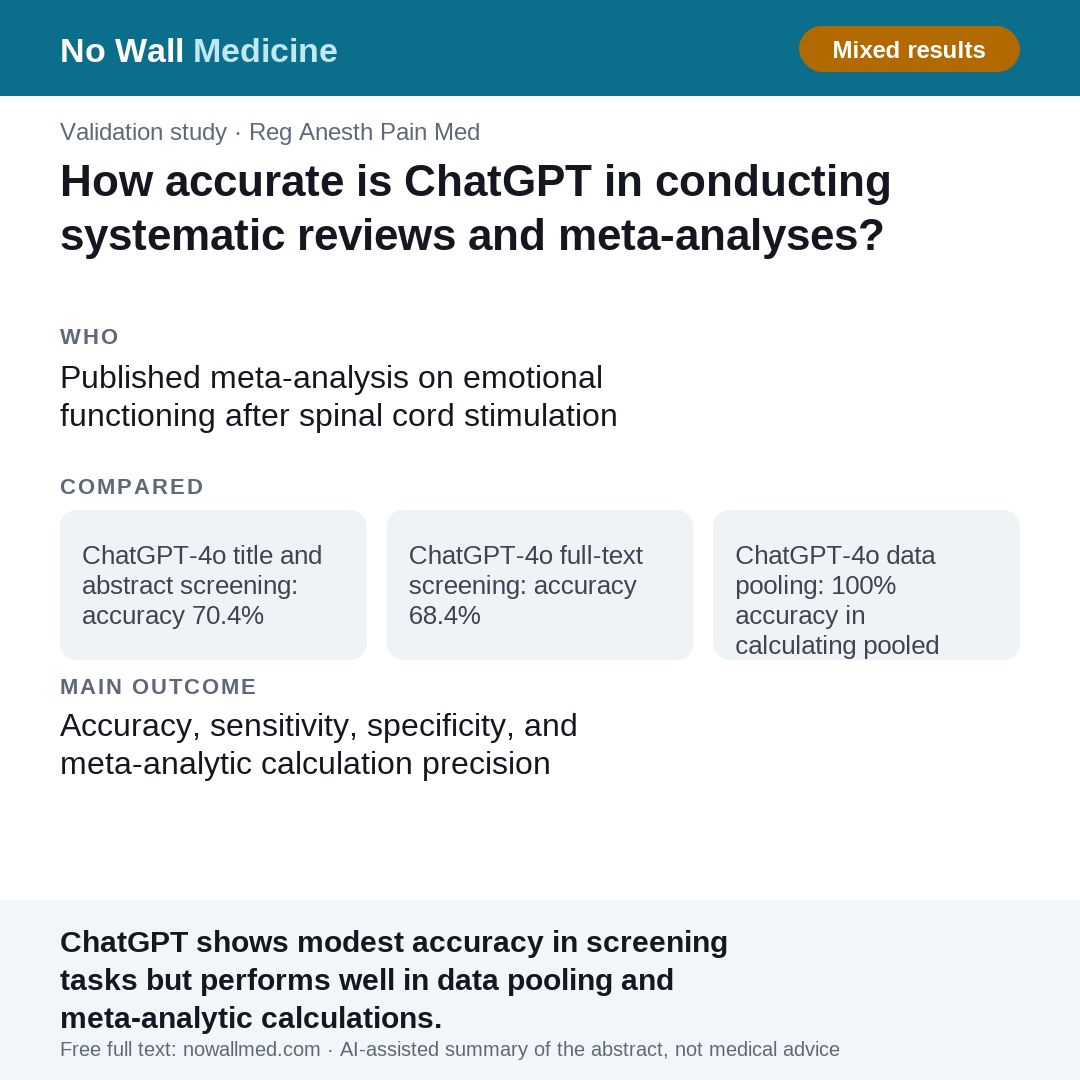
Clinical question: How accurate is ChatGPT in conducting systematic reviews and meta-analyses?
Why it matters: The utility of large-language models like ChatGPT in conducting the time-intensive tasks of systematic reviews and meta-analyses remains unclear.
Key points
- Researchers compared ChatGPT-4o against human experts using a published meta-analysis on emotional functioning after spinal cord stimulation.
- For title and abstract screening, ChatGPT achieved 70.4% accuracy, 54.9% sensitivity, and 80.1% specificity, while full-text screening accuracy was 68.4%.
- ChatGPT achieved 100% accuracy in calculating pooled mean differences, 95% confidence intervals, and heterogeneity estimates for most outcomes.
Headline and key points written with AI from the paper’s abstract, with every number checked against it. Read the paper before relying on them.
Abstract
Introduction
Artificial intelligence (AI), particularly large-language models like Chat Generative Pre-Trained Transformer (ChatGPT), has demonstrated potential in streamlining research methodologies. Systematic reviews and meta-analyses, often considered the pinnacle of evidence-based medicine, are inherently time-intensive and demand meticulous planning, rigorous data extraction, thorough analysis, and careful synthesis. Despite promising applications of AI, its utility in conducting systematic reviews with meta-analysis remains unclear. This study evaluated ChatGPT's accuracy in conducting key tasks of a systematic review with meta-analysis. Methods
This validation study used data from a published meta-analysis on emotional functioning after spinal cord stimulation. ChatGPT-4o performed title/abstract screening, full-text study selection, and data pooling for this systematic review with meta-analysis. Comparisons were made against human-executed steps, which were considered the gold standard. Outcomes of interest included accuracy, sensitivity, specificity, positive predictive value, and negative predictive value for screening and full-text review tasks. We also assessed for discrepancies in pooled effect estimates and forest plot generation. Results
For title and abstract screening, ChatGPT achieved an accuracy of 70.4%, sensitivity of 54.9%, and specificity of 80.1%. In the full-text screening phase, accuracy was 68.4%, sensitivity 75.6%, and specificity 66.8%. ChatGPT successfully pooled data for five forest plots, achieving 100% accuracy in calculating pooled mean differences, 95% CIs, and heterogeneity estimates (I2 score and tau-squared values) for most outcomes, with minor discrepancies in tau-squared values (range 0.01-0.05). Forest plots showed no significant discrepancies. Conclusion
ChatGPT demonstrates modest to moderate accuracy in screening and study selection tasks, but performs well in data pooling and meta-analytic calculations. These findings underscore the potential of AI to augment systematic review methodologies, while also emphasizing the need for human oversight to ensure accuracy and integrity in research workflows.
Abstract reproduced under the article’s CC BY NC licence.
Topics
Cite this article
Purewal A, Fautsch K, Klasova J, Hussain N, D'Souza RS. Human versus artificial intelligence: evaluating ChatGPT's performance in conducting published systematic reviews with meta-analysis in chronic pain research. Reg Anesth Pain Med. 2026. doi:10.1136/rapm-2024-106358
Spotted a mistake? Suggest a correction