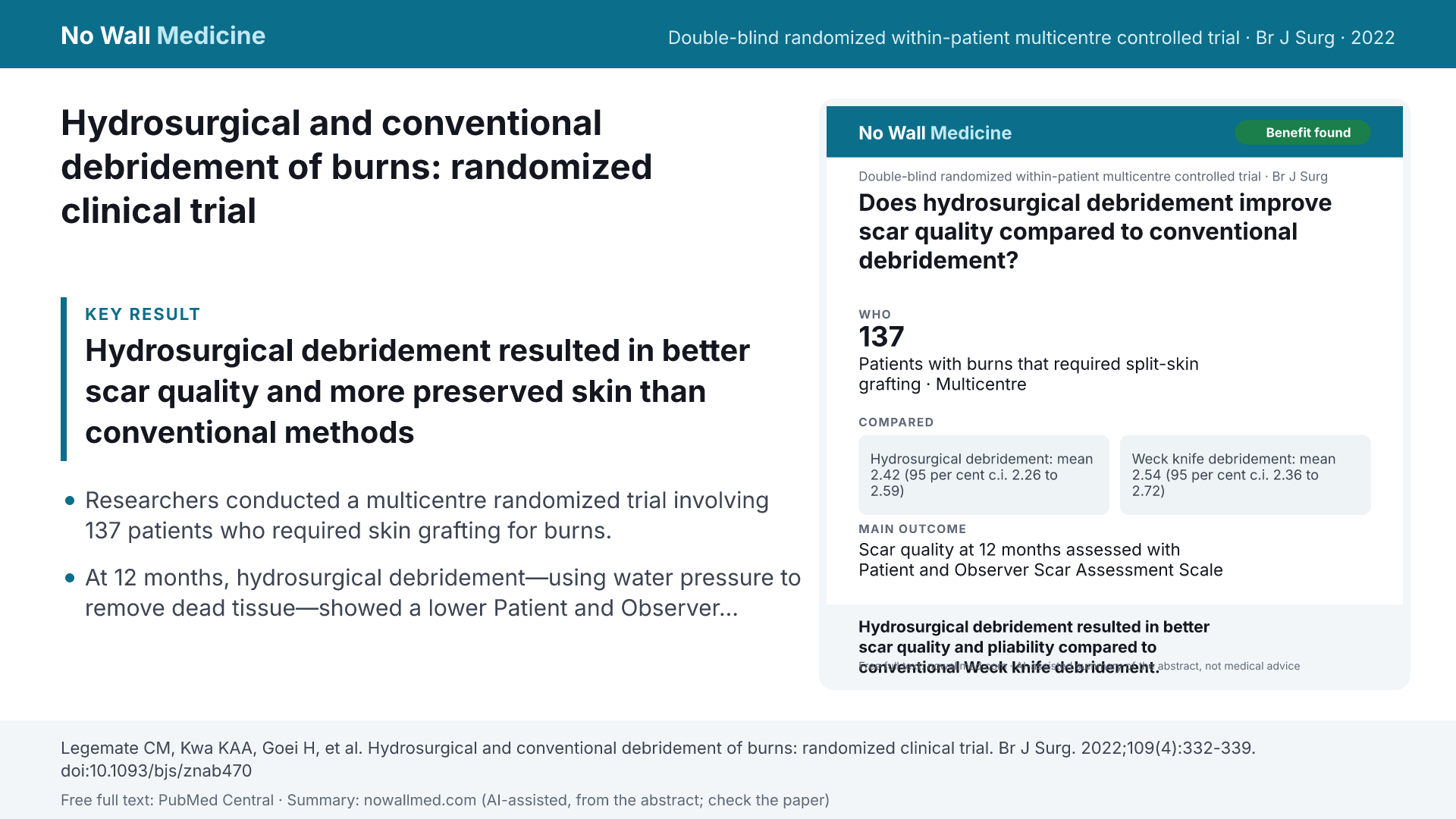
Hydrosurgical debridement resulted in better scar quality and more preserved skin than conventional methods
Hydrosurgical and conventional debridement of burns: randomized clinical trial
Double-blind randomized within-patient multicentre controlled trialBenefit found
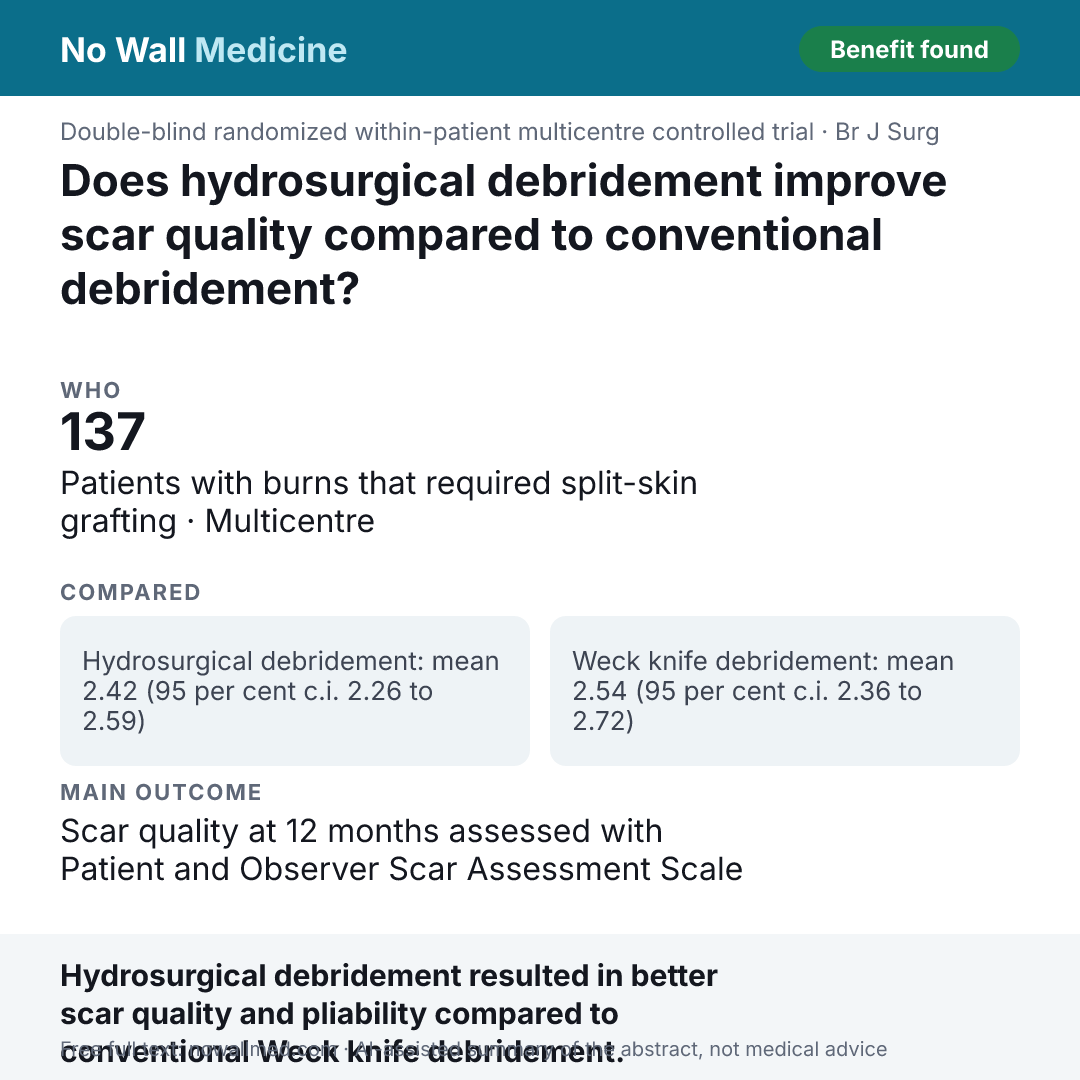
Does hydrosurgical debridement improve scar quality compared to conventional debridement?
Who
137
Patients with burns that required split-skin grafting · Multicentre
Compared
Hydrosurgical debridement: mean 2.42 (95 per cent c.i. 2.26 to 2.59)
Weck knife debridement: mean 2.54 (95 per cent c.i. 2.36 to 2.72)
Main outcome
Scar quality at 12 months assessed with Patient and Observer Scar Assessment Scale
Result: P = 0.023
Bottom line: Hydrosurgical debridement resulted in better scar quality and pliability compared to conventional Weck knife debridement.
Br J Surg · 2022-03-04 · Save PNG
Clinical question: Does hydrosurgical debridement improve scar quality compared to conventional debridement?
Key points
- Researchers conducted a multicentre randomized trial involving 137 patients who required skin grafting for burns.
- At 12 months, hydrosurgical debridement—using water pressure to remove dead tissue—showed a lower Patient and Observer Scar Assessment Scale observer total item score of 2.42 versus 2.54 for conventional Weck knife debridement.
- Hydrosurgery was associated with significantly more preserved dermis, which is the deeper layer of skin, compared to conventional methods.
Headline and key points written with AI from the paper’s abstract, with every number checked against it. Read the paper before relying on them.
Was this summary helpful?
Subject terms
Headline, design, result, key points, caveat and citation as plain text.
Cite this article
Legemate CM, Kwa KAA, Goei H, et al. Hydrosurgical and conventional debridement of burns: randomized clinical trial. Br J Surg. 2022;109(4):332-339. doi:10.1093/bjs/znab470
Spotted a mistake? Suggest a correction