Hyperbaric oxygen therapy was associated with higher wound healing rates and lower amputation rates
Hyperbaric Oxygen Therapy for Diabetic Foot Ulcers Based on Wagner Grading: A Systematic Review and Meta-analysis
Meta-analysis of 14 randomized controlled trialsBenefit found
Does hyperbaric oxygen therapy improve outcomes for diabetic foot ulcers based on Wagner grading?
Who
14
Patients with diabetic foot ulcers
Compared
Hyperbaric oxygen therapy
Other treatments
Main outcome
wound healing, amputations, debridement, and nonhealing wounds
Result: RR = 2.39; 1.87-3.05
Bottom line: Hyperbaric oxygen therapy improves wound healing and reduces amputation rates for Wagner grades II, III, and IV.
Plast Reconstr Surg Glob Open · 2024-03-25Download image
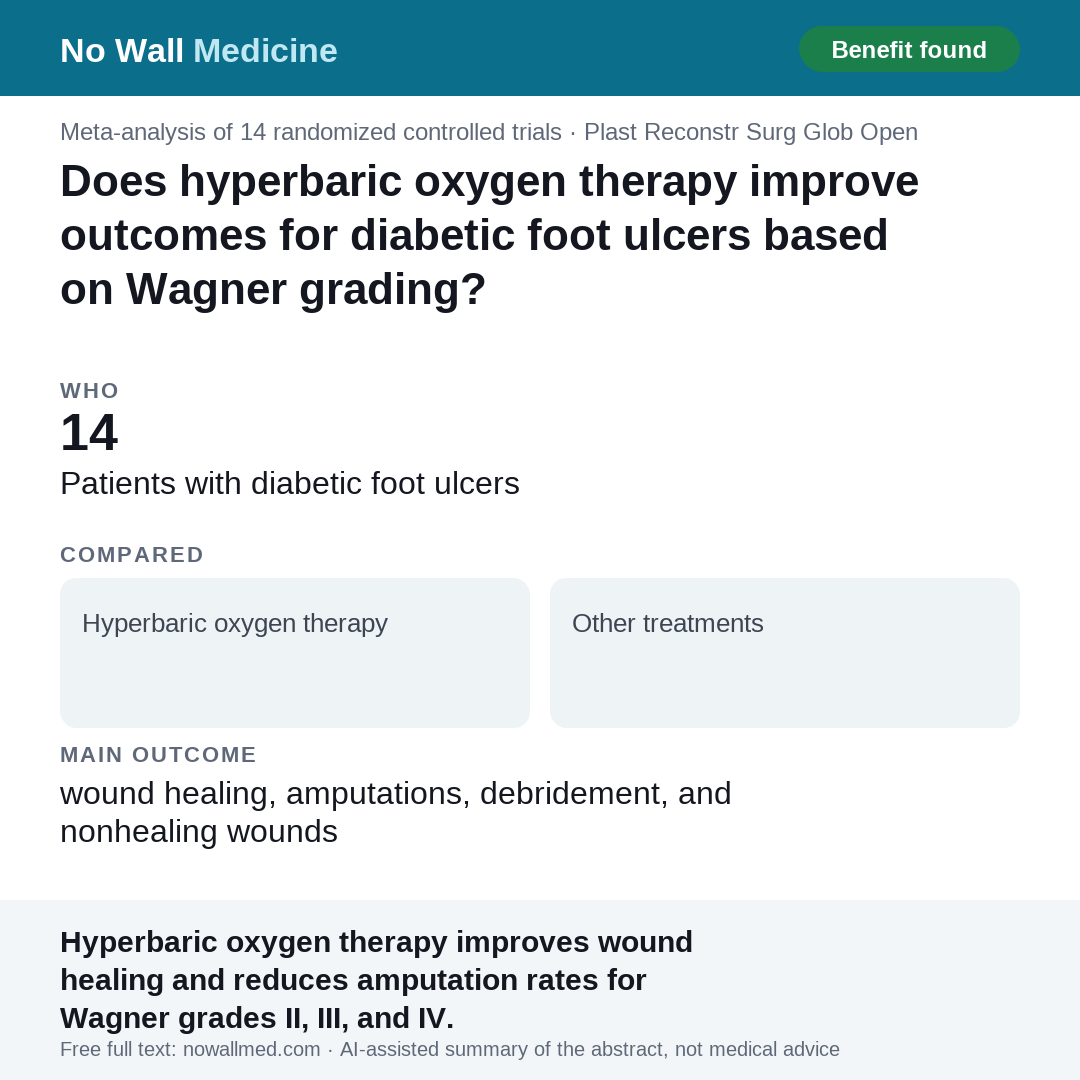
Clinical question: Does hyperbaric oxygen therapy improve outcomes for diabetic foot ulcers based on Wagner grading?
Why it matters: The benefits and risks of hyperbaric oxygen therapy compared to other treatments for diabetic foot ulcers based on the Wagner grading system were not clearly established.
Key points
- Researchers analyzed 14 randomized controlled trials to compare hyperbaric oxygen therapy, which involves breathing pure oxygen in a pressurized chamber, against other treatments for diabetic foot ulcers.
- Hyperbaric oxygen therapy was associated with higher wound healing rates 8 or more weeks after treatment (RR = 2.39; 1.87-3.05; P < 0.00001) and lower minor/distal amputation rates (RR = 0.58; 0.43-0.80; P < 0.007).
- The therapy was associated with lower major/proximal amputation rates (RR = 0.31; 0.18-0.52; P < 0.00001) and lower operative debridement rates for Wagner grade II wounds (RR = 0.09; 0.01-0.60; P = 0.01).
Headline and key points written with AI from the paper’s abstract, with every number checked against it. Read the paper before relying on them.
Was this summary helpful?
Cite this article
Oley MH, Oley MC, Kepel BJ, Faruk M, Wagiu AMJ, Sukarno I. Hyperbaric Oxygen Therapy for Diabetic Foot Ulcers Based on Wagner Grading: A Systematic Review and Meta-analysis. Plast Reconstr Surg Glob Open. 2024. doi:10.1097/GOX.0000000000005692
Spotted a mistake? Suggest a correction
Top studies every Monday
The week’s key trials and guidelines in your specialties, plus any topics you follow. By email, free.
Get the weekly digest