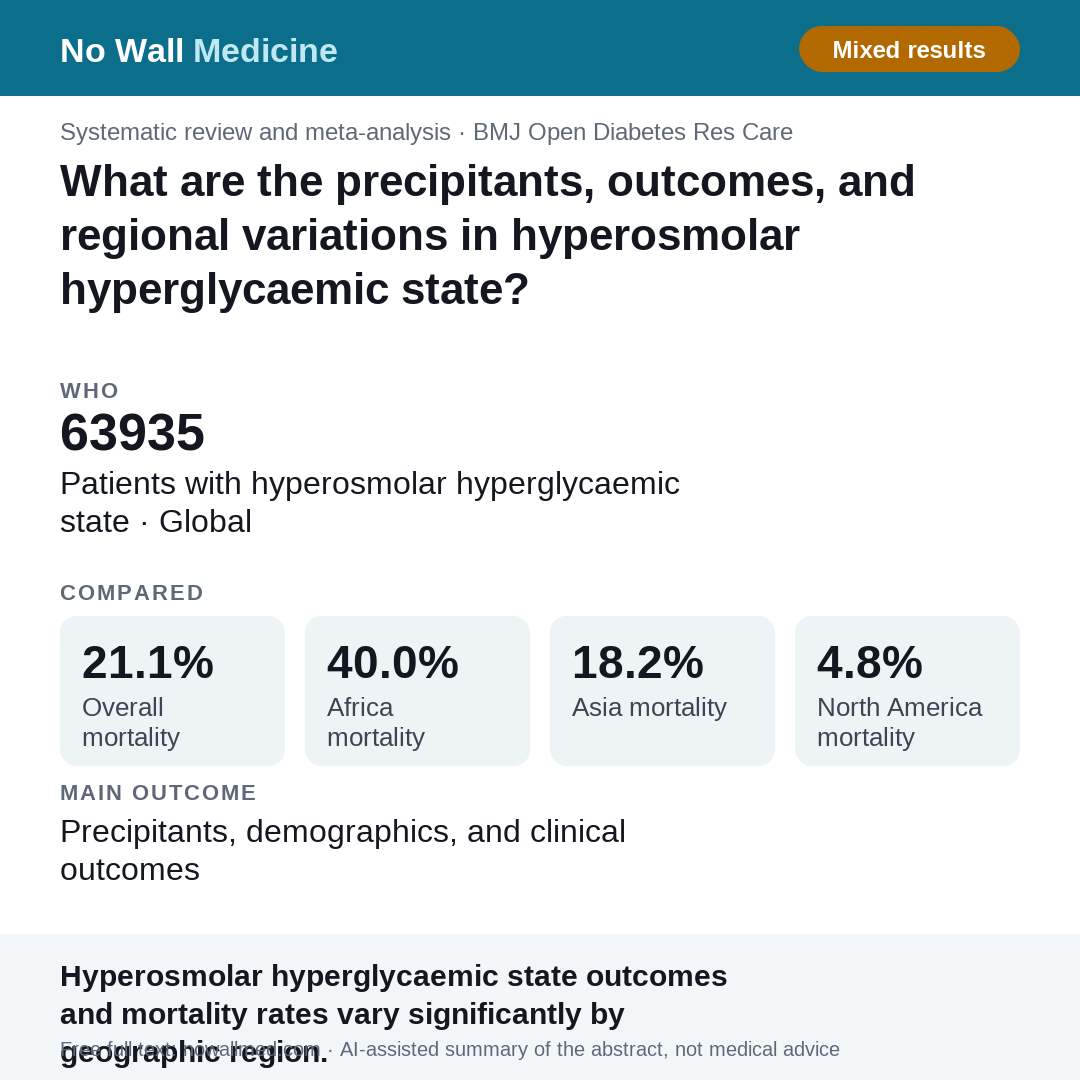
Clinical question: What are the precipitants, outcomes, and regional variations in hyperosmolar hyperglycaemic state?
Why it matters: Current knowledge of hyperosmolar hyperglycaemic state is limited to small case series and observational cohorts, leaving a lack of robust data on triggers and mortality.
Key points
Researchers analyzed 27 studies involving 63,935 cases of hyperosmolar hyperglycaemic state, a serious complication of high blood sugar.
The overall mortality rate was 21.1%, with the highest rate in Africa at 40.0% and the lowest in North America at 4.8%.
Common triggers for the condition included non-infective illness at 49.5%, infection at 44.0%, and a new diabetes diagnosis at 31.7%.
Headline and key points written with AI from the paper’s abstract, with every number checked against it. Read the paper before relying on them.
Current knowledge of hyperosmolar hyperglycaemic state (HHS) is drawn from case series and small observational cohorts, limiting applicability to broader clinical practice. There is a lack of robust, large-scale studies exploring triggers of HHS and associated mortality. This absence of reliable data impedes prevention strategies, tailored clinical guidelines, and equitable resource allocation. We conducted this systematic review to aggregate all relevant HHS cases, explore precipitating factors and outcomes, and how these vary by region. Searches across Ovid, PubMed, EMBASE, MEDLINE, Scopus, Web of Science, and Cochrane Library followed the Preferred Reporting Items for Systematic Reviews and Meta-Analyses (PRISMA) guidelines. Studies reporting HHS cases from database inception to February 2025 were selected. Data on demographics, biochemical results, precipitants, outcomes, and complications were collected. 27 studies with a total of 63 935 cases were included. The median age was 63.8 years (IQR: 56.1-72.0). Common precipitants were non-infective illness (49.5%), infection (44.0%), and new diabetes diagnosis (31.7%). Intensive treatment unit admission was 40.8%, with the highest rate in North America (70.0%). Median hospital stay was 7.5 days, longest in Asia (17.5 days) and shortest in North and South America (4.0 days). Overall mortality was 21.1%, highest in Africa (40.0%), followed by Asia (18.2%), and lowest in North America (4.8%). Complications were acute kidney injury (7.6%), pulmonary oedema (4.8%), and acute coronary syndrome (3.9%). HHS presents with similar biochemistry globally, but outcomes vary significantly. Reducing mortality requires better diabetes diagnosis, harmonised protocols, and resource-adapted management to reduce gaps and inform prevention guidelines.PROSPERO registration numberCRD42025625923.
Abstract reproduced under the article’s CC BY NC licence.
Topics
Humans; Hyperglycemic Hyperosmolar Nonketotic Coma