High oxygen levels were associated with worsened heart relaxation in patients undergoing heart bypass surgery
Hyperoxia-induced deterioration of diastolic function in anaesthetised patients with coronary artery disease - Randomised crossover trial
Randomised crossover clinical trialHarm found
Does hyperoxia affect cardiac function in anaesthetised patients with coronary artery disease?
Who
Patients scheduled for elective coronary artery bypass graft surgery
Compared
Normoxaemia (0.3 inspired oxygen fraction)
Hyperoxia (0.8 inspired oxygen fraction): averaged E/e' 8.6 [2.6]
Main outcome
Diastolic function and systolic function
Bottom line: Diastolic function consistently worsens under hyperoxia in patients with coronary artery disease.
BJA Open · 2023-04-27Download image
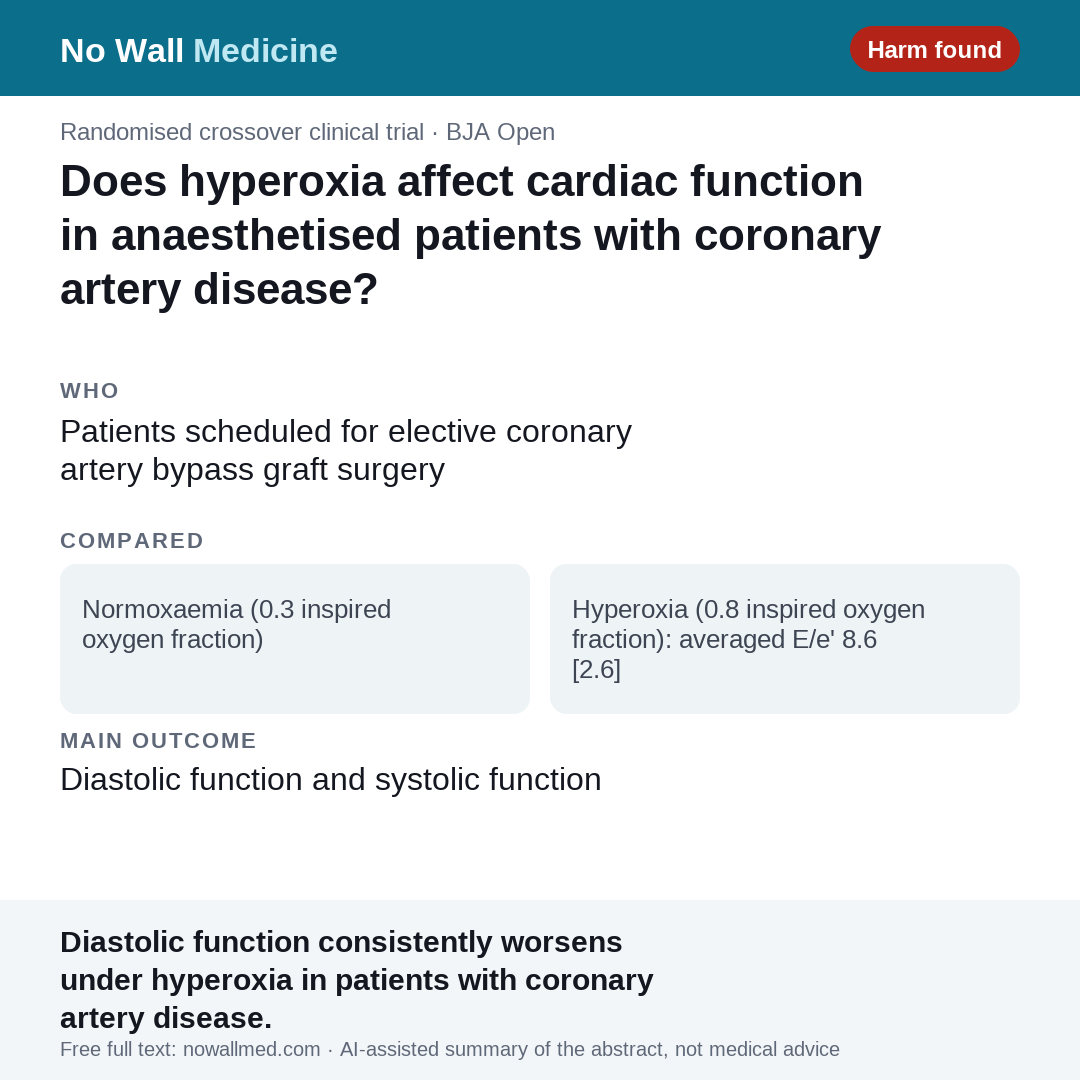
Clinical question: Does hyperoxia affect cardiac function in anaesthetised patients with coronary artery disease?
Why it matters: There are currently no recommendations for how to titrate oxygen levels in patients with stable coronary artery disease.
Key points
- Patients scheduled for elective coronary artery bypass surgery were randomized to receive either 0.3 inspired oxygen fraction or 0.8 inspired oxygen fraction.
- Hyperoxia was associated with worsened diastolic function, which is the heart's ability to relax, shown by an increase in averaged E/e' from 8.2 [2.4] to 8.6 [2.6].
- The effect of hyperoxia on systolic function, or the heart's contraction, depended on the patient's baseline ventricular function at normal oxygen levels.
Headline and key points written with AI from the paper’s abstract, with every number checked against it. Read the paper before relying on them.
Was this summary helpful?
Cite this article
Friess JO, Mikasi J, Baumann R, Ranjan R, Fischer K, Levis A. Hyperoxia-induced deterioration of diastolic function in anaesthetised patients with coronary artery disease - Randomised crossover trial. BJA Open. 2023. doi:10.1016/j.bjao.2023.100135
Spotted a mistake? Suggest a correction
Top studies every Monday
The week’s key trials and guidelines in your specialties, plus any topics you follow. By email, free.
Get the weekly digest