High-risk hypertension may change how well blood thinners prevent stroke after cryptogenic stroke
Hypertension With High-Risk Features in Cryptogenic Stroke: An Exploratory Analysis of the ARCADIA Randomized Clinical Trial
Exploratory analysis of a randomized clinical trialMixed results
Does hypertension with high-risk features modify treatment effect of anticoagulation versus antiplatelet therapy?
Who
945
Patients with recent cryptogenic stroke and atrial cardiopathy · 185 sites in North America
Compared
Without hypertension with high-risk features: hazard ratio 0.43 (95% CI, 0.22-0.85)
With hypertension with high-risk features: hazard ratio 1.68 (95% CI, 0.78-3.62)
Main outcome
recurrent ischemic stroke or systemic embolism
Result: hazard ratio 0.43 (95% CI, 0.22-0.85) vs hazard ratio 1.68 (95% CI, 0.78-3.62)
Bottom line: Apixaban was beneficial without high-risk hypertension, but showed no significant association in patients with high-risk hypertension features.
Limitation: This was an exploratory analysis of a randomized clinical trial.
JAMA Neurol · 2026-04-21Download image
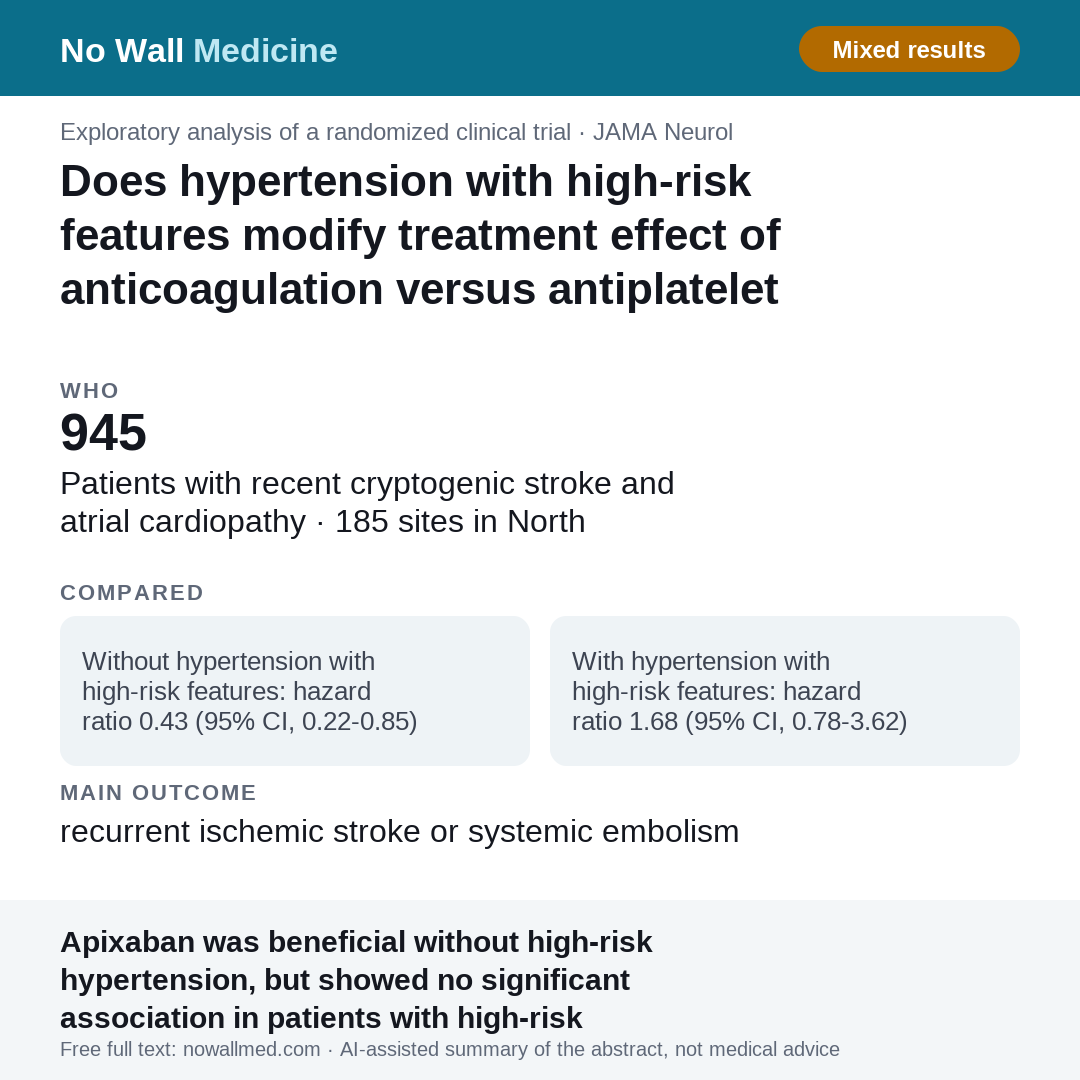
Clinical question: Does hypertension with high-risk features modify treatment effect of anticoagulation versus antiplatelet therapy?
Why it matters: Current stroke classification may fail to exclude patients with hypertension-related cerebrovascular disease, which might explain why previous trials found no difference between anticoagulation and antiplatelet therapy.
Key points
- Researchers analyzed 945 patients from the ARCADIA trial who had a cryptogenic stroke, which is a stroke of unknown cause, and atrial cardiopathy.
- In patients without high-risk hypertension, apixaban was associated with a lower risk of recurrent stroke or systemic embolism compared to aspirin (hazard ratio, 0.43).
- No significant association was observed between the treatment and stroke prevention in the 351 patients who had high-risk hypertension features.
Headline and key points written with AI from the paper’s abstract, with every number checked against it. Read the paper before relying on them.
Topics
Spotted a mistake? Suggest a correction