Hyperthyroidism and clinical depression: a systematic review and meta-analysis
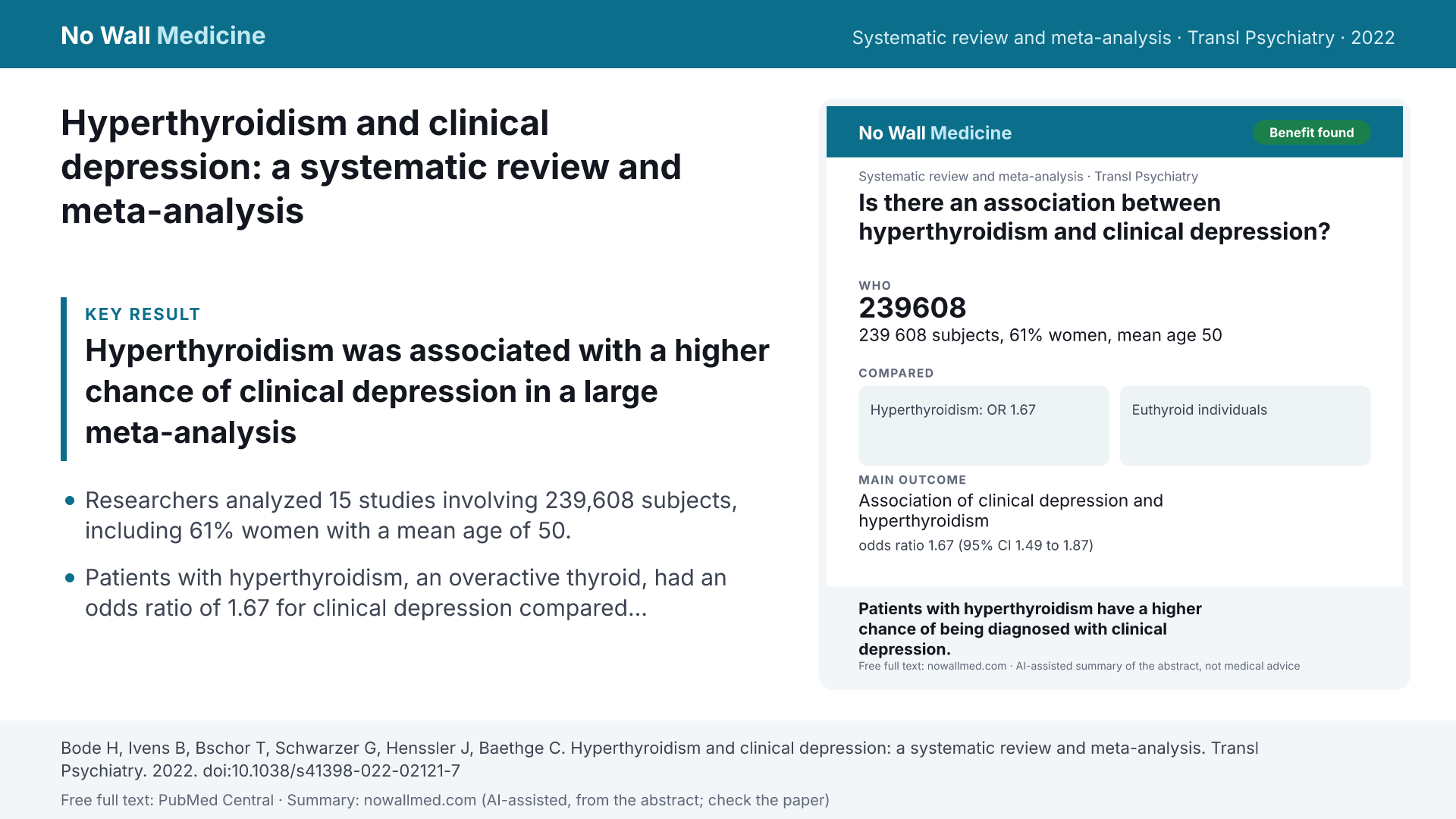
Key result: Hyperthyroidism was associated with a higher chance of clinical depression in a large meta-analysis
Systematic review and meta-analysisBenefit found
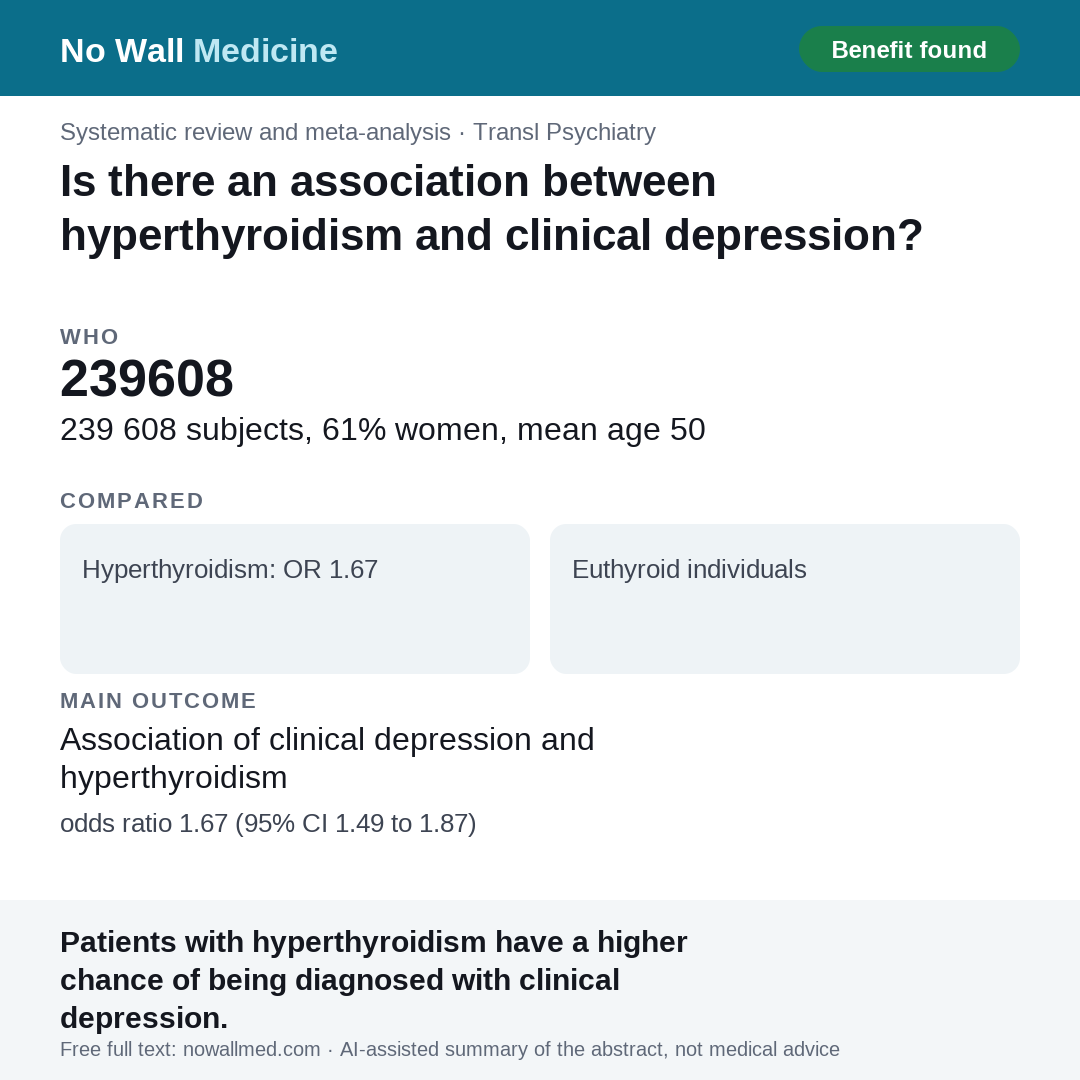
Is there an association between hyperthyroidism and clinical depression?
Who
239608
239 608 subjects, 61% women, mean age 50
Compared
Hyperthyroidism: OR 1.67
Euthyroid individuals
Main outcome
Association of clinical depression and hyperthyroidism
Result: odds ratio 1.67 (95% CI 1.49 to 1.87)
Bottom line: Patients with hyperthyroidism have a higher chance of being diagnosed with clinical depression.
Transl Psychiatry · 2022-09-05Download image
Key points
- Researchers analyzed 15 studies involving 239,608 subjects, including 61% women with a mean age of 50.
- Patients with hyperthyroidism, an overactive thyroid, had an odds ratio of 1.67 for clinical depression compared to individuals with normal thyroid levels.
- The association was slightly less pronounced for subclinical hyperthyroidism with an odds ratio of 1.36 compared to 1.70 for overt hyperthyroidism.
Why it matters: The extent of the association between hyperthyroidism and clinical depression in the general population had not yet been estimated using a meta-analysis.
Discussion prompts
- Would these patients look like yours? Who was left out?
- Is the main outcome one that matters to patients?
- Is the difference large enough to change what you do?
Cite: Bode H, Ivens B, Bschor T, Schwarzer G, Henssler J, Baethge C. Hyperthyroidism and clinical depression: a systematic review and meta-analysis. Transl Psychiatry. 2022. doi:10.1038/s41398-022-02121-7
Free full text: PubMed Central · Summary and visual abstract: nowallmed.com/a/hyperthyroidism-and-clinical-depression-a-systematic-review-and-meta-13171hr/ (AI-assisted from the abstract; check the paper before relying on it).