Hypokalaemia and atrial fibrillation detected by implanted loop recorders
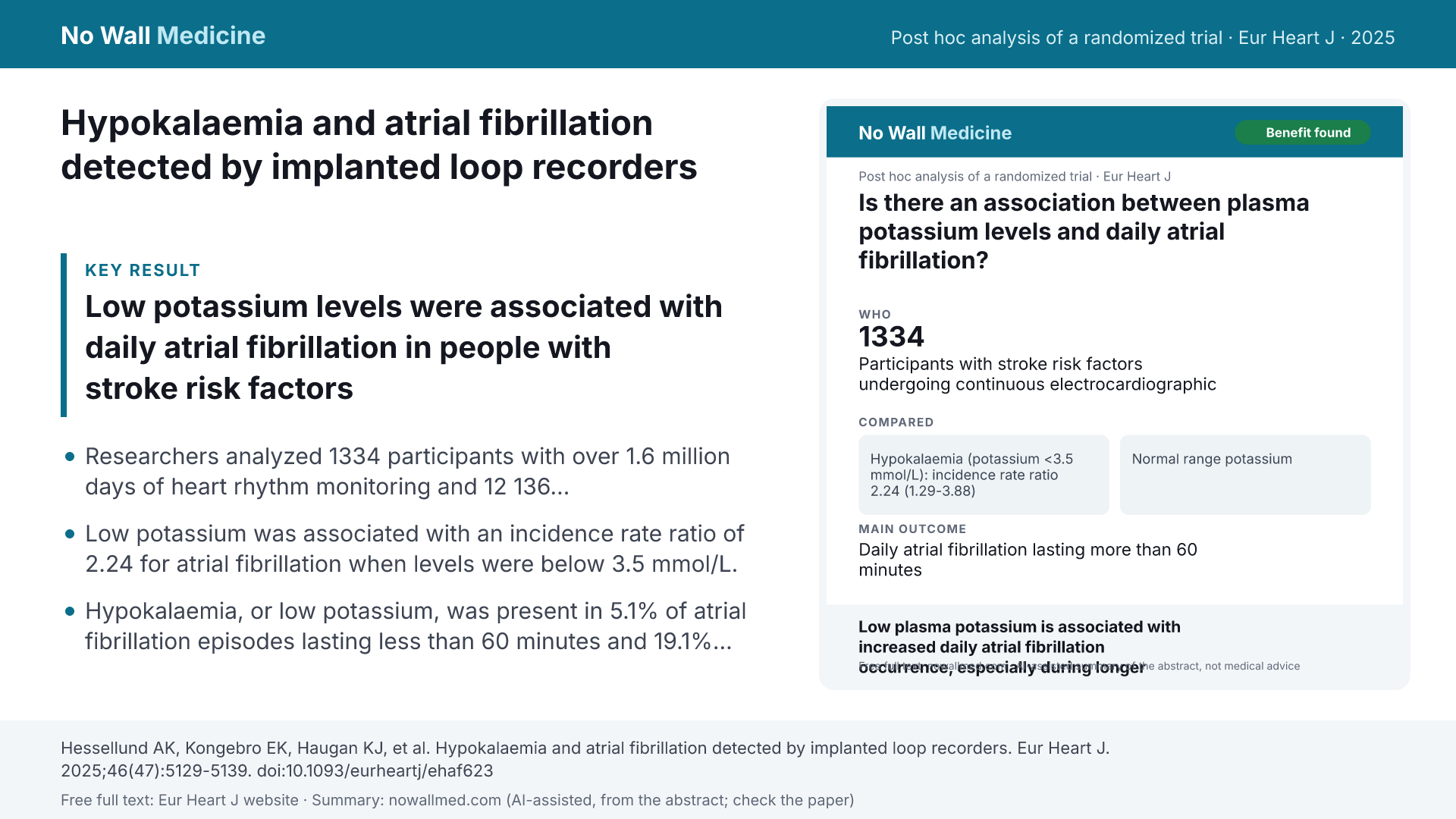
Key result: Low potassium levels were associated with daily atrial fibrillation in people with stroke risk factors
Key points
- Researchers analyzed 1334 participants with over 1.6 million days of heart rhythm monitoring and 12 136 potassium measurements.
- Low potassium was associated with an incidence rate ratio of 2.24 for atrial fibrillation when levels were below 3.5 mmol/L.
- Hypokalaemia, or low potassium, was present in 5.1% of atrial fibrillation episodes lasting less than 60 minutes and 19.1% of episodes lasting more than 240 minutes.
Why it matters: The day-to-day association between plasma potassium levels and atrial fibrillation remains unclear in individuals at risk for stroke.
Limitation the authors note: This was an exploratory post hoc analysis of the LOOP study.
Discussion prompts
- Would these patients look like yours? Who was left out?
- Is the main outcome one that matters to patients?
- Is the difference large enough to change what you do?
Cite: Hessellund AK, Kongebro EK, Haugan KJ, et al. Hypokalaemia and atrial fibrillation detected by implanted loop recorders. Eur Heart J. 2025;46(47):5129-5139. doi:10.1093/eurheartj/ehaf623
Free full text: Eur Heart J website · Summary and visual abstract: nowallmed.com/a/hypokalaemia-and-atrial-fibrillation-detected-by-implanted-loop-1kbqtby/ (AI-assisted from the abstract; check the paper before relying on it).