Researchers plan randomized trial to test if cooling large animals after cardiac arrest protects the brain
Hypothermia After Cardiac Arrest in Large Animals (HACA-LA): Study protocol of a randomized controlled experimental trial
Randomized controlled experimental trialUnclear result
Does hypothermia after cardiac arrest confer benefit compared to normothermia in large animals?
Who
Adult female pigs
Compared
Immediate intravenous cooling to 33 °C
Delayed two hour intravenous cooling to 33 °C
Intravenously controlled normothermia at 38 °C
Main outcome
Histological brain injury on day seven
Bottom line: This study protocol aims to investigate if hypothermia is neuroprotective in large animal models.
Resusc Plus · 2024-06-29Download image
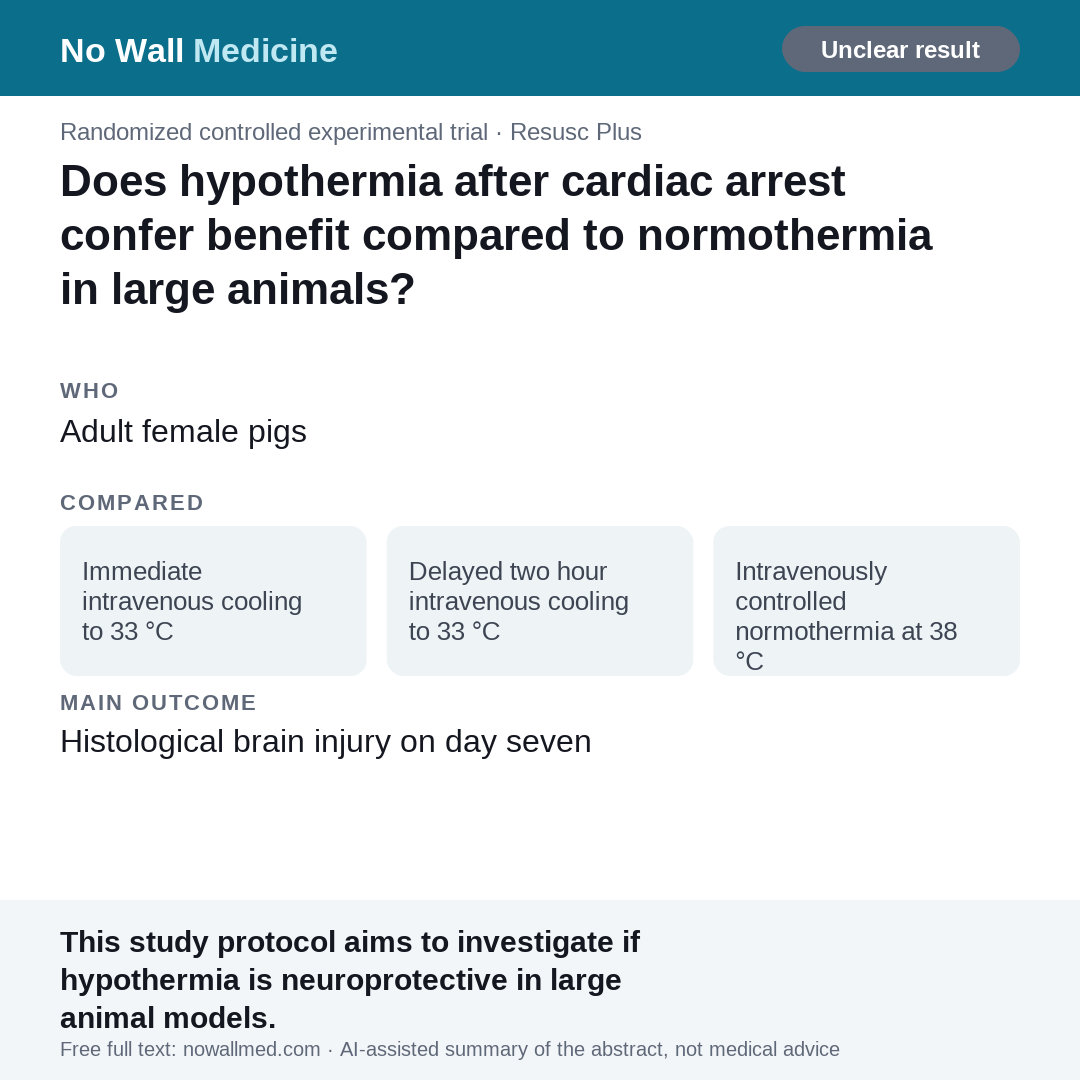
Clinical question: Does hypothermia after cardiac arrest confer benefit compared to normothermia in large animals?
Why it matters: It is unknown if induced hypothermia, or cooling the body, provides neuroprotection in large animals with human-like brains after cardiac arrest.
Key points
- The study protocol describes a randomized trial using adult female pigs that undergo ten minutes of cardiac arrest and four minutes of cardiopulmonary resuscitation.
- Animals will be randomized to receive immediate cooling to 33 °C, delayed cooling to 33 °C after 2 h, or controlled normothermia at 38 °C.
- The primary goal is to measure histological brain injury, which is physical damage to brain tissue, on day seven after the procedure.
Headline and key points written with AI from the paper’s abstract, with every number checked against it. Read the paper before relying on them.
Was this summary helpful?

Cite this article
Persson O, Valerianova A, Bělohlávek J, Cronberg T, Nielsen N, Englund E. Hypothermia After Cardiac Arrest in Large Animals (HACA-LA): Study protocol of a randomized controlled experimental trial. Resusc Plus. 2024. doi:10.1016/j.resplu.2024.100704
Spotted a mistake? Suggest a correction
Top studies every Monday
The week’s key trials and guidelines in your specialties, plus any topics you follow. By email, free.
Get the weekly digest