Genetic variants linked to autism and neuronal migration are associated with reading disabilities
Hypothesis-driven genome-wide association studies provide novel insights into genetics of reading disabilities
Hypothesis-driven genome-wide association studiesBenefit found
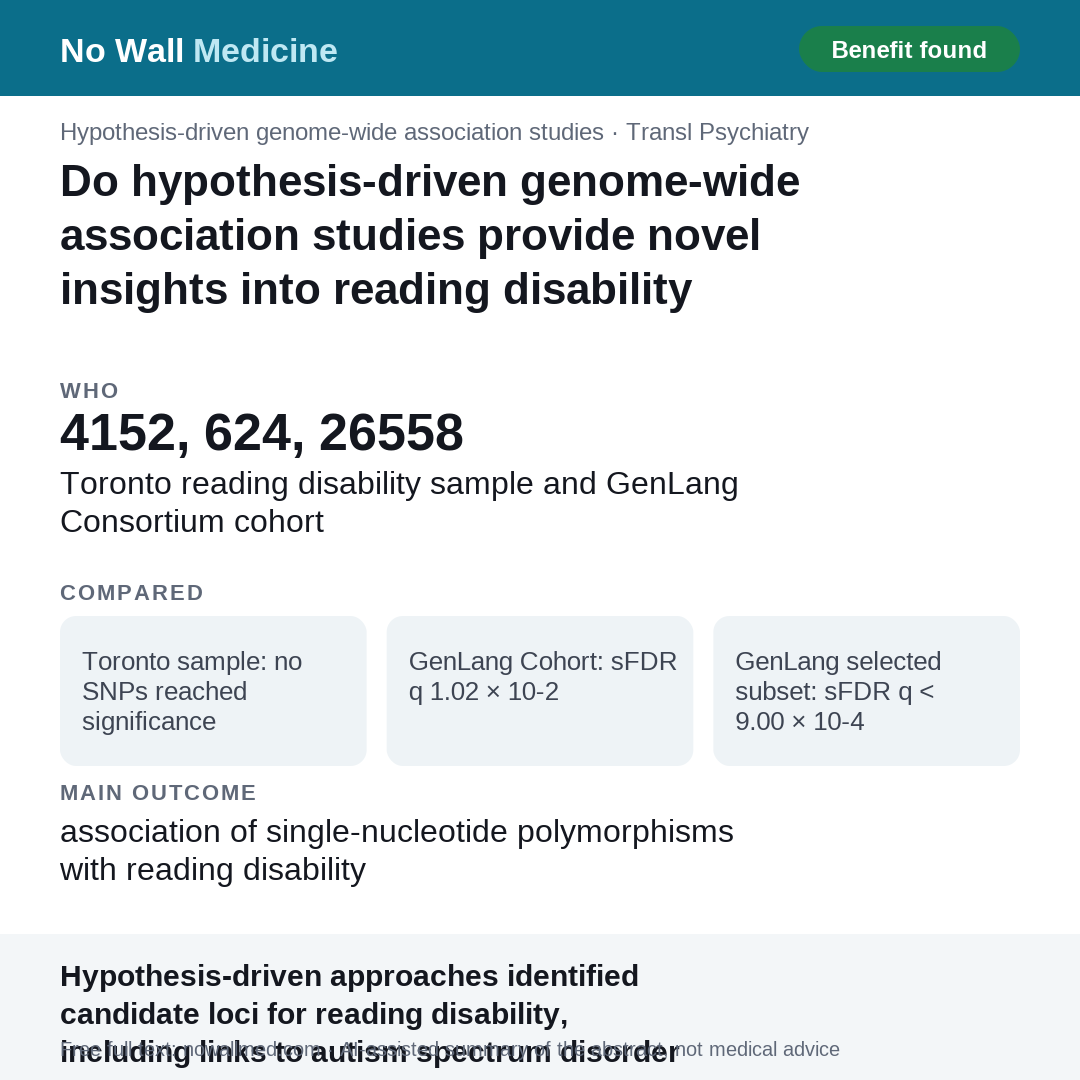
Do hypothesis-driven genome-wide association studies provide novel insights into reading disability genetics?
Who
4152, 624, 26558
Toronto reading disability sample and GenLang Consortium cohort
Compared
Toronto sample: no SNPs reached significance
GenLang Cohort: sFDR q 1.02 × 10⁻²
GenLang selected subset: sFDR q < 9.00 × 10⁻⁴
Main outcome
association of single-nucleotide polymorphisms with reading disability
Bottom line: Hypothesis-driven approaches identified candidate loci for reading disability, including links to autism spectrum disorder genes.
Limitation: Finding is limited to the Toronto sample suggesting that ascertainment influences genetic associations.
Transl Psychiatry · 2022-11-29Download image
Clinical question: Do hypothesis-driven genome-wide association studies provide novel insights into reading disability genetics?
Why it matters: The molecular mechanisms underlying reading disabilities are largely undetermined, specifically regarding whether disturbed neuronal migration or autism spectrum disorder genes play a role.
Key points
- Researchers analyzed a Toronto sample of 624 individuals and a GenLang Consortium meta-analysis of 26,558 individuals to find genetic links to reading difficulties.
- In the GenLang cohort, variants in DOCK7 and CDH4 were associated with the neuronal migration or axon guidance hypothesis with an sFDR q of 1.02 × 10⁻².
- A subset of 4,152 GenLang participants showed a significant association for a locus between BTG3 and C21orf91 with an sFDR q < 9.00 × 10⁻⁴.
Limitation the authors note: The finding is limited to the Toronto sample, suggesting that how participants are selected influences genetic associations.
Headline and key points written with AI from the paper’s abstract, with every number checked against it. Read the paper before relying on them.
Was this summary helpful?
Subject terms
Cite this article
Price KM, Wigg KG, Eising E, Feng Y, Blokland K, Wilkinson M. Hypothesis-driven genome-wide association studies provide novel insights into genetics of reading disabilities. Transl Psychiatry. 2022. doi:10.1038/s41398-022-02250-z
Spotted a mistake? Suggest a correction
Top studies every Monday
The week’s key trials and guidelines in your specialties, plus any topics you follow. By email, free.
Get the weekly digest