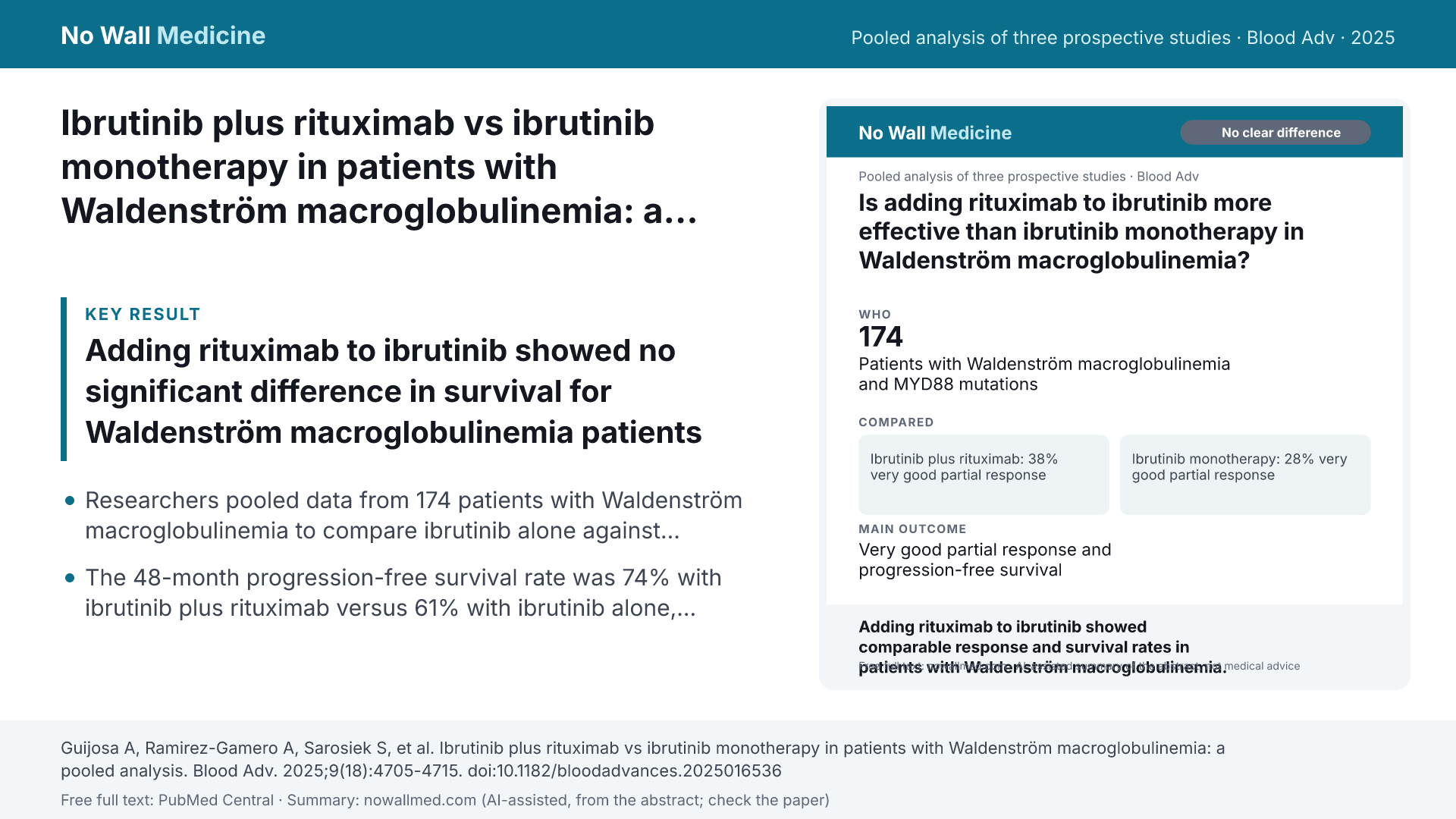
Adding rituximab to ibrutinib showed no significant difference in survival for Waldenström macroglobulinemia patients
Ibrutinib plus rituximab vs ibrutinib monotherapy in patients with Waldenström macroglobulinemia: a pooled analysis
Pooled analysis of three prospective studiesNo clear difference
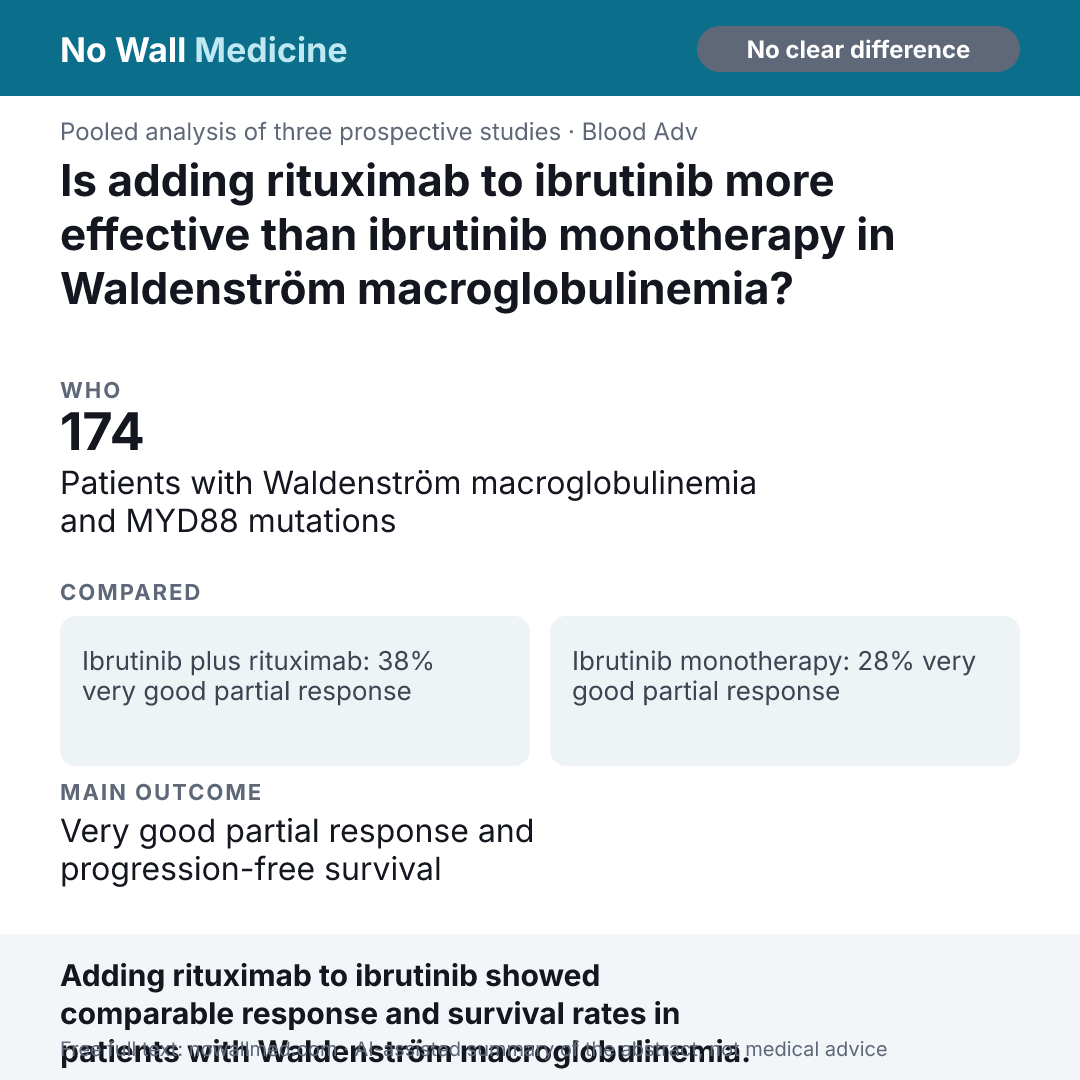
Is adding rituximab to ibrutinib more effective than ibrutinib monotherapy in Waldenström macroglobulinemia?
Who
174
Patients with Waldenström macroglobulinemia and MYD88 mutations
Compared
Ibrutinib plus rituximab: 38% very good partial response
Ibrutinib monotherapy: 28% very good partial response
Main outcome
Very good partial response and progression-free survival
Bottom line: Adding rituximab to ibrutinib showed comparable response and survival rates in patients with Waldenström macroglobulinemia.
Limitation: The benefit of adding rituximab remains unclear as no prospective trial has compared these two regimens.
Blood Adv · 2025-07-17 · Save PNG
Same trial (NCT01614821, NCT02604511)
Papers we list that report this registered trial, oldest first. Read a secondary analysis alongside the main results.
- Longer follow-up
Ibrutinib showed sustained efficacy in patients with rituximab-refractory Waldenström macroglobulinemia Clin Cancer Res 2021-08 - Pooled analysis No clear difference
This paper Blood Adv 2025-07 - Main results
Evolution of tumor subclones and T-cell dynamics underlie variable ibrutinib responses in Waldenström macroglobulinemia Blood 2026-02
Clinical question: Is adding rituximab to ibrutinib more effective than ibrutinib monotherapy in Waldenström macroglobulinemia?
Why it matters: The benefit of adding rituximab to ibrutinib treatment for Waldenström macroglobulinemia remains unclear because prospective trials comparing these two regimens have not been conducted.
Key points
- Researchers pooled data from 174 patients with Waldenström macroglobulinemia to compare ibrutinib alone against ibrutinib plus rituximab, a monoclonal antibody.
- The 48-month progression-free survival rate was 74% with ibrutinib plus rituximab versus 61% with ibrutinib alone, but this difference was not statistically significant.
- In patients with CXCR4 mutations, the 48-month progression-free survival rate was 72% with ibrutinib plus rituximab compared to 43% with ibrutinib alone.
Headline and key points written with AI from the paper’s abstract, with every number checked against it. Read the paper before relying on them.
Was this summary helpful?
Abstract
Ibrutinib (I) and ibrutinib plus rituximab (I+R) are highly efficacious in treating Waldenström macroglobulinemia (WM). However, the benefit of adding rituximab remains unclear, and a prospective trial to compare these two regimens has not been undertaken. Therefore, we performed a pooled analysis of prospective studies to compare their effectiveness. Patient-level demographic, response, and survival data were pooled from three prospective studies (ClinicalTrials.gov identifiers: NCT01614821, NCT02604511, NCT02165397). We included patients treated with I+R or I, excluding those without MYD88 mutations. Among 174 patients (58 I+R, 116 I), very good partial response (VGPR) rates were comparable across treatment groups (38% I+R vs 28% I; P = .21). The 48-month progression-free survival (PFS) rate was 74% with I+R vs 61% with I (P = .22). The 48-month overall survival rate was 94% vs 89% (P = .45). In patients with CXCR4 mutations, I+R trended toward higher VGPR (27% vs 11%; P = .10), and had a superior 48-month PFS rate (72% vs 43%; P = .03). CXCR4 mutations were associated with inferior VGPR (42% vs 17%; P = .001) and 48-month PFS in the I arm (43% vs 72%; P = .002). In the I+R arm, CXCR4 mutations were associated with numerically inferior VGPR (47% vs 27%; P = .12), but the 48-month PFS rate was not impacted (74% vs 72%; P = .96). I+R significantly improved PFS over I in patients with CXCR4-mutated WM, along with a nonsignificant increase in VGPR in this subgroup. These results support routine CXCR4 testing in patients with WM, and clinical trials of rituximab with covalent or noncovalent Bruton tyrosine kinase inhibitors.
Abstract reproduced under the article’s CC BY NC ND licence.
Subject terms
Headline, design, result, key points, caveat and citation as plain text.
Cite this article
Guijosa A, Ramirez-Gamero A, Sarosiek S, et al. Ibrutinib plus rituximab vs ibrutinib monotherapy in patients with Waldenström macroglobulinemia: a pooled analysis. Blood Adv. 2025;9(18):4705-4715. doi:10.1182/bloodadvances.2025016536
Spotted a mistake? Suggest a correction