Ibudilast, a neuroimmune modulator, reduces heavy drinking and alcohol cue-elicited neural activation: a randomized trial
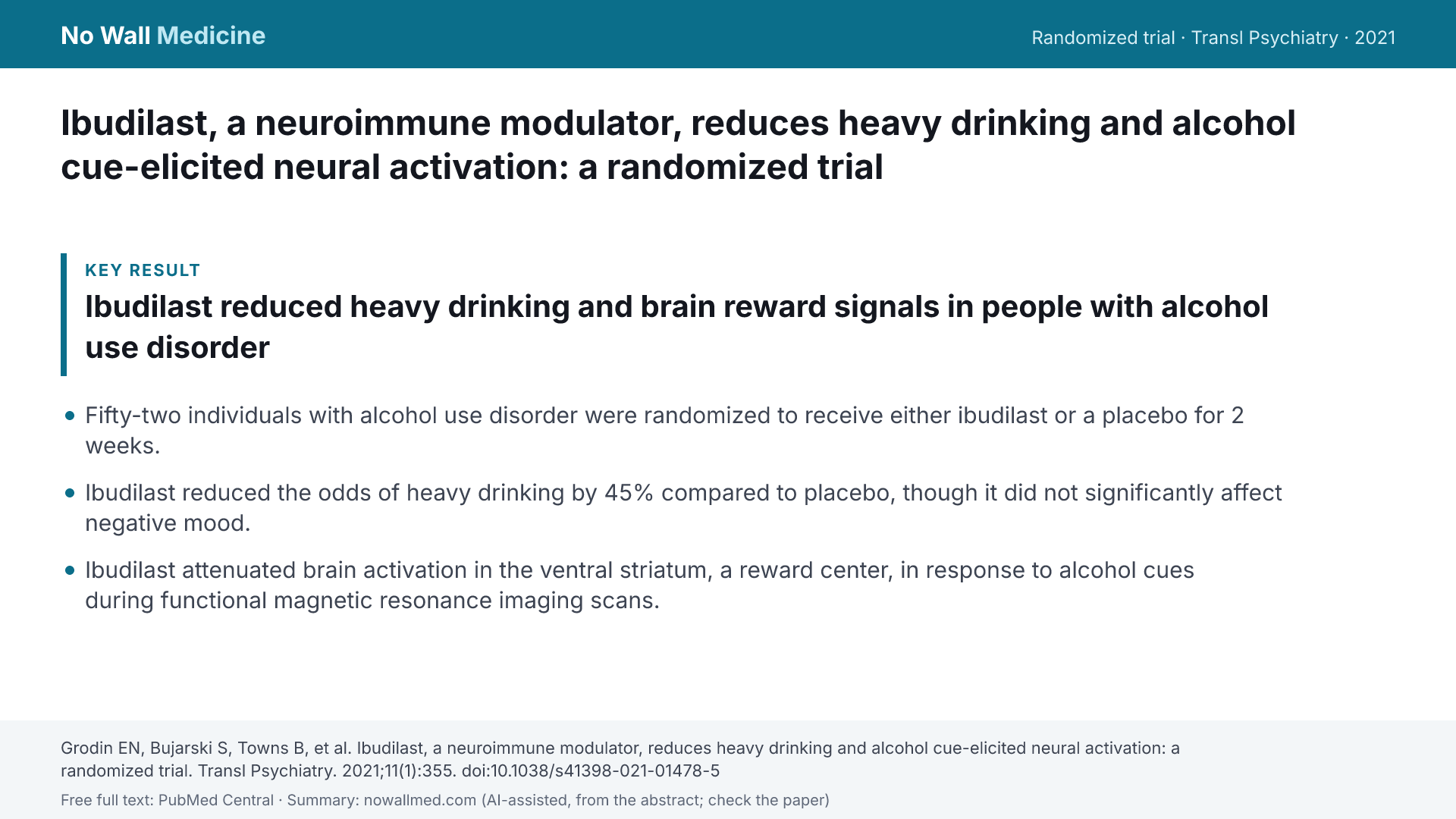
Key result: Ibudilast reduced heavy drinking and brain reward signals in people with alcohol use disorder
Key points
- Fifty-two individuals with alcohol use disorder were randomized to receive either ibudilast or a placebo for 2 weeks.
- Ibudilast reduced the odds of heavy drinking by 45% compared to placebo, though it did not significantly affect negative mood.
- Ibudilast attenuated brain activation in the ventral striatum, a reward center, in response to alcohol cues during functional magnetic resonance imaging scans.
Why it matters: The mechanisms of action by which ibudilast affects the human brain in treating alcohol use disorder remain largely unknown.
Discussion prompts
- Would these patients look like yours? Who was left out?
- Is the main outcome one that matters to patients?
- Is the difference large enough to change what you do?
Cite: Grodin EN, Bujarski S, Towns B, et al. Ibudilast, a neuroimmune modulator, reduces heavy drinking and alcohol cue-elicited neural activation: a randomized trial. Transl Psychiatry. 2021;11(1):355. doi:10.1038/s41398-021-01478-5
Free full text: PubMed Central · Summary and visual abstract: nowallmed.com/a/ibudilast-a-neuroimmune-modulator-reduces-heavy-drinking-and-alcohol-10hna9a/ (AI-assisted from the abstract; check the paper before relying on it).